A pygmy sperm whale that lived along the Peruvian coast more than 6 million years ago had a skull so uneven that researchers initially considered whether the fossil had been distorted after burial. Their conclusion was more remarkable: the crooked form was natural anatomy, and it may represent the most extreme facial asymmetry yet documented in a mammal.
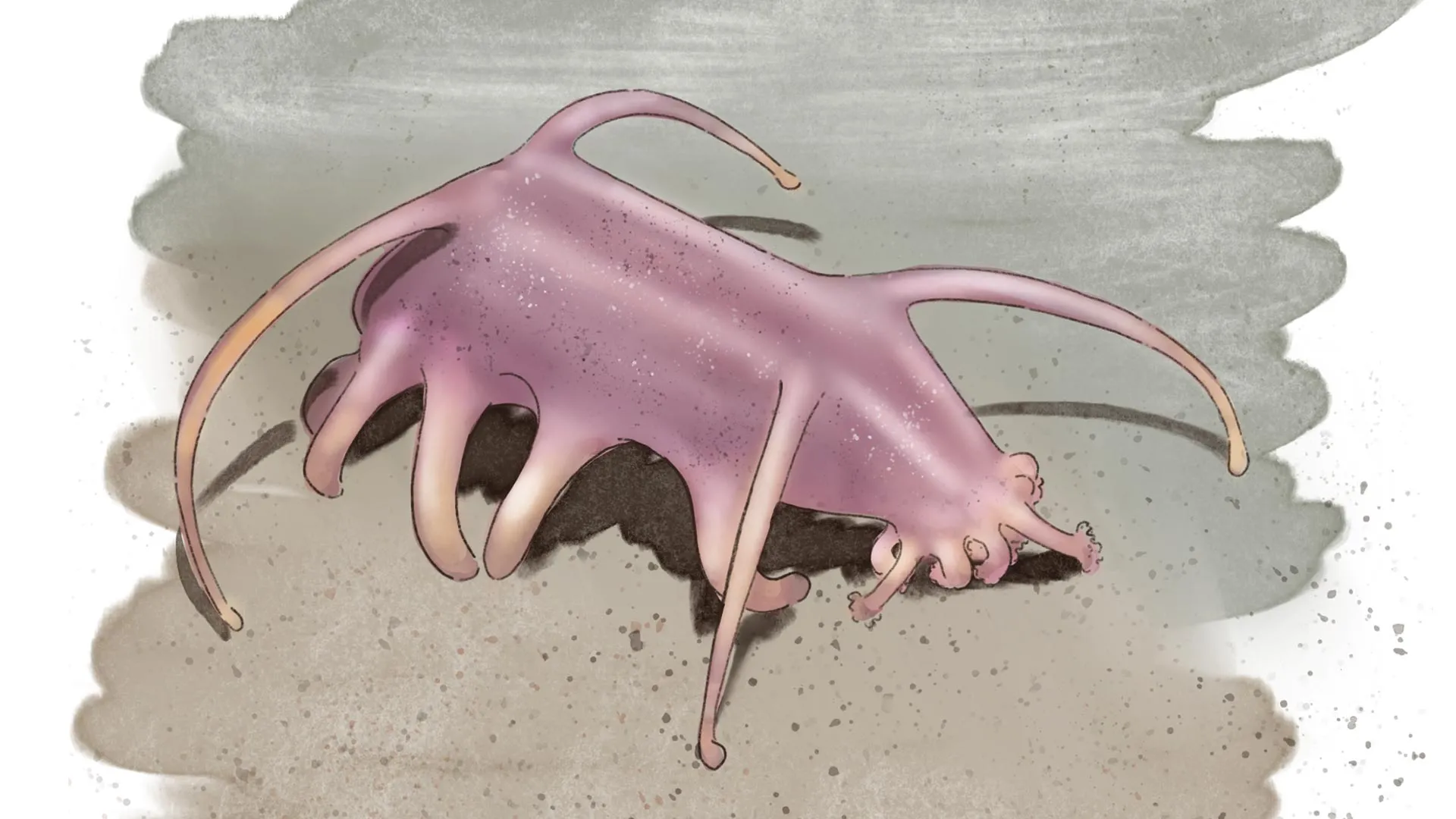
The extinct species, Scaphokogia huachafo, lived during the Late Miocene, roughly 6.3 million to 5.6 million years ago. It was a relatively small whale, measuring about 2.7 meters long, but its head was highly specialized. Its snout curved strongly downward, while features normally arranged more evenly across a skull were shifted and enlarged on one side.
An asymmetry beyond the usual whale pattern
Most vertebrates have bodies and skulls that are approximately symmetrical from left to right. Toothed whales are an important exception. Their skulls evolved uneven structures that accommodate soft-tissue systems involved in producing sound and in echolocation, the biological sonar used to interpret their surroundings.
Modern sperm whales and pygmy sperm whales already stand out for unusual head anatomy. In Scaphokogia huachafo, however, the imbalance extended much farther than the region near the blowhole. According to the researchers, both bony nostrils were displaced to the left side of the skull, and the facial bones differed sharply in size and position. That pattern made the specimen appear at first glance as though its head had been damaged after death.
Instead, the team identified the distortion as an evolutionary trait. The fossil’s anatomy is described as the strongest facial asymmetry known in whales and dolphins and potentially the strongest known in any mammal. The finding highlights how far cetacean head structures could diverge as whales adapted sound-producing and sound-directing systems for specific ecological roles.

A fossil from the Late Miocene
The species was identified from a fossil discovered in Peru. Its name places it among the pygmy sperm whales, a lineage related to the much larger sperm whale but distinctive in its own right. Its small body size and unusual skull point to an animal whose feeding and sensing behavior differed substantially from that of open-water pursuit predators.
The study’s interpretation links the skull’s extreme asymmetry to a specialized lifestyle near the seafloor. The research team suggests that the whale’s downward-curving snout and rearranged facial anatomy were adaptations for foraging on the bottom. That would have required the animal to locate prey in an environment where visibility can be limited and where sound-based sensing may be especially useful.
The source description of the animal’s head emphasizes an asymmetrical forehead structure associated with sound production and directional echolocation while it searched the seafloor. In toothed whales, the connection between cranial shape and sound is central: anatomy around the forehead can house fatty structures involved in producing and directing acoustic signals. The new fossil suggests that this general arrangement could be modified into forms far more extreme than those familiar from living species.
What the skull suggests about behavior
Fossils cannot record an animal’s calls directly, so the study does not establish exactly what sounds Scaphokogia huachafo made or how it interpreted echoes. But its skull provides physical evidence of an unusually lopsided head architecture, and the researchers connect that architecture with directional echolocation and seafloor feeding.
That interpretation matters because whale skulls are more than passive remains. Their shapes preserve clues to sensory biology: where air passages ran, how facial bones were arranged, and how space was allocated for tissues that helped produce sound. When these components are dramatically shifted, as they are in this fossil, they can reveal a lineage experimenting with a different sensory configuration.
The specimen also offers a reminder that evolution does not always favor symmetrical solutions. For a marine mammal relying on specialized acoustics, a lopsided skull may have been an advantage rather than a compromise. The researchers’ conclusion that the odd shape was natural rather than postmortem damage changes the fossil from an apparent anomaly into evidence of a highly adapted animal.
Why the discovery is significant
Whale evolution is often presented through changes in body size, limbs, swimming, and feeding. Scaphokogia huachafo underscores another dimension: the evolution of the head as an instrument for sensing. Its anatomy indicates that extinct toothed whales could develop remarkably specialized structures around sound production and echolocation.
The discovery also expands the known range of pygmy sperm whale diversity in the Late Miocene. Rather than simply resembling smaller versions of their living relatives, extinct forms could possess combinations of features no longer seen today. In this case, an oversized and displaced facial system may have helped a small whale exploit prey along the ocean floor.
For paleontologists, the skull is a caution against dismissing an unfamiliar fossil shape as damage. The feature that initially made the specimen seem unreliable became the key result. For the wider study of mammal evolution, it offers a striking example of how a sensory adaptation can reshape an animal’s face to an extraordinary degree.
As researchers compare the fossil with other toothed whales, the animal may help clarify how anatomical asymmetry became tied to sound production in cetaceans. Its extreme form does not reveal every detail of its life, but it gives an unusually clear view of the evolutionary possibilities opened by echolocation beneath the sea.
This article is based on reporting by Science Daily. Read the original article.
Originally published on sciencedaily.com