A Polar-Materials Result in the Pages of Science
A new research report titled Synergistic polar states by selective atomic gradients has appeared in Science, the peer-reviewed journal of the American Association for the Advancement of Science. According to the publication metadata, the article occupies pages 107 through 112 of volume 394, issue 6819, dated October 2026. Direct access to the full text was not available at the time of writing, so the discussion below focuses on the scientific territory the title maps out and on the broader research context surrounding it, rather than on numbers or claims that cannot be verified from the available record.
Even so, the title alone carries real information. It names a phenomenon — synergistic polar states — and a method for producing it: selective atomic gradients. Together, those two phrases describe a materials-engineering strategy that has become one of the more active fronts in condensed-matter and functional-materials research.
Why Polar States Are Worth Engineering
In many crystalline solids, positive and negative charge centers do not sit perfectly on top of one another. That offset produces an electric dipole, and when dipoles align collectively across a crystal, the material is said to be polar. Ferroelectrics are the best-known example: their polarization can be reversed by an applied electric field, which makes them useful in non-volatile memory, precision sensors, actuators, tunable capacitors, and electro-optic devices.
Control over polarization is therefore not an academic curiosity. It underpins technologies that need fast, low-power, and durable switching of an electrical state. It also matters for emerging areas such as neuromorphic computing, where device behavior depends on how polar domains form, move, and relax over time.
The limits of uniform materials
Historically, much of polar-materials design assumed a relatively uniform crystal. Researchers chose a composition, grew it, and measured what polarization resulted. That approach works, but it leaves a lot of design space untouched. Real crystals are rarely perfect, and the imperfections — interfaces, strain, defects, chemical inhomogeneity — often dominate the properties that matter for devices.
That realization pushed the field toward deliberate non-uniformity: instead of smoothing gradients away, engineers now try to write them in on purpose.

What Selective Atomic Gradients Mean
A gradient, in this context, is a systematic change in the crystal as you move through it. The change might be in chemical composition, in the spacing between atomic planes, in the density of particular defects, or in the occupancy of specific atomic sites. When the variation is imposed one atomic layer at a time, it becomes an engineering tool rather than an accident.
The word selective is the important qualifier. It implies that not every element or layer is varied indiscriminately. Instead, specific atomic species or specific planes are targeted, while the rest of the lattice is left comparatively undisturbed. That selectivity is what allows a gradient to shape polarization without destroying the crystalline order that makes the material useful in the first place.
- Compositional gradients shift the ratio of constituent elements across a film, changing local lattice parameters and bonding.
- Strain gradients bend atomic planes, producing flexoelectric effects that can generate polarization even in nominally non-polar materials.
- Defect gradients concentrate vacancies or substitutions near an interface, creating built-in electric fields.
- Site-selective gradients modify only one sublattice or one atomic layer, leaving the surrounding framework intact.
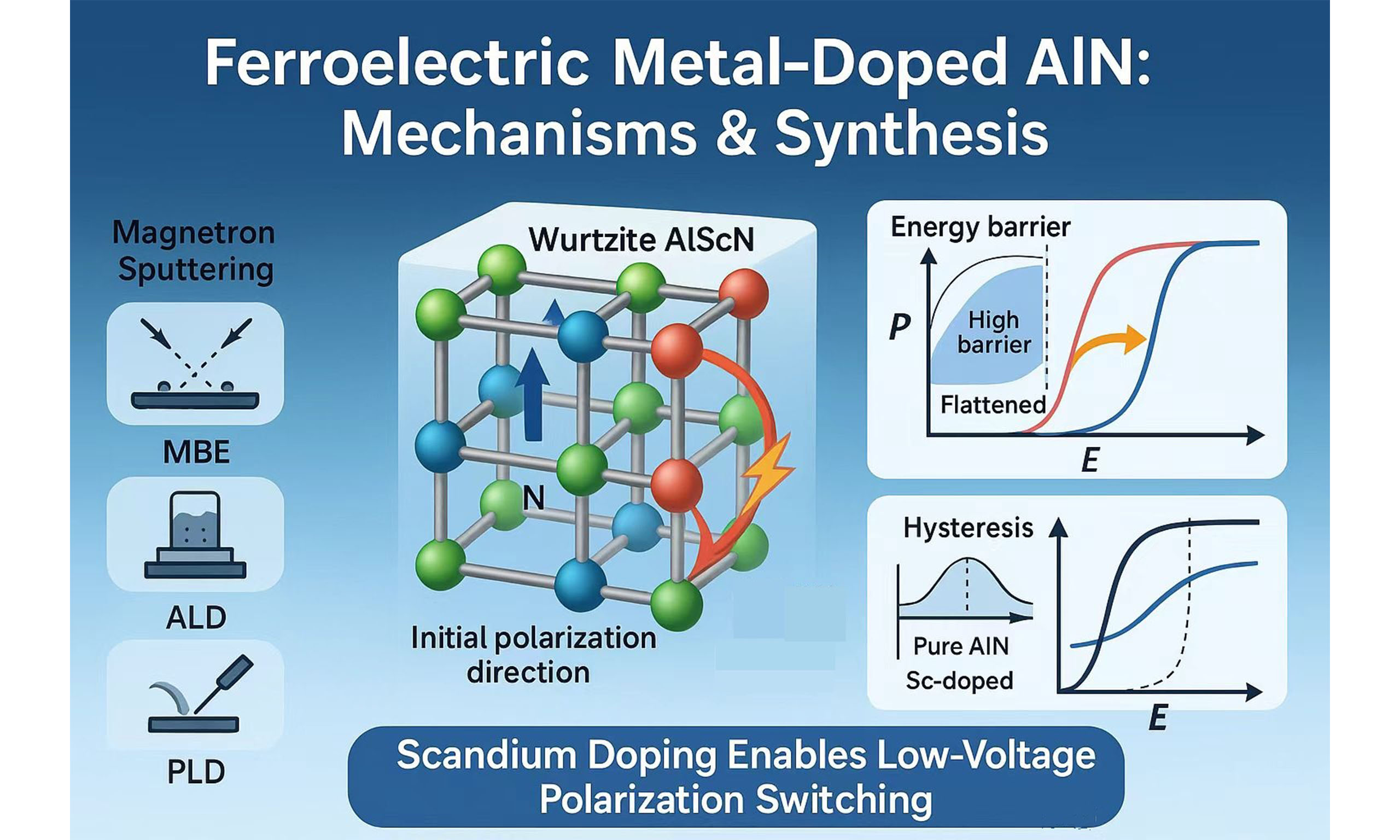
Deposition techniques such as pulsed-laser deposition, molecular-beam epitaxy, and atomic-layer deposition give researchers layer-level command over these variables, which is why the approach has become practical rather than merely theoretical.
The Promise of Synergy
The other half of the title — synergy — suggests that the resulting polar state is not simply the sum of its parts. In complex oxides, several mechanisms can produce or influence polarization at once: a conventional ferroelectric instability, a flexoelectric response to strain gradients, interfacial charge transfer, and defect-driven internal fields.
When these mechanisms are tuned to reinforce one another, the material may exhibit behavior that none of them would produce alone. Possible consequences include enhanced polarization, unusual domain configurations, or states that respond to more than one external stimulus.
Competition is as interesting as cooperation
Synergy does not necessarily mean everything pulls in the same direction. Competing interactions can also generate novel states — for example, arrangements in which polarization rotates or cancels in a patterned way rather than pointing uniformly. Domain walls and polar vortices are classic examples of structures that emerge from competition, and they often carry properties distinct from the bulk material around them.
A gradient provides a natural lever for setting up such competition, because it forces different regions of the crystal to prefer different polar arrangements. Where those preferences meet, interesting physics tends to occur.

How Researchers Interrogate These Systems
Because the phenomena of interest are local and often confined to nanoscale regions, characterizing them requires tools with atomic resolution. Scanning transmission electron microscopy can map atomic columns and reveal displacements directly. Piezoresponse force microscopy probes local electromechanical response and domain patterns. Diffraction methods using X-rays or neutrons provide complementary information about average structure and symmetry.
Theory is equally central. Density functional theory can evaluate which polar configurations a given atomic arrangement should favor, while phase-field and phenomenological models connect those microscopic preferences to the domain structures observed experimentally. Progress in this field typically comes from an iterative loop in which prediction, growth, and measurement correct one another.
Open Questions to Watch
Several questions follow naturally from a result framed around selective atomic gradients.
- Stability: do gradient-engineered polar states persist at elevated temperatures and over long operating periods?
- Switching: how do these states respond to applied fields, and how fast can they be reversed?
- Scalability: can the required atomic-level control be maintained over wafer-scale areas and in manufacturing environments?
- Reproducibility: how sensitive are the results to small variations in growth conditions?
- Device relevance: which applications would benefit most from the added control, and at what cost in process complexity?
None of these questions is unique to a single paper. They define the agenda for the wider effort to treat atomic-scale gradients as a design parameter rather than a nuisance.

The Larger Trajectory
Materials science has repeatedly advanced by gaining finer control over structure. The ability to specify composition layer by layer transformed semiconductors and magnetic thin films. If selective atomic gradients can be used to compose polar states on demand, the same logic would extend to ferroelectrics and related oxides.
That would mean moving from choosing a material to designing a response: deciding where polarization should appear, how strong it should be, and how it should couple to strain, charge, or light. The report in Science, volume 394, issue 6819, belongs to that trajectory. For readers tracking functional oxides, it marks a contribution worth following into the primary literature.
This article is based on reporting by Science (AAAS). Read the original article.
Originally published on science.org