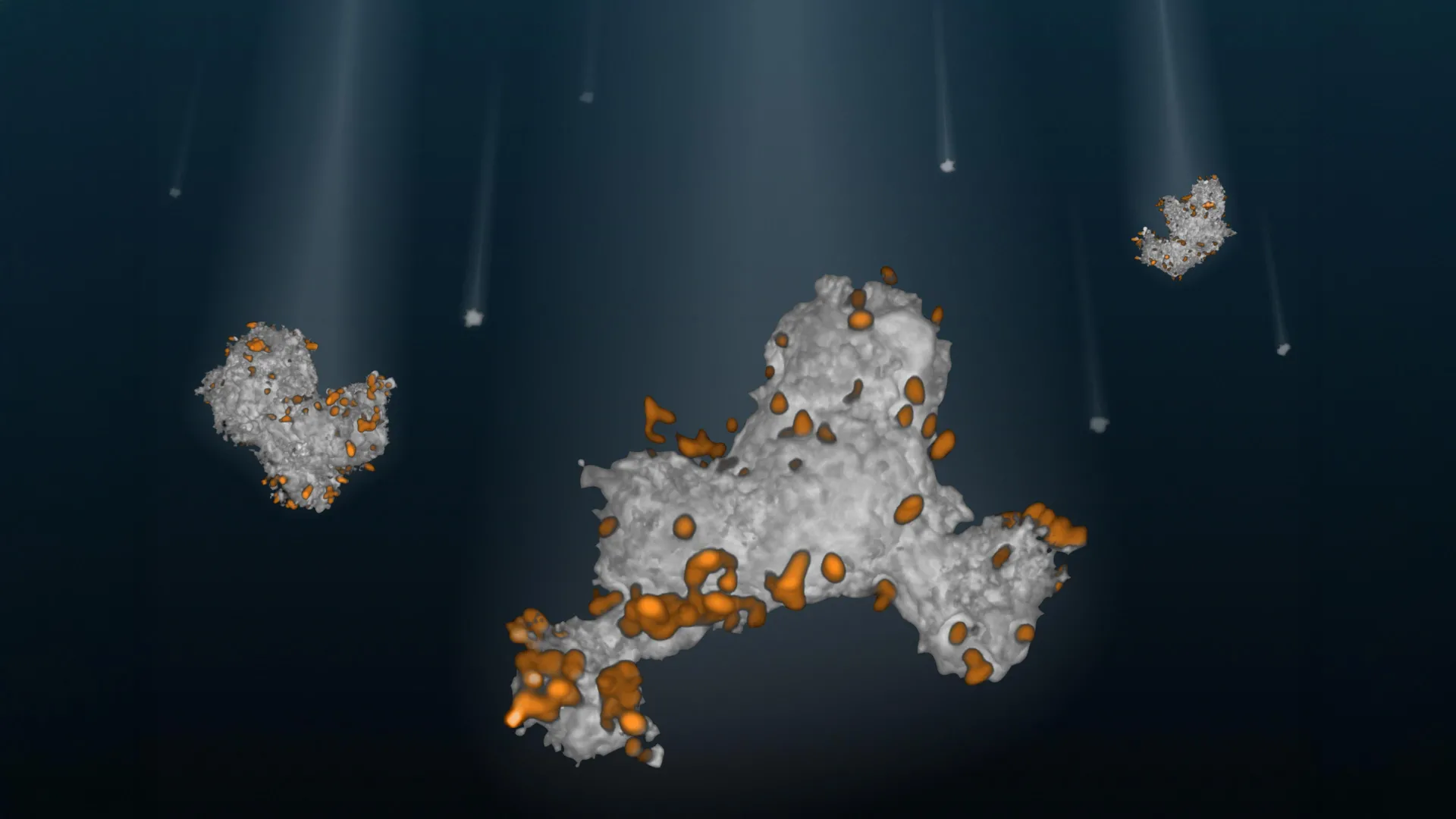
Marine snow may sound harmless, but the slow fall of this organic debris through the ocean is a major part of Earth’s carbon cycle. These particles—made from dead organisms, plankton remains, waste, mucus and other material—carry carbon away from surface waters toward the deep sea.
New research described by scientists at UC San Diego’s Scripps Institution of Oceanography and the University of Lincoln points to an overlooked variable in that process: the particles’ stickiness. The work, published in Science, finds that the viscosity of marine snow can influence how readily bacteria break it down during its descent.
A long journey for ocean carbon
Marine snow removes more than 10 gigatons of carbon from surface waters each year, according to the researchers. But only about two gigatons reaches deep enough waters for the carbon to remain stored for centuries or millennia.
As particles sink, bacteria colonize them and consume their contents. That biological processing can return carbon to the water column before it reaches the deep ocean. The study suggests that the physical character of the particle helps determine how much survives the journey.

Why viscosity matters
The researchers found that particularly viscous, or gooey, marine-snow particles can transport more than six times as much carbon to the deep ocean as particles with a thinner consistency. The proposed mechanism is straightforward: stickier material resists bacterial breakdown more effectively.
That makes the finding relevant to efforts to understand and model the ocean’s role in regulating atmospheric carbon. The ocean’s biological carbon pump depends not only on how much organic material is produced near the surface, but also on how efficiently that material escapes decomposition while sinking.
A physical property with climate implications
The study adds a connection between mucus-like materials, microbial activity and long-term carbon storage. It also highlights why estimates based only on the quantity of sinking particles may miss an important part of the system: two particles carrying similar amounts of carbon may have very different chances of delivering it to the deep sea.
The result does not mean marine snow can be treated as a simple climate solution. Instead, it offers a more detailed explanation for why much of the carbon exported from surface waters never reaches long-term storage depths. Incorporating particle viscosity into research on marine ecosystems could improve understanding of where the ocean’s carbon transport is most effective—and how it could respond as ocean conditions change.

What comes next
Scientists will need to determine how common highly viscous particles are across different ocean regions and seasons, and how environmental shifts affect their formation. But the new work establishes that the texture of this underwater snowfall is not a minor detail. It may be a meaningful control on how much carbon the ocean can move out of contact with the atmosphere.
This article is based on reporting by Science Daily. Read the original article.
Originally published on sciencedaily.com