A new route to an old planetary question
Where did Earth’s water come from? A new study described by the University of New Mexico proposes that a substantial share may have formed on the young planet itself, rather than arriving entirely aboard comets, meteorites or other water-bearing objects from space.
The work, published in Nature Geoscience, centers on chemical reactions between rocky material containing iron and hydrogen in the extremely hot atmosphere surrounding the forming Earth. In laboratory experiments designed to recreate aspects of those conditions, the researchers found that water could form in minutes.
If that process operated at planetary scale, it could have generated very large quantities of water during Earth’s formation. The study’s summary says the mechanism could produce hundreds of oceans’ worth of water, changing how scientists think about the origin of one of the defining ingredients for life on Earth.
From falling pebbles to water vapor
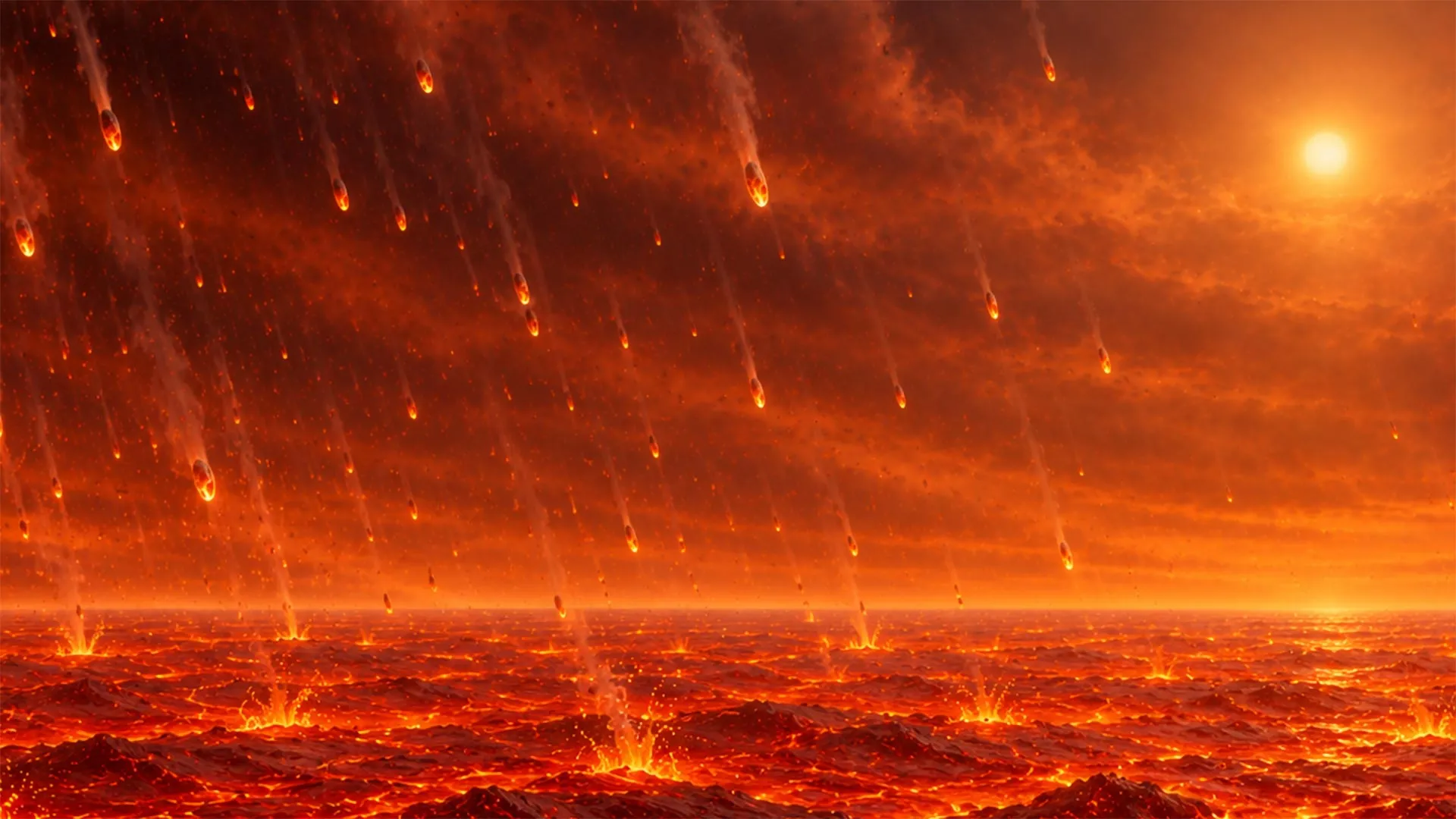
The research examines a phase of planetary formation in which an early Earth-sized body accumulated material from smaller rocky objects, often described as pebbles. The researchers investigated what might happen when iron-bearing rocks encountered a hydrogen-rich atmosphere at very high temperatures.
According to the account, the reactions produced water quickly. That speed is important: a process that happens in minutes under the relevant conditions may be capable of operating while enormous amounts of material are arriving and interacting with a young planet’s atmosphere.
The experimental work was led by graduate student Susmita Garai with Zachary Sharp, professor and director of Earth and Planetary Sciences at the University of New Mexico, and Peter Olson. Sharp said previous explanations for Earth’s water have generally relied on external sources, including comets and meteorites. The new mechanism instead suggests that a planet forming from ordinary rocky building blocks and surrounded by hydrogen could generate water internally.
The proposed chemistry does not necessarily rule out external delivery. Rather, it offers an additional source that could have been important during Earth’s earliest stages. That matters because the balance among possible sources of Earth’s water remains a long-standing scientific question.

Why the idea is significant
Water is essential to the familiar picture of a habitable Earth, but explaining its presence has never been simple. The planet formed in a violent, hot environment, and scientists have debated how much water could survive or arrive during that process. The traditional external-delivery picture places substantial weight on icy bodies and water-rich meteorites striking the growing planet.
The new work shifts attention toward a more general chemical possibility: water may be an expected product of rocky-planet formation under certain conditions. If iron-rich rocky particles and atmospheric hydrogen can react efficiently at high temperature, the formation of water would not depend exclusively on a particular sequence of icy impacts.
The researchers’ interpretation is therefore broader than Earth alone. Sharp said that virtually any Earth-sized planet could have water through this newly identified mechanism. That is an inference about the potential reach of the process, not evidence that every rocky planet is wet or habitable. A planet’s atmosphere, composition, temperature, history and ability to retain water would all still matter.
What the experiments add
The core contribution is experimental. Instead of treating the proposed reactions only as a theoretical possibility, the team built high-temperature experiments to test whether water could actually form when iron-bearing rocks reacted with hydrogen. The supplied report says that the researchers observed water production within minutes in conditions intended to represent the early Earth’s atmosphere.
That finding gives planetary scientists a concrete mechanism to evaluate in models of accretion and atmospheric evolution. It also reframes “pebble rain” as more than a means of adding mass to a growing world. The rocky material itself may participate in atmospheric chemistry that changes the planet’s inventory of water.
Exactly how much water this route contributed to the real Earth remains a separate question. Laboratory results must be connected to the complexity of a forming planet: the quantity and composition of incoming material, the amount of hydrogen available, temperatures over time, atmospheric escape and later geological processes. The study argues that the potential scale is large, not that it has precisely measured Earth’s final water budget.

Implications beyond Earth
The most evocative implication is for the search for habitable worlds. If water can form naturally as rocky planets assemble in hydrogen-rich environments, then it may be less unusual than models based largely on external delivery imply. That could increase the number of worlds with at least one prerequisite for life.
But water formation is only one part of habitability. A world also needs to retain water and maintain conditions where it can persist in relevant forms. The new study does not claim that life is common; it suggests a chemical route that may make water more readily available during the formation of rocky planets.
For Earth science, the result adds a fresh perspective to a foundational mystery. The planet’s oceans may reflect not only material delivered from elsewhere in the Solar System, but also a rapid reaction between rock and hydrogen in the furnace of Earth’s own birth.
This article is based on reporting by Science Daily. Read the original article.
Originally published on sciencedaily.com