An alien comet is giving astronomers a chemical clue from another planetary system
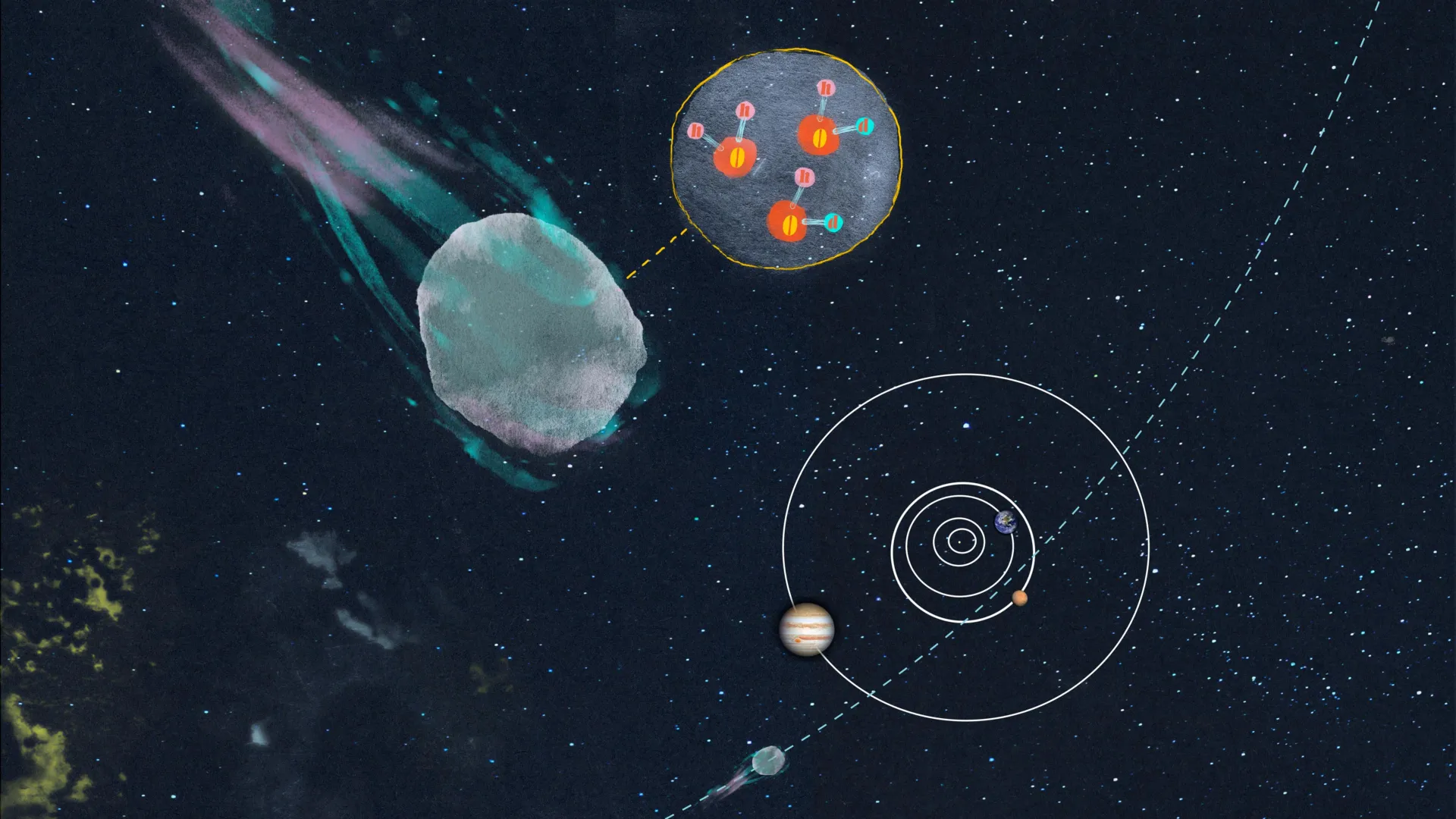
Only three confirmed interstellar visitors have ever been detected passing through our solar system, and one of them is now offering an unusually rich scientific payoff. According to a new study led by the University of Michigan, the comet 3I/ATLAS contains an extraordinary amount of deuterium-rich water, far above anything previously observed in comets associated with our own solar system.
The finding, published in Nature Astronomy according to the supplied report, gives researchers a way to infer the environment in which the object formed. Their conclusion is that 3I/ATLAS likely emerged under conditions much colder than those that shaped the solar system around the Sun.
Why heavy water matters
Ordinary water is made from oxygen and hydrogen, but hydrogen itself comes in different isotopic forms. The heavier isotope, deuterium, contains a proton and a neutron rather than just a proton. When water incorporates deuterium, it becomes what scientists commonly call heavy water.
The proportion of deuterium to ordinary hydrogen acts as a chemical fingerprint. In this case, lead author Luis Salazar Manzano of the University of Michigan said the amount of deuterium relative to ordinary hydrogen in 3I/ATLAS is higher than anything previously seen in other planetary systems and planetary comets, based on the supplied source text. That makes the comet important not merely as a visitor, but as a preserved record of physical conditions in a distant star system.

A rare chance to compare solar systems
Interstellar objects are valuable because they carry material assembled elsewhere, outside the formation history of the Sun and planets. Most planetary science is built from local evidence: asteroids, comets, moons, and meteorites that all share the same broad origin story. An interstellar comet breaks that pattern. It is a sample from another system delivered, briefly, into ours.
The University of Michigan team argues that 3I/ATLAS formed in a region much colder than typical solar-system comet-forming environments. That conclusion comes directly from the unusual isotopic composition of its water. If confirmed by subsequent work, it suggests that the chemistry of planet formation across the galaxy may be more varied than the solar system alone would imply.
The broader implication is not simply that this comet is odd. It is that the pathways producing water and icy bodies in other systems may operate under temperature regimes or environmental histories quite different from those familiar to solar-system science. That widens the range of plausible planetary architectures in the galaxy.
What makes 3I/ATLAS special
The report notes that 3I/ATLAS was detected less than a year ago and is only the third confirmed interstellar object ever identified. That rarity amplifies the importance of every measurable property. Because the object is passing through rather than staying in orbit, observations are time-limited, and each dataset becomes disproportionately valuable.
The study was supported by NASA, the U.S. National Science Foundation, and Chile’s National Research and Development Agency, reflecting how high-priority such observations are. The results give astronomers a concrete measurement to compare across systems instead of relying only on models.

A chemical message from far beyond the Sun
Planetary science often advances through indirect evidence: spectra, brightness curves, and subtle chemical ratios. In that sense, 3I/ATLAS is a near-perfect messenger. It does not tell scientists what its home system looks like in detail, but it does preserve one crucial fact about it: the water chemistry formed under conditions unlike those that dominated our own neighborhood.
That is why the deuterium measurement matters. Heavy water is not just a curiosity. It is a record of formation temperature and history. The more unusual that record, the more it challenges the assumption that our solar system is a reliable template for others.
For now, 3I/ATLAS remains a fleeting visitor. But the data it carries could have a long afterlife, helping astronomers map the diversity of planetary formation across the galaxy one rare object at a time.
This article is based on reporting by Science Daily. Read the original article.
Originally published on sciencedaily.com