The Largest Black Holes in Gravitational-Wave Catalogs May Be Cosmic Recyclers
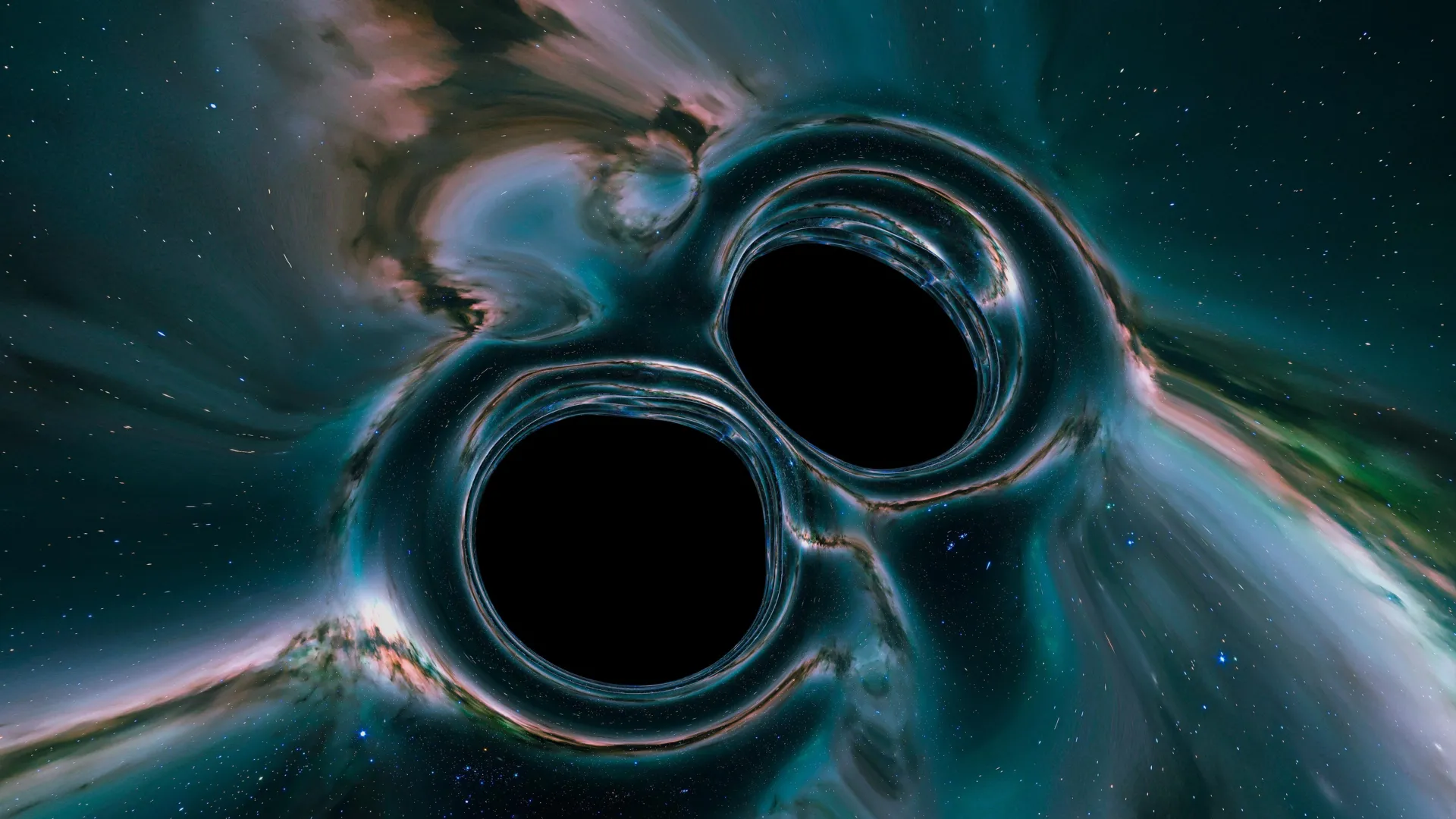
The biggest black holes detected through gravitational waves may not have formed directly from collapsing stars. Instead, new research suggests that many of them were assembled through repeated mergers inside extremely crowded star clusters, creating a distinct population of heavy, rapidly spinning objects with a very different history from more ordinary stellar black holes.
The finding, reported by a team led by Cardiff University and published in Nature Astronomy, adds an important layer to what gravitational-wave astronomy can now do. The field is no longer limited to counting merger events. It is starting to reconstruct how black holes grow and where the environments that shape them are most likely to exist.
That shift matters because the origin of very massive black holes has been one of the more difficult puzzles raised by gravitational-wave observations. Some objects appear too large or too dynamically unusual to fit neatly into the simplest picture of a star collapsing once and leaving behind a black hole with a straightforward evolutionary history.
A Large Catalog, and a New Population Question
The researchers examined version 4.0 of the LIGO-Virgo-KAGRA Gravitational-Wave Transient Catalog, known as GWTC4. The catalog contains 153 reliable detections of merging black holes, giving astronomers a much larger sample than was available in the early years of gravitational-wave science.
With that larger data set, the team asked whether the most massive black holes in the catalog could be “second-generation” objects. In this scenario, black holes born from dying stars do not remain isolated. Instead, they collide with one another in dense stellar settings, producing larger remnants that can later merge again. Over time, this creates a hierarchical chain of collisions that effectively recycles black holes into heavier descendants.
According to the source text, the environments capable of supporting that process are star clusters with densities up to a million times greater than the region around our Sun. In such settings, repeated close encounters become plausible enough for hierarchical merging to move from theoretical possibility to observable explanation.

Spin Turns Out to Be a Critical Clue
Mass alone does not solve the problem. What appears to strengthen the case for hierarchical mergers is the spin behavior of the heaviest objects. The Cardiff-led team identified two groups in the gravitational-wave data: a lower-mass population consistent with black holes formed through ordinary stellar collapse, and a higher-mass population whose spins line up with what scientists would expect from repeated mergers in dense clusters.
That distinction is significant because spin acts like a historical record. A black hole produced by prior mergers can carry angular momentum signatures that differ from those expected in first-generation objects. If the most massive black holes are also spinning in the way hierarchical growth predicts, that helps separate them from the rest of the population instead of merely stretching the standard stellar-collapse model to fit larger numbers.
The result is a more structured picture of the black hole census. Rather than a smooth continuum of similar objects differing only by size, the catalog may contain two populations shaped by different formation channels. One population emerges from the deaths of massive stars. The other is forged through violent recycling in crowded cosmic environments.
Why the Finding Matters for Astrophysics
If the interpretation holds up, it changes the role gravitational-wave observatories play in astrophysics. These facilities are not just detecting distant cataclysms. They are tracing the hidden ecology of star clusters, compact-object interactions, and the long-term growth pathways of black holes.
Lead author Dr. Fabio Antonini, quoted in the source, described gravitational-wave astronomy as a tool for understanding how black holes grow, where they grow, and what that reveals about the lives and deaths of massive stars. That framing captures the broader importance of the work. A merger signal is not merely a one-time event. It can also encode the evolutionary background of the objects that produced it.
The study therefore points beyond black holes themselves. If dense star clusters are acting as black hole assembly lines, then astronomers gain a new way to probe the dynamics of those clusters. The properties of merger remnants can become indirect evidence for environmental conditions that would otherwise be difficult to observe in detail across cosmic distances.

From Singular Events to Black Hole Family Trees
One of the most powerful implications of the research is conceptual. It encourages scientists to think of some black holes not as endpoints but as intermediate products. In a hierarchical-merger picture, a black hole can be both the outcome of one collision and the ingredient in a later one. That creates something closer to a family tree than a single birth event.
This idea also helps explain why some of the largest black holes detected in merger catalogs have seemed unusual. If they are “cosmic Frankensteins,” to borrow the source’s phrasing, then their size and spin are not anomalies requiring a wholly new mechanism. They are the natural result of black holes being reprocessed in dense stellar environments where gravity keeps throwing them together.
That does not mean every large black hole detected by LIGO, Virgo, or KAGRA has the same origin. The study instead suggests that a distinct high-mass class exists alongside a more standard low-mass population. Future catalog updates will be crucial in testing how cleanly that division persists as the number of detections rises.
The Next Phase of Gravitational-Wave Astronomy
As gravitational-wave detectors continue collecting events, the statistical power of this kind of analysis will only improve. More mergers mean better estimates of mass distributions, more precise spin measurements, and stronger tests of whether hierarchical growth is the dominant explanation for the heaviest systems.
That is why this result feels larger than a single black hole study. It marks a stage at which gravitational-wave science begins to sort populations, infer environments, and reconstruct pathways of growth across many events. The field is moving from discovery to demography.
- The researchers analyzed 153 reliable black hole merger detections in GWTC4.
- The heaviest black holes may be second-generation objects created through repeated mergers.
- Dense star clusters provide the environment needed for hierarchical growth.
- Spin patterns help distinguish the largest black holes from ordinary stellar-collapse remnants.
If confirmed by future observations, the work will sharpen one of the most important insights gravitational waves have delivered so far: the universe’s biggest black holes may not be born big at all. Some of them may be built, collision by collision, in the most crowded stellar environments the cosmos can produce.
This article is based on reporting by Science Daily. Read the original article.

Originally published on sciencedaily.com


