A Bronze Age object that may have doubled as a celestial tool
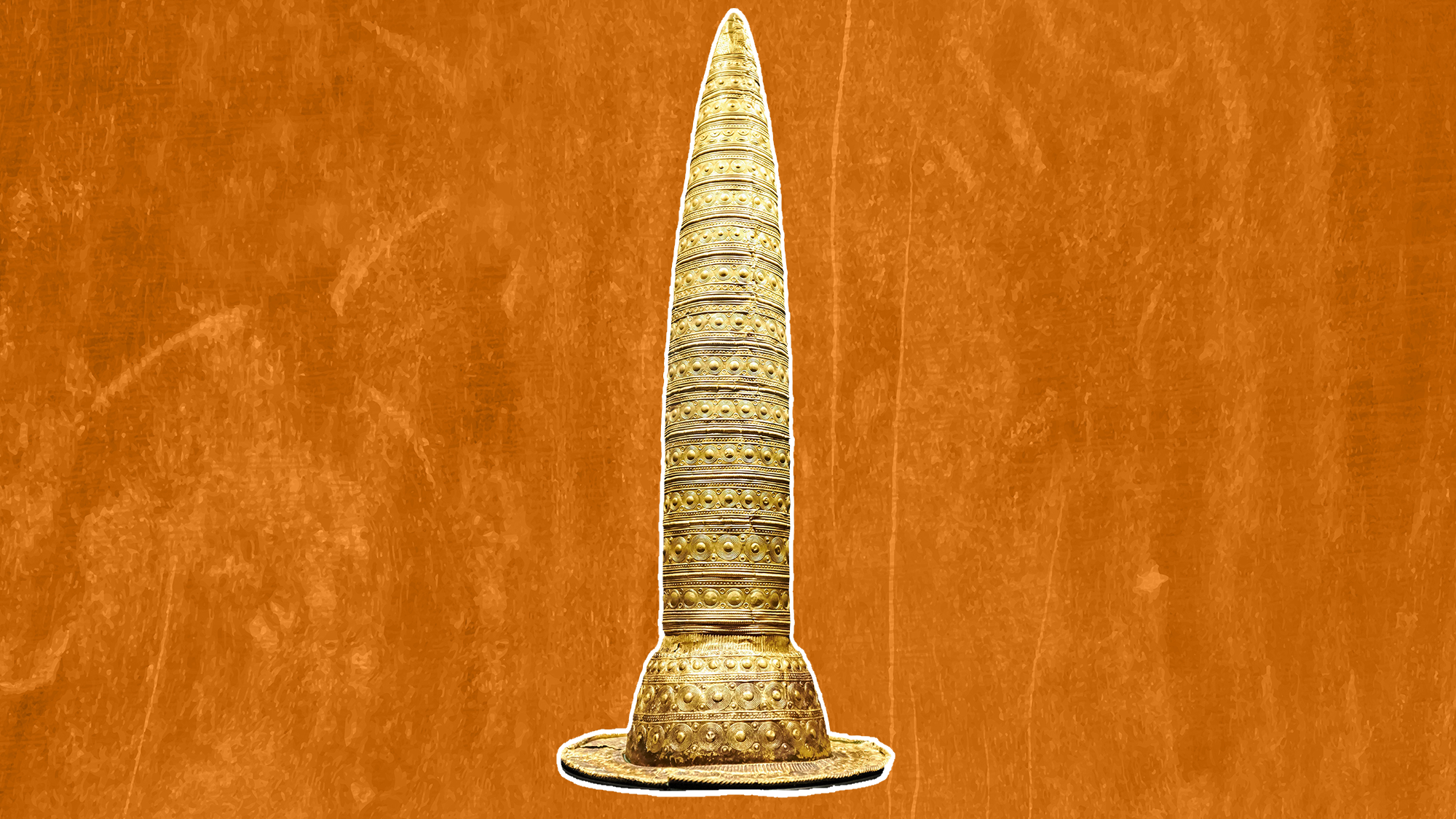
The Berlin gold hat is one of those artifacts that immediately invites two readings at once. On one level, it is unmistakably ceremonial: a tall, conical headdress made from a single sheet of hammered gold, striking enough to dominate any ritual setting. On another, scholars have argued that its carefully arranged decorative bands were not merely ornamental. Instead, they may have preserved a usable system for tracking time in the sky.
That possibility is what keeps the object relevant far beyond archaeology enthusiasts. If the interpretation holds, the hat is evidence that Bronze Age elites in Central and Western Europe may have embedded astronomical knowledge into prestigious ceremonial objects, turning authority, religion, and timekeeping into a single package.
The artifact is now held by the Museum of Prehistory and Early History in Berlin, which acquired it in 1996 after it had circulated on the antiquities market. That history leaves a major gap: its original findspot is unknown. Even so, researchers have some geographic context. The other three known gold hats of the same general type were found in southern Germany and western France, suggesting a broader regional tradition rather than an isolated one-off creation.
What the object is and why it stands out
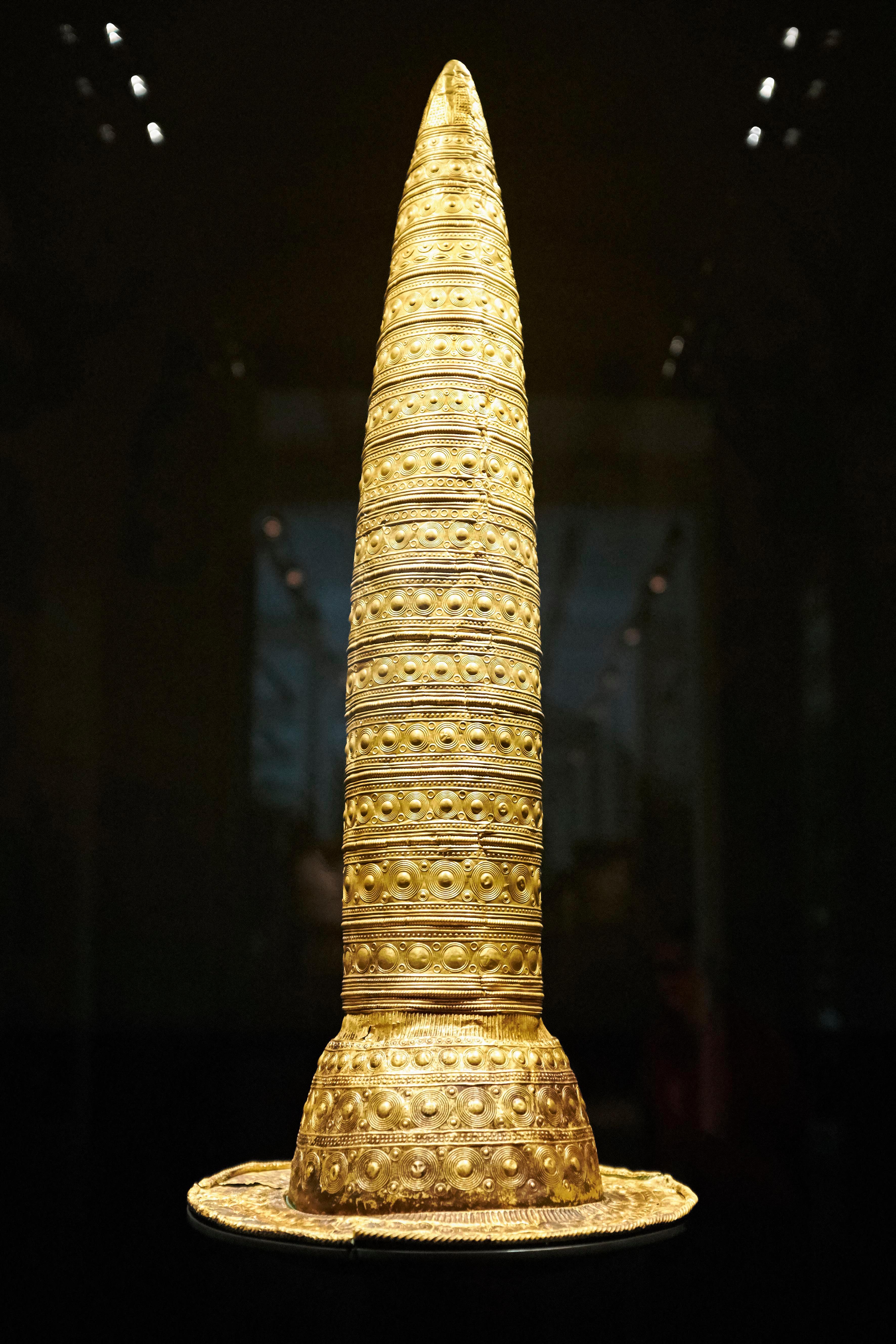
The Berlin specimen is the best preserved of the four known Bronze Age gold hats. According to the supplied source material, it dates to roughly 1000 to 800 B.C. It is about 74 centimeters tall and weighs just over 480 grams. A flat bronze band and bronze wire define the brim, while a now-lost wool or felt lining probably helped stabilize it when worn.
Its visual impact would have been substantial. The surface is covered with repeated motifs including concentric circles, disks, and ovals arranged in horizontal bands. Even before any astronomical interpretation enters the discussion, that design tells us the object was made with a precise decorative program. This was not improvised prestige metalwork. It was structured, deliberate, and meant to communicate something.
The strongest interpretation presented in the source text comes from archaeologist Wilfried Menghin, who argued in a 2008 study that those bands encode numerical values corresponding to a calendar. In that reading, each band carries a count, and combinations of bands can be used to calculate lunar months and solar years and convert between lunar and solar dates.

Why scholars connect it to eclipse prediction
The most arresting claim attached to the Berlin gold hat is that the calendar logic could also be used to predict lunar eclipses. That does not mean the hat was a modern scientific instrument, nor does it mean Bronze Age people had a fully abstract mathematical astronomy in the contemporary sense. It does suggest, however, that recurring sky cycles may have been observed, systematized, and folded into elite knowledge.
This matters because eclipse prediction, even in a limited practical form, sits at the intersection of observation and social power. A person able to anticipate unusual celestial events would not simply possess useful knowledge. That person could appear to mediate between the heavens and the community.
The source text reflects that idea directly. Museum director Matthias Wemhoff described the wearer as someone carrying “secret and very special knowledge,” and imagined a priest emerging at sunrise on a mountaintop while the gold surface caught the first light. Whether or not that reconstruction matches a specific historical ceremony, it captures the broader logic behind the object: brilliance, rarity, and encoded order would all reinforce ritual status.
A ceremonial object with political meaning
If the hat did function within a sun cult, as the source suggests, then it was probably more than liturgical dress. It may have been part of a system in which specialist knowledge helped legitimate leadership. Ancient societies often linked power to control over calendars because calendars regulated planting, festivals, and collective time. A figure who could align rituals with celestial cycles would gain authority not only as a religious actor but also as a social organizer.
That is one reason the Berlin gold hat continues to attract attention. It hints that Bronze Age Europe sustained knowledge traditions that were portable, symbolic, and institutionally guarded. The encoded-band interpretation, if correct, implies that information was preserved not in writing but in designed objects and specialist practice.
There is also a subtler point here. The hat’s gold surface and labor-intensive construction indicate access to materials, craftsmanship, and patronage. Even without certainty about its exact use, it belongs to a world in which elite display and cosmological meaning were closely connected. The object did not need to choose between beauty and utility. In ancient ceremonial culture, the two could be inseparable.

What remains uncertain
The unknown discovery location is a serious limitation. Without excavation context, archaeologists lose information about deposition, associated goods, and local ritual setting. That makes sweeping claims risky. The astronomical interpretation is compelling, but it remains an interpretation rather than a settled fact simply demonstrated by the object alone.
Even so, the Berlin gold hat is valuable precisely because it preserves a strong pattern. Its repeated symbols, its relationship to three comparable hats, and the calendar reading advanced by researchers give scholars a concrete basis for thinking about how prehistoric European communities organized sacred knowledge.
In that sense, the hat is not just a spectacular artifact from deep time. It is a reminder that technological sophistication does not always look like machinery. Sometimes it looks like hammered gold shaped into a ceremonial cone, carrying a coded model of the sky in plain sight.
This article is based on reporting by Live Science. Read the original article.
Originally published on livescience.com


