An Intuitive Idea Meets a Hard Constraint
Few assumptions in forest ecology feel as self-evident as this one: give a tree more days of favorable weather and it should grow more. Warmer springs, later autumns, and earlier snowmelt all lengthen the window in which photosynthesis can operate, and for years that logic has quietly underpinned expectations about how the world's conifer forests will respond to a shifting climate. A newly published paper in Science challenges that assumption directly.
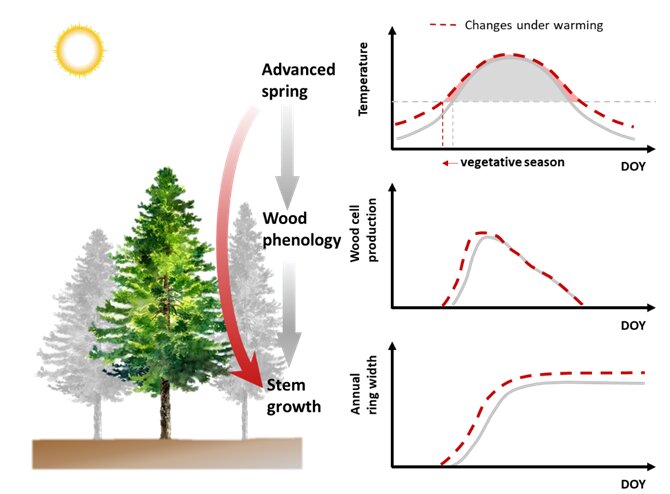
The study, titled "Growth rate overrides the benefit of extended growing season from boreal to semiarid conifers," appears in Volume 393, Issue 6816 of Science, occupying pages 1101 through 1106. Its core claim is compact but consequential: across an exceptionally wide band of climates, the number of days available for growth is not the factor that decides how much a conifer actually grows. That role belongs to growth rate itself.
The framing matters because it inverts a common mental model. Rather than treating the growing season as the master variable and growth rate as a downstream consequence, the paper positions growth rate as the governing control — one that can neutralize, and in some settings erase, whatever advantage a longer season might appear to offer.
What the Title Actually Asserts
Read closely, the paper's title makes a specific and testable claim: growth rate overrides the benefit of an extended growing season. This is a comparative statement. It does not argue that growing season length is meaningless. It argues that when the two factors are weighed against each other, growth rate wins.
The phrase "from boreal to semiarid conifers" defines the scope. The comparison is not confined to a single forest type or a single latitude. It spans the cold-dominated northern forests, where low temperatures have historically limited biological activity, and the drier woodland systems where moisture, not warmth, is the scarce resource. That breadth is what makes the conclusion notable. A finding that holds only in water-limited systems would be easy to explain away; a finding that persists across both cold-limited and drought-limited conifers points to something more fundamental about how trees allocate and deploy the carbon they capture.

Why Season Length Has Long Seemed Like an Advantage
The appeal of the extended-growing-season hypothesis is straightforward. Photosynthesis requires light, liquid water, and temperatures warm enough for enzymatic activity. If climate change delivers more days that satisfy those conditions, the reasoning goes, cumulative carbon uptake should rise, and with it, wood production and forest biomass.
But a longer window is only an opportunity, not an outcome. Several well-understood mechanisms can prevent extra days from translating into extra growth:
- Water supply: A longer warm season can accelerate soil moisture depletion, so additional days may arrive when the tree is already under hydraulic stress and cannot keep its stomata open.
- Frost exposure: Earlier onset of activity in spring increases the risk of damage from late cold snaps, which can set growth back rather than advance it.
- Respiratory costs: Warmer conditions sustain metabolic consumption as well as production, and warmer nights in particular can consume carbon that daytime photosynthesis has fixed.
- Nutrient and structural limits: Building new wood requires nitrogen, phosphorus, and vascular capacity. Where those are constrained, more photosynthetic days cannot be converted into more tissue.
Each of these factors decouples the length of the season from the amount of growth. The new paper's contribution is to argue that this decoupling is not a peripheral complication but the dominant pattern across conifer systems.
Growth Rate as the Deciding Variable
If growth rate overrides season length, the practical question becomes what growth rate represents. Conceptually, it captures how aggressively a tree converts available resources into new tissue — a trait bound up with stomatal regulation, hydraulic architecture, carbon allocation between roots and shoots, and the species' overall life-history strategy.
Conifers vary enormously along this axis. Some are built for rapid establishment and competitive capture of light and water. Others are built for persistence, tolerating stress and growing slowly but surviving conditions that would kill faster-growing neighbors. The paper's framing suggests that this axis, rather than the calendar, determines how much a given conifer gains from a lengthening season. A fast-growing tree may exploit any additional favorable window; a slow-growing, stress-adapted tree may not, even when the window is wide open.

A Gradient That Spans Two Very Different Worlds
The boreal and semiarid endpoints of the study's range represent opposite constraints. In boreal forests, the historical limiting factor has been cold — a short frost-free period, cold soils, and a brief window for cambial activity. In semiarid woodlands, the limiting factor is water, and the risk of a longer warm season is that it deepens rather than relieves drought stress.
That the same overriding pattern is reported across both settings implies the mechanism is not simply about which resource happens to be scarce. Instead, it suggests that the capacity to turn favorable conditions into growth is itself the bottleneck — a property of the organism rather than of the calendar.
Why This Matters for Carbon Projections
Terrestrial carbon accounting leans heavily on season length as an accessible proxy for productivity. Satellite records of greenness, modeled frost-free periods, and phenological metrics are all comparatively easy to measure over large areas, which makes them attractive inputs for estimating how much carbon forests take up.
If growth rate is the true control, then projections that treat a lengthening season as an automatic gain in carbon storage may systematically overestimate the sink. The error would not be uniform. It would concentrate exactly where the mismatch between season length and growth capacity is largest — which, according to the paper's title, includes both the far northern forests and the drier woodlands that fringe them.
The same logic reshapes expectations about where forests can persist. A species that cannot translate extra growing days into competitive growth may lose ground even in regions where the climate envelope appears, on paper, to be improving.

Implications for Management and Restoration
Forest managers routinely make decisions that implicitly assume season length drives performance — matching seed sources to future climates, selecting species for assisted migration, and setting expectations for plantation yields under warming scenarios. The paper's argument suggests a reorientation.
- Seed transfer and provenance selection may need to weight intrinsic growth rate more heavily than correspondence between current climate and projected season length.
- Restoration in semiarid landscapes may gain little from additional growing days if moisture, not time, remains the binding constraint.
- Carbon crediting and offset frameworks that reward expected productivity gains from longer seasons should treat those gains as conditional rather than guaranteed.
Questions the Finding Raises
A result framed at this level of generality invites follow-up work rather than closing the subject. Among the open threads:
- Which specific physiological or anatomical traits define the growth-rate axis that overrides season length?
- How does the pattern interact with rising atmospheric carbon dioxide, changing nitrogen deposition, and shifts in disturbance regimes such as fire and insect outbreaks?
- Does stand age or successional stage modify the effect, given that growth rates decline as trees mature?
- How much of the signal is specific to conifers, and how much extends to broadleaf forests?
The Bottom Line
The paper published in Science, Volume 393, Issue 6816, offers a corrective to a durable assumption. A longer growing season is an opportunity, and opportunities are only worth what the organism can make of them. From the cold-limited boreal forest to the water-limited semiarid woodland, the determining factor in how much a conifer grows appears to be the rate at which it grows — not the number of days it is given.
For researchers building carbon budgets, for managers choosing what to plant and where, and for anyone tracking how forests will fare on a warming planet, that distinction is not academic. It changes which variables deserve attention and which projections deserve skepticism.
This article is based on reporting by Science (AAAS). Read the original article.
Originally published on science.org