
A long-delayed change in the US sunscreen market
The US Food and Drug Administration has approved bemotrizinol for over-the-counter sunscreen use, opening the door to the first newly permitted OTC sunscreen ingredient in the United States since 1999. The approval, dated June 9, 2026 in the source material, marks a notable regulatory shift in a product category that has changed more slowly in the US than in parts of Europe and Asia.
That lag is central to why the decision matters. According to the source text, bemotrizinol is not a new molecule in global terms. Consumers in Europe and Asia have used it for decades. Its approval in the US therefore does not announce a scientific debut so much as a regulatory catch-up, one that could expand the range of sunscreen formulations available to American consumers.
The source article presents the development as significant not only because of the long gap since 1999, but also because sunscreen products sit at the intersection of public health, consumer behavior, and basic physics. As summer intensifies in the US, sunscreen becomes less of a niche personal-care category and more of a mass seasonal health tool. A new approved ingredient can therefore matter well beyond formulation chemistry.
Why ultraviolet light is the core problem
To understand why the addition of bemotrizinol matters, it helps to start with what sunscreen is trying to manage. The source explains that sunlight reaching Earth is made up mainly of infrared light, visible light, and ultraviolet light. Roughly half is infrared, about 40% is visible light, and around 10% is ultraviolet. UV light has the shortest wavelengths of the three, which is part of what makes it dangerous to living tissue.
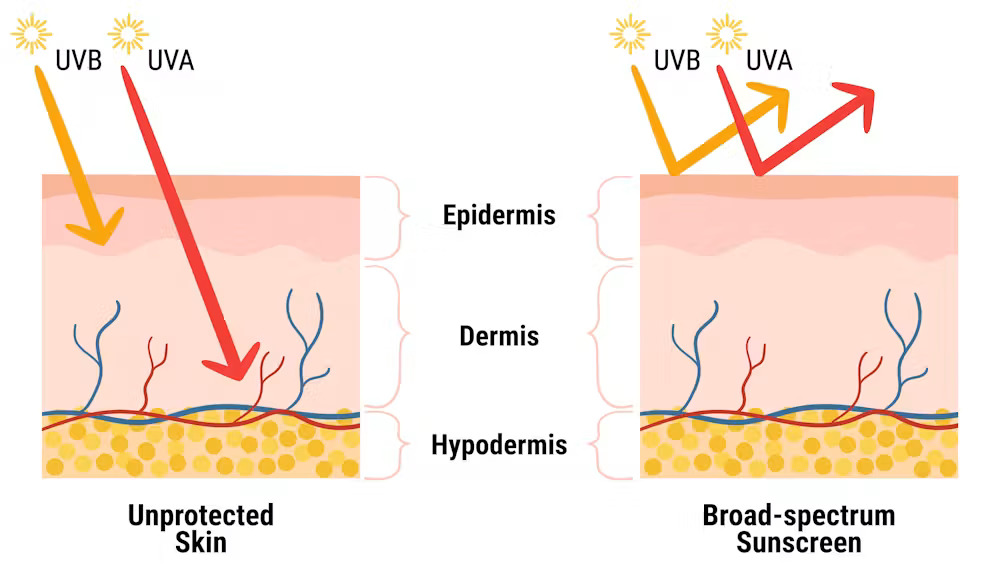
That basic fact underlies the entire sunscreen market. UV radiation is invisible, but it is the portion of sunlight that sunscreen products are designed to reduce or manage at the skin’s surface. In that sense, approval of any sunscreen ingredient is not just about adding another consumer option. It is about authorizing another tool for dealing with one of the most biologically harmful parts of normal sun exposure.
The source also notes that chemical sunscreens have been around for a long time, dating back to the late 19th century. Over time, these products have evolved substantially. Bemotrizinol now joins that progression in the US market after years of being absent from the list of OTC-permitted ingredients available to domestic manufacturers.

What the approval changes
The practical consequence of the FDA decision is straightforward: bemotrizinol can now be used in over-the-counter sunscreen products sold to US consumers. That does not mean every sunscreen on shelves will change immediately, nor does it guarantee rapid reformulation across the market. But it does mean manufacturers have a newly cleared option when designing future products.
Because the ingredient has already been used for decades in Europe and Asia, the decision may also influence expectations among consumers who have followed international sunscreen differences for years. In recent summers, the gap between what is sold in the US and what is available abroad has become a more visible part of consumer discussion, particularly among people who pay close attention to sun protection products.
The source article stops short of making detailed performance comparisons against existing US ingredients, so any stronger ranking would go beyond the supplied material. But the regulatory fact alone is meaningful. Approval ends a 27-year drought in newly permitted OTC sunscreen ingredients in the US, a number large enough to signal how slowly this product class has moved through the American system.
Why this is more than a beauty-industry story
It would be easy to read the approval as a niche cosmetics update, but the source material points in a broader direction. Sunscreen is a health product first. The article frames the issue around protecting skin from the damaging effects of the sun’s rays, and it treats the addition of bemotrizinol as part of that larger public-health function.
That framing matters because public conversations about sunscreen often swing between marketing language and cultural habits, while the underlying issue remains simple: UV exposure can damage tissue, and consumers rely on products that are supposed to mitigate that harm. When a regulator approves a new ingredient after such a long gap, the decision carries implications for product development, medical guidance, and consumer confidence.
It also has symbolic value. The US has often appeared conservative in this corner of consumer health regulation relative to other major markets. By clearing an ingredient already familiar abroad, the FDA has signaled some willingness to update the domestic toolkit, even if the move comes later than many advocates would have preferred.

What to watch next
The approval is a milestone, but it is only the start of the market impact. The next question is how quickly bemotrizinol appears in actual US retail products. Ingredient approval does not instantly translate into shelf presence. Companies have to formulate, test, package, and distribute products, and retailers have to decide how quickly to bring them in.
There is also a consumer-education dimension. Many shoppers do not track sunscreen chemistry closely. For them, the name bemotrizinol may mean little on its own. The more important point is that the US now has an additional approved OTC sunscreen ingredient after more than a quarter century without one.
From a policy standpoint, the June 9, 2026 decision stands as the headline. From a market standpoint, the real test begins afterward: whether the approval broadens meaningful product choice and whether it helps modernize a category that has long been seen as lagging behind international peers.
For now, the development is best understood as both practical and overdue. The FDA has not invented a new sunscreen era overnight. It has, however, authorized a new ingredient for American over-the-counter use for the first time since 1999, and that alone makes the decision one of the more consequential health-product regulatory changes of the summer.
This article is based on reporting by Live Science. Read the original article.
Originally published on livescience.com