JWST finds direct evidence that violent outflows may help end star formation in young galaxies
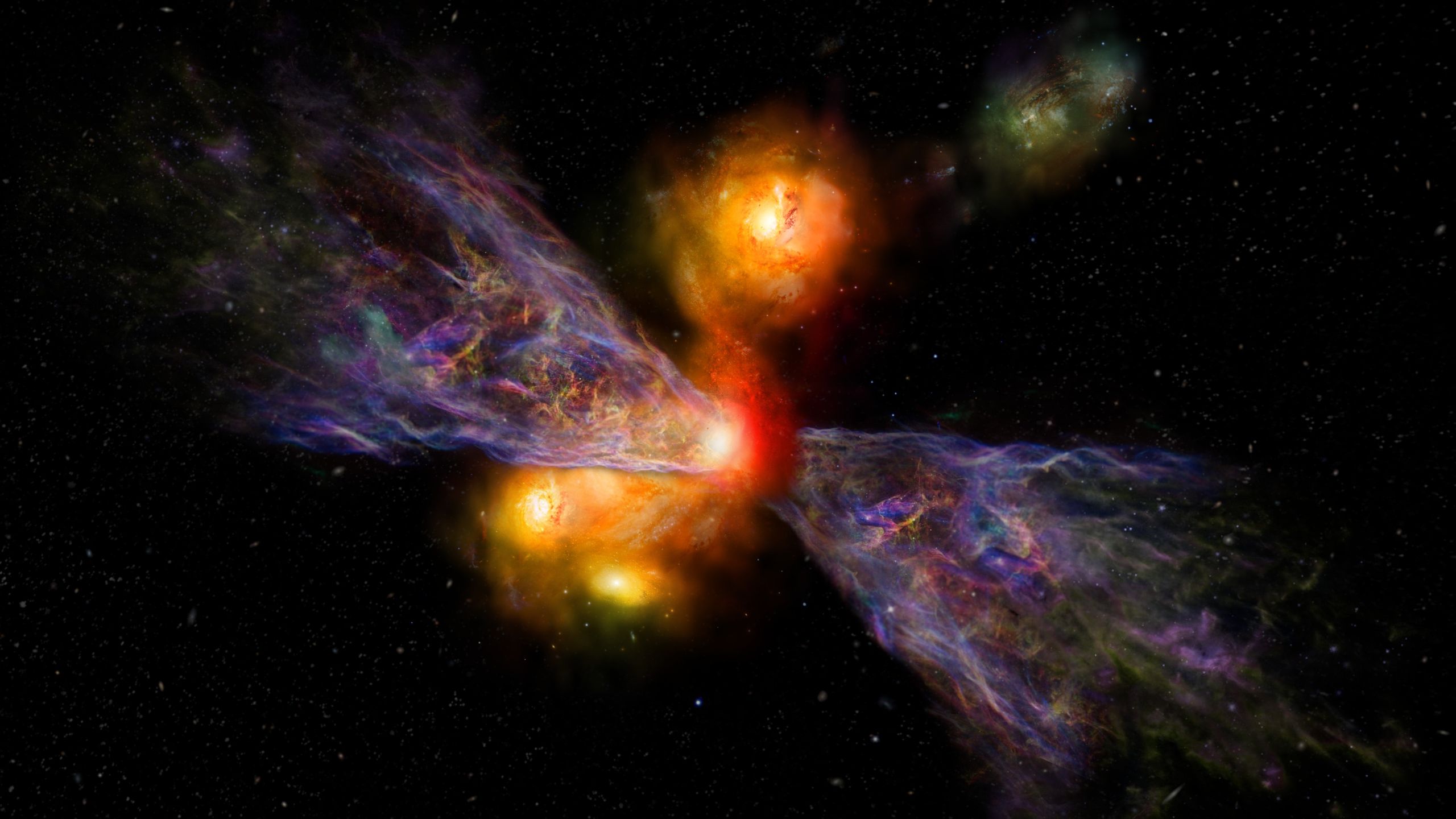
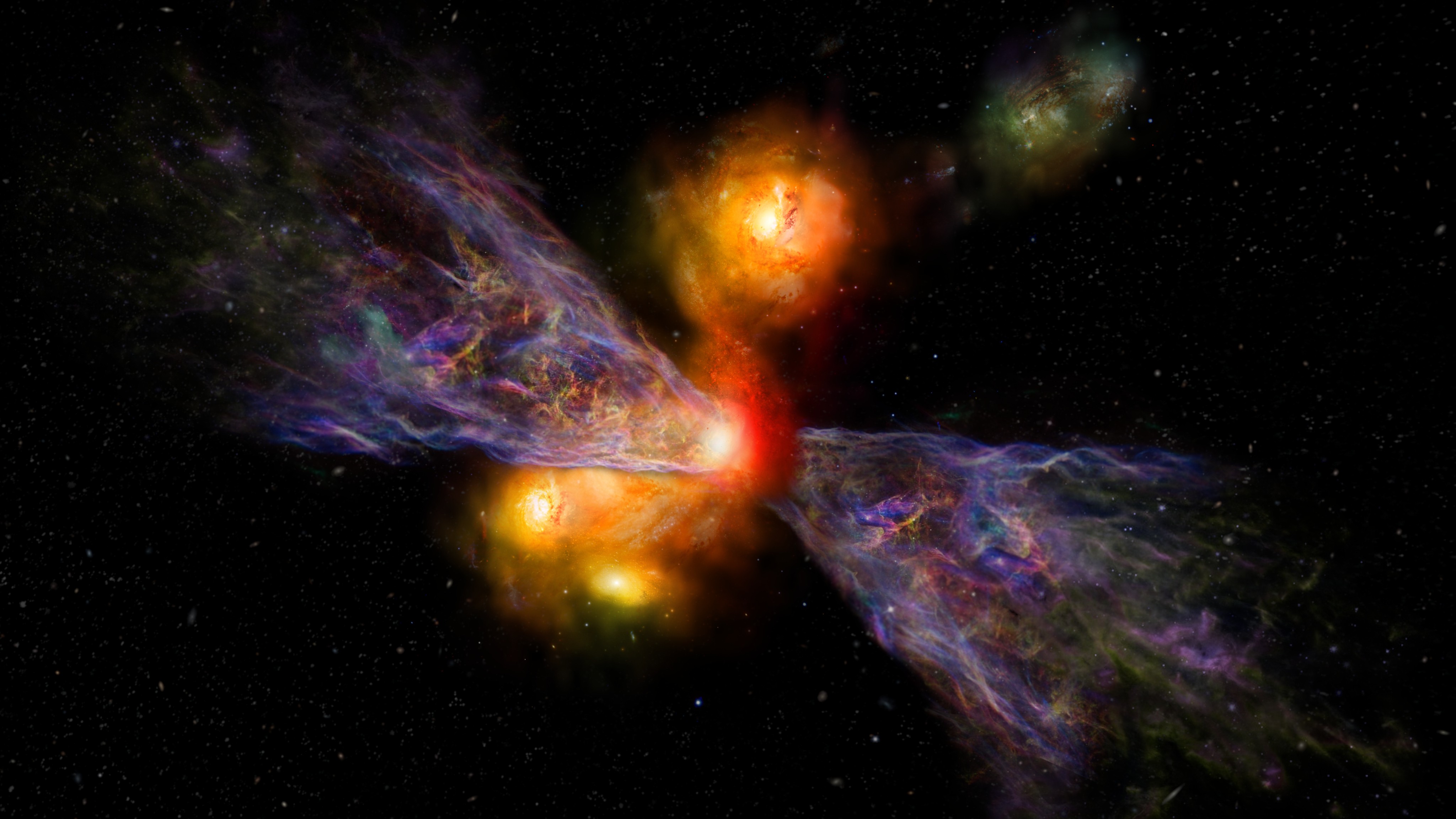
Astronomers using the James Webb Space Telescope and the Atacama Large Millimeter/submillimeter Array have observed what appears to be a powerful gas outflow escaping from a galaxy system seen just 1 billion years after the Big Bang. The target, known as CRISTAL-02, is a merging system with a stellar mass around 10 billion times that of the sun. According to the researchers, the outflow is almost as long as the system itself and is moving into space at hundreds of miles per second.
The observation matters because it offers direct support for a long-discussed explanation for one of the biggest puzzles raised by Webb: why some galaxies in the early universe seem to have grown large quickly and then stopped making stars not long afterward. The new work, published June 10 in Monthly Notices of the Royal Astronomical Society, argues that star-driven winds associated with galactic mergers can remove or disrupt the gas needed for future star formation.
A puzzle from the first billion years
Webb has repeatedly shown that the young universe was more mature than many researchers expected. Within the first billion years after the Big Bang, galaxies had already built up substantial mass. Just as surprising, many of them also appear to have become quiescent, meaning their star formation slowed dramatically or stopped altogether, only about a billion years later.
That combination has forced astronomers to look more closely at the mechanisms that can rapidly switch galaxies from fast growth to inactivity. Galactic winds have long been considered one candidate. The idea is straightforward: if a galaxy loses too much cold gas, or if that gas is heated, dispersed, or expelled, the raw material for building new stars disappears. What has been harder to establish is whether such winds were strong enough, early enough, to shape galaxies in the first chapter of cosmic history.
CRISTAL-02 gives researchers a case study at exactly that epoch. Because the system is being seen at a time when the universe was only about 1 billion years old, it offers a window into the transition from active growth to possible shutdown in the young cosmos.

Why mergers may matter
The source text describes CRISTAL-02 as a galactic merger in the later stages of a multigalaxy collision. In broad terms, mergers can concentrate gas, trigger intense bursts of star formation, and stir up the internal dynamics of a system. Those same conditions can also produce strong feedback, including winds that carry material outward.
What makes the new result notable is not simply that gas is present outside the galaxy, but that the plume is both large and fast. A structure on that scale suggests the outflow is not a minor side effect. Instead, it could be a central part of how the system evolves. If enough gas is removed, the merger that briefly fuels activity may also help end it.
This helps frame galactic collisions in a less romantic way than the usual “bigger galaxy from two smaller ones” picture. Mergers still build larger structures, but they may also create the conditions that suppress later growth. In that sense, the same process that assembles a massive galaxy may contribute to making it quiet.
What the instruments contributed
Webb and ALMA are complementary tools for this kind of work. Webb can probe the distant universe with exceptional sensitivity, while ALMA is especially powerful for studying cold gas and dust at millimeter and submillimeter wavelengths. Together, they allow astronomers to connect galaxy structure, star formation, and gas motion in systems that would have been far harder to characterize only a few years ago.
That combination is increasingly important as scientists move from simply cataloging surprising early galaxies to explaining how they formed and evolved. Webb has made the problem sharper by finding so many massive and apparently dormant systems at high redshift. Follow-up studies like this one are the next step: identifying physical mechanisms rather than just reporting anomalies.

What this could mean for galaxy evolution
The immediate implication is that star-driven winds can plausibly play a major role in quenching galaxies much earlier in cosmic history than had been firmly demonstrated before. If CRISTAL-02 is representative of a broader population, then violent outflows associated with mergers may help explain why Webb sees a diverse mix of active and quiescent galaxies so early.
The finding also suggests that “dead” galaxies in the early universe may not require a single exotic explanation. Instead, at least some of them could result from feedback processes that become especially intense in merger-driven environments. That would make quenching less of an outlier and more of a natural stage in fast early growth.
The Live Science report goes a step further by noting that such observations could offer a preview of how large galaxies eventually wind down, including in the distant future of systems like the Milky Way. That broader analogy remains interpretive, but the core observation is more concrete: a young merging galaxy system appears to be losing gas on a scale that could directly affect its ability to keep making stars.
The broader Webb era question
One reason this result will draw attention is that it fits a larger pattern in astronomy since Webb began operations. Many of the telescope’s most important contributions have not been isolated discoveries, but pressure tests on existing models. Observations of unexpectedly massive early galaxies, early black holes, and mature chemical signatures have all pushed theorists to refine how quickly structures formed after the Big Bang and how efficiently internal feedback operated.
CRISTAL-02 now adds another datapoint to that revision effort. It suggests that the early universe was not only a time of rapid assembly, but also of rapid shutdown in some systems, with feedback processes capable of reshaping galaxies on relatively short timescales.
Further observations will determine how common these giant outflows are and whether they are enough on their own to produce the population of quiescent galaxies Webb has uncovered. But as direct evidence goes, this is an important step: astronomers have caught a young galaxy system apparently venting the material it needs to survive as a star factory.
This article is based on reporting by Live Science. Read the original article.
Originally published on livescience.com