Seafloor burial may blunt one feared Arctic climate feedback
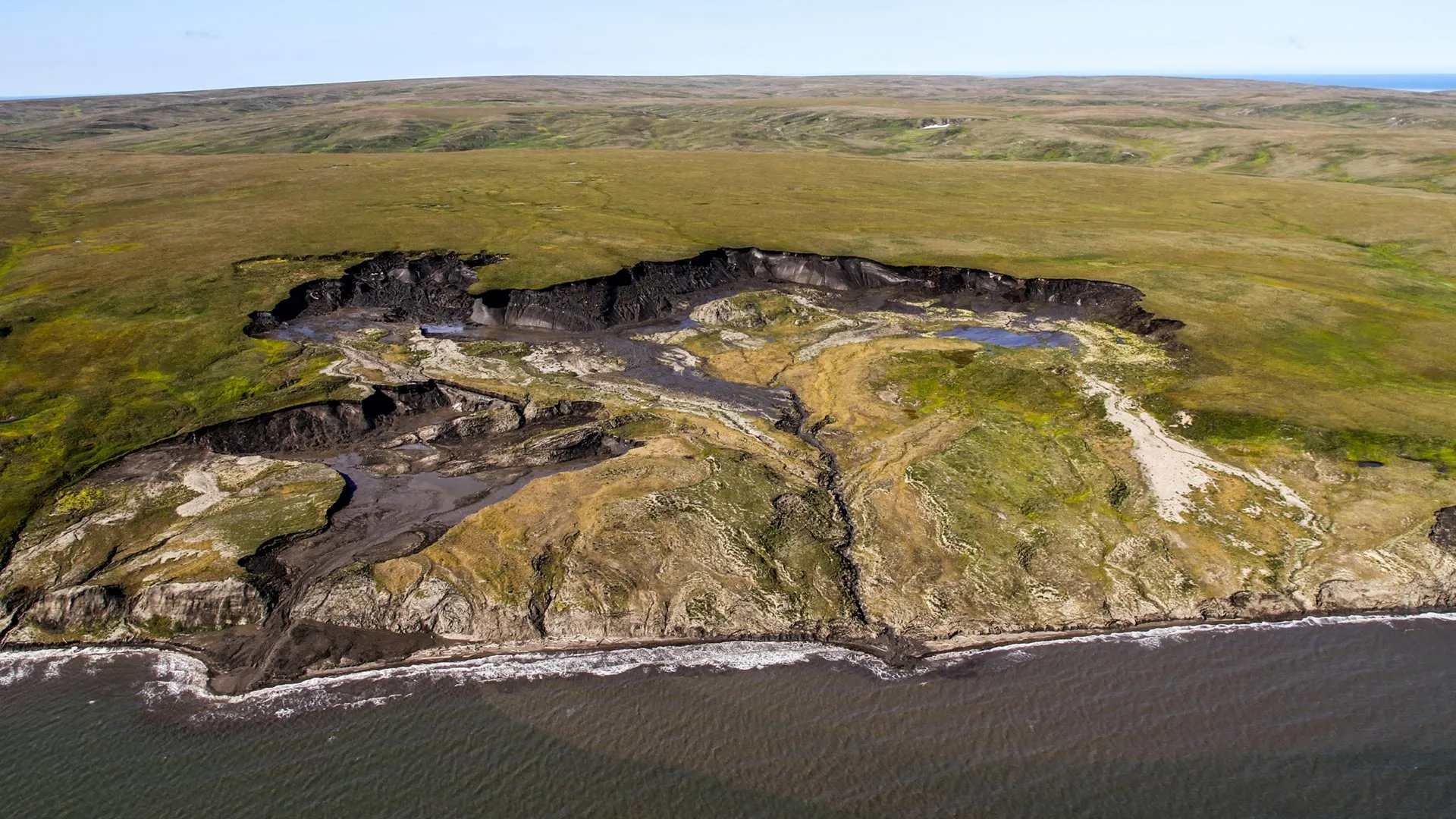
Thawing permafrost has long been treated as one of climate science’s most troubling feedback risks. Arctic soils and coastal sediments hold enormous stores of ancient organic carbon, and as warming accelerates across the far north, that frozen material is increasingly being mobilized by erosion and thaw. The core concern is straightforward: once released into the ocean, microbes could consume that old carbon and convert a large share of it into climate-warming gases.
New research highlighted by the Alfred Wegener Institute and reported via ScienceDaily points to a more complex outcome. Working near Qikiqtaruk, also known as Herschel Island, in Canada, researchers examined sediment cores to track what happens after land-derived carbon enters Arctic coastal waters. Their conclusion is notable: much of that carbon appears to be buried in seafloor sediments before microbes can break it down, while only about 10 percent is converted into gases.
That does not erase the climate threat posed by thawing permafrost. It does, however, suggest that one pathway from thaw to atmospheric emissions may be less direct, and in some coastal settings less severe, than many feared. In a field where feedback loops matter enormously, identifying a natural buffer is important.
A major carbon store is starting to move
The study starts from a well-established reality. Arctic permafrost ecosystems on land contain roughly 1,300 gigatonnes of organic carbon, according to the source material, with another 400 gigatonnes stored in ocean sediments and river deltas. As Arctic temperatures rise faster than in other regions, frozen ground is thawing and coastlines are eroding, allowing previously locked carbon to wash into the sea through rivers and collapsing coasts.
The source text cites estimates that up to 0.02 gigatonnes of this carbon already enters the ocean each year. It also says that by 2100, this outflow could rise by 70 to 150 percent. Those are the kinds of projections that have elevated permafrost carbon from a regional geology issue to a planetary climate concern.
The open question is what fraction of that material becomes a near-term atmospheric problem. If microbes quickly metabolize it, the thawed carbon would reinforce warming. If instead much of it is trapped in seabed sediments, the timing and magnitude of that feedback could look different from worst-case assumptions.

What the sediment cores showed
To investigate that question, the researchers studied sediment cores collected off the permafrost coast of Herschel Island. Sediment cores function like environmental archives: layer by layer, they preserve evidence of what materials entered a system and what happened to them afterward.
According to the supplied source text, the team found that large amounts of carbon from land are preserved in the seafloor. They also found that marine microorganisms appear to prefer fresher carbon produced in the ocean over the older carbon released from permafrost. That behavioral detail matters because it offers a mechanism for why ancient terrestrial carbon is not being consumed as aggressively as some models might assume.
If microbes are selective eaters, then old permafrost carbon may spend less time exposed to biological breakdown and more time being incorporated into sediments. That does not mean the material is harmless, but it does mean the ocean floor may serve as a significant carbon sink in these Arctic coastal zones.
Why the finding matters beyond one coastline
The result is meaningful because it addresses a critical uncertainty in climate accounting. Permafrost carbon is often discussed as a looming emissions pulse, but the path from thawed ground to atmospheric greenhouse gases passes through multiple environments: rivers, coastal shelves, sediments, and microbial communities. This study suggests those intermediate steps can substantially change the outcome.
For climate modelers, that means the geography of thaw may be just as important as the amount of thaw. Carbon released along some Arctic coasts may be more likely to settle and be buried, while carbon entering other systems could remain more vulnerable to microbial conversion. The implication is not that the risk disappears, but that it is heterogeneous and should be measured rather than assumed.
The work also underscores how much depends on coastal processes. Erosion, sediment transport, water chemistry, and biological activity all influence whether old carbon is ventilated back to the atmosphere or locked into the seabed. As Arctic shorelines destabilize, those coastal margins become a front line in the global carbon cycle.
Reasons for caution
There is a limit to how far this result can be generalized from the supplied material alone. The source describes findings from one study area near Herschel Island, not a definitive answer for the entire Arctic. Coastal environments differ widely, and rates of burial versus decomposition could vary with temperature, currents, sediment load, and ecosystem structure.
Just as important, even a minority share converted into greenhouse gases can still matter at scale if the amount of carbon entering the ocean keeps rising. A 10 percent conversion rate is far less alarming than complete microbial breakdown, but it is not trivial in a warming system already under stress.
Nor does sediment burial eliminate other consequences of permafrost thaw, including landscape collapse, coastal damage, ecosystem disruption, and the broader greenhouse impact of thaw occurring on land before carbon ever reaches the sea.
A more nuanced climate signal
The significance of the Herschel Island result is that it replaces a simple narrative with a more defensible one. Ancient Arctic carbon is indeed being mobilized as the planet warms. But once it reaches coastal waters, a substantial portion may be intercepted by the seabed rather than immediately recycled into the atmosphere.
That is not a climate reprieve so much as a refinement. It suggests the Arctic Ocean’s margins may provide a partial buffering function at the same time that warming intensifies carbon release from land. For policymakers and scientists, the message is clear: permafrost feedbacks are real, but their strength depends on physical and biological processes that need closer measurement.
In climate research, the most consequential advances are often not the ones that confirm a fear in its simplest form, but the ones that show where the system is more complicated. This study appears to do exactly that, identifying a buried pathway for ancient carbon that could materially shape how the Arctic’s warming signal reaches the rest of the planet.
This article is based on reporting by Science Daily. Read the original article.

Originally published on sciencedaily.com


