A New Frontier in Interface Engineering
The performance and longevity of perovskite-based solar cells hinge on the quality of their internal interfaces. Among the most critical is the junction between nickel oxide (NiOx) and the perovskite light-absorbing layer. This interface facilitates the extraction of positive charge carriers, but it is also a site of chemical vulnerability. A new study published in Science (Volume 393, Issue 6818, pages 1364–1368, September 2026) reports a breakthrough: conformal oxides can decouple chemical stability from energetic alignment at the NiOx/perovskite interface. This finding, if validated and scaled, could remove a longstanding trade-off that has limited the durability of perovskite photovoltaics.
Perovskite solar cells have attracted intense interest because they can be manufactured at low cost and with high power conversion efficiencies. However, their commercial viability is hampered by instability. The materials degrade when exposed to moisture, heat, oxygen, and even light, and interfaces are often the first to fail. The NiOx/perovskite interface is particularly challenging because NiOx, while an excellent hole-transport material, can react with perovskite components. These reactions create defects and charge traps that reduce performance and accelerate degradation.
The Coupled Nature of Stability and Energetics
In conventional interface engineering, researchers face a dilemma. Chemical stability is often improved by adding passivation layers or modifying surface chemistry, but these changes frequently disrupt the energy level alignment. Conversely, tuning the energetics to optimize charge transfer may introduce chemical incompatibilities. The two properties—chemical stability and energetic alignment—are said to be coupled. Improving one tends to worsen the other.
The new study, as its title indicates, demonstrates that conformal oxides can break this coupling. A conformal oxide is a thin, uniform coating that conforms to the underlying surface topography, covering it completely without significant thickness variation. Such coatings can act as a physical barrier, shielding the perovskite from chemical attack while still allowing charge carriers to pass through or be efficiently extracted. Crucially, the research suggests that the oxide layer can be engineered to maintain or even enhance the desired energy level alignment.
By decoupling these two properties, the researchers open the door to independent optimization. One could, in principle, design a conformal oxide that provides robust chemical protection without compromising the electronic properties of the interface. This is a significant conceptual advance because it reframes the problem: instead of searching for a single material that balances both requirements, scientists can now consider multilayer or composite strategies where each function is handled separately.

Why NiOx/Perovskite Interfaces Matter
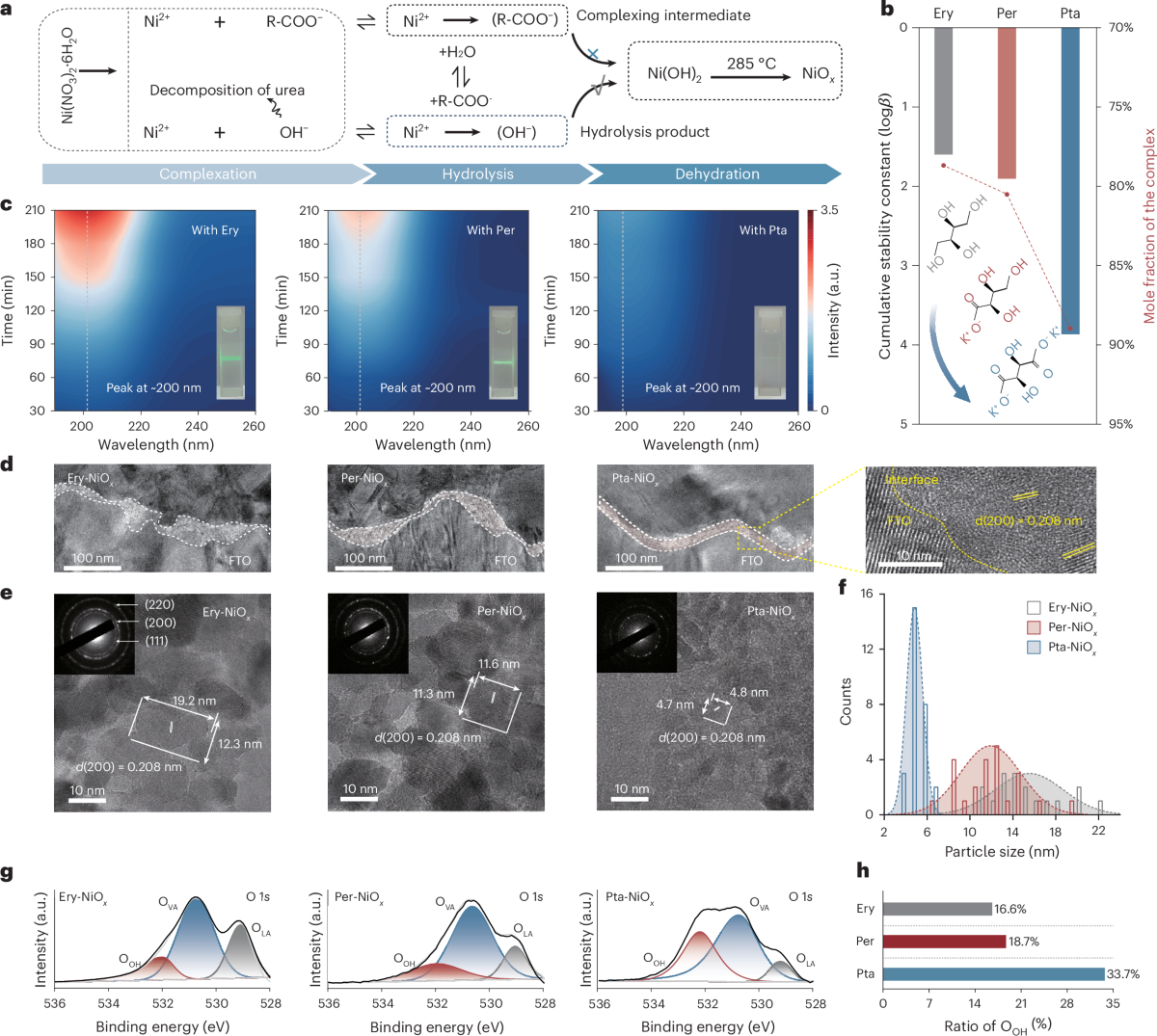
Nickel oxide is a widely used hole-transport layer in p-i-n perovskite solar cells. Its valence band aligns well with the perovskite's highest occupied molecular orbital, enabling efficient hole extraction. However, NiOx surfaces can contain defects and reactive sites. When the perovskite is deposited on top, chemical reactions can occur, especially under operational stress. These reactions produce volatile species, deep trap states, and non-radiative recombination centers, all of which degrade device performance.
Previous approaches to stabilize this interface have included self-assembled monolayers, organic passivators, and ultrathin inorganic layers. Each has limitations. Organic molecules may themselves degrade, and ultrathin layers may not be sufficiently robust or uniform. Conformal oxides, by contrast, can be deposited with precise thickness control and excellent step coverage, making them attractive candidates for durable interface engineering.
Implications for Perovskite Commercialization
The ultimate goal of perovskite research is to produce modules that can compete with silicon on both cost and lifetime. Stability remains the biggest hurdle. If interfaces can be made resilient without sacrificing efficiency, the path to commercialization becomes much clearer. The decoupling demonstrated in this study suggests that the trade-off between chemical stability and energetics is not fundamental—it can be overcome with the right material design.
Potential benefits of this approach include:
- Enhanced stability under real-world operating conditions
- Maintained or improved charge extraction efficiency
- Compatibility with scalable manufacturing techniques
Moreover, the concept could extend beyond NiOx/perovskite interfaces. Other perovskite junctions, such as those with electron-transport layers or metal electrodes, face similar challenges. A general strategy for decoupling stability and energetics could be broadly applicable. This is why the publication in Science is notable: it signals that the findings are considered significant and rigorous by the peer-review community.
Looking Ahead
As with any laboratory breakthrough, questions remain about scalability, long-term reliability, and compatibility with high-throughput manufacturing. The study appears in the September 2026 issue of Science, and its details will undoubtedly spur further investigation. Researchers will want to understand the exact mechanisms by which conformal oxides decouple the interface properties, how the oxides behave under real-world operating conditions, and whether the approach can be integrated into tandem solar cells or flexible devices.
What is already clear is that the work challenges a prevailing assumption. For years, the field has treated chemical stability and energetic alignment as inextricably linked. By showing that they can be separated, the authors provide a new design principle. This could accelerate the development of perovskite solar cells that are both highly efficient and durable enough for decades of use.
Conclusion
The study "Conformal oxides decouple chemical stability and energetics at NiOx/perovskite interfaces" represents a promising step forward in materials science. Published in Science (Volume 393, Issue 6818, pages 1364–1368, September 2026), it offers a fresh perspective on interface engineering. If the findings hold up to further scrutiny and scale-up, they could play a key role in making perovskite photovoltaics a mainstream technology. For now, the research highlights the power of decoupling—separating intertwined properties to achieve what neither could accomplish alone.
This article is based on reporting by Science (AAAS). Read the original article.

Originally published on science.org