A Primate Gene That Jumped Into a Virus
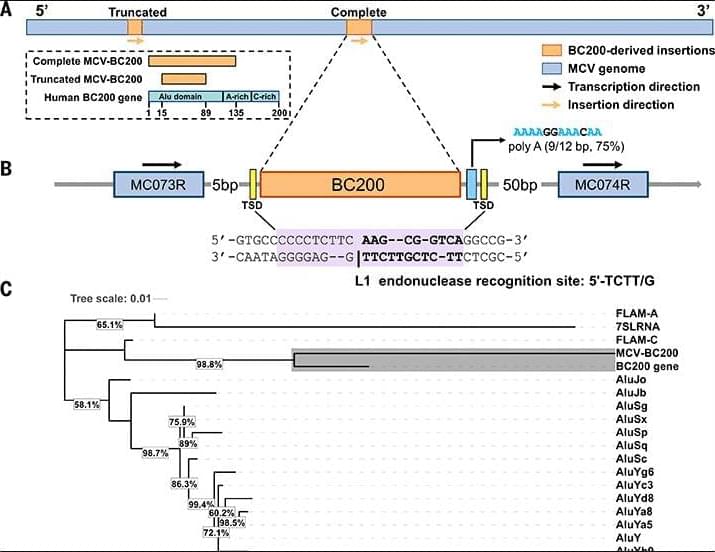
Scientists writing in the journal Science report an unusual genomic event: a gene known as BC200 has escaped into a human poxvirus. According to the title and bibliographic record of the paper, which appears in Volume 393, Issue 6818, at pages 1342 through 1346 in September 2026, that escape is not an isolated curiosity. It is presented as evidence that BC200 remains an actively moving element in primates, continuing to transpose long after it first appeared in the lineage.
The finding sits at the intersection of two fields that rarely share a headline: the study of transposable elements, the stretches of DNA that copy themselves from one genomic location to another, and the study of poxviruses, the large DNA viruses that include some of the most historically consequential human pathogens. When a host gene turns up in a viral genome, it usually means the virus picked up genetic material from a cell it infected and carried it forward. The BC200 case suggests the traffic between primate genomes and poxviruses is still live.
Details about the mechanism, the specific poxvirus strain, and the experimental approach are contained in the full paper, which is behind the publisher's access barrier. What the record makes clear is the headline claim: a host gene has been found in a human poxvirus, and that transfer shines a light back on the donor gene's mobility in primates.
Why BC200 Is an Unusual Passenger
BC200 has a long history in molecular biology as a primate-specific gene. It belongs to the broader family of small RNA and long non-coding RNA elements that do not encode proteins but still influence how cells behave. Because it is restricted to primates, it has been used as a marker for questions about when particular genetic innovations appeared in the lineage. Because it is repetitive in nature and derived from a mobile element, it has also drawn attention from researchers interested in how genomes acquire novelty.
A gene that never stopped moving
The most provocative part of the new report is the word "persistent." A gene copied into a virus is a snapshot of one moment. Persistent transposition is a pattern — it implies the element has been replicating and relocating repeatedly, on a timescale relevant to primate evolution. If BC200 were a frozen relic, a single viral capture would still be interesting, but it would say little about activity. The framing of the paper instead treats the viral copy as a signal that the underlying element has kept working.
That distinction matters for how biologists date events. A transposable element that moved once leaves a single trace that can be hard to place in time. An element that moves again and again generates multiple independent copies, each with its own history, and those copies can be compared to reconstruct when movements happened. The BC200-in-a-virus observation adds a new kind of marker to that comparison set.

How a Host Gene Ends Up Inside a Poxvirus
Poxviruses are not small, streamlined pathogens. They carry large genomes by viral standards and are known for acquiring host sequences, which is one reason they attract interest from researchers studying the boundaries between host and pathogen DNA. Viral capture of host material generally occurs when a virus replicates inside an infected cell and incorporates a fragment of cellular genetic material into its own genome, either by accident or through a process that proves advantageous enough to persist.
The result is a viral genome carrying a piece of primate biology. From the virus's perspective, such sequences can be raw material for adaptation. From the host's perspective, they are a record of an encounter. The new paper's framing suggests BC200's appearance in a human poxvirus is best read as both: evidence of a transfer event and a window into the broader mobility of the gene in the primates that hosted it.
- The transfer points to a viral acquisition of host DNA, a phenomenon well documented in large DNA viruses.
- The identity of the captured sequence ties directly back to a primate-specific element that has a long research history.
- The emphasis on persistence reframes BC200 from a static genomic feature to an ongoing participant in genome change.
Reading the Finding Against the Primate Timeline
Because BC200 is reported as primate-specific, any evidence of continued movement has implications for how scientists reconstruct the sequence of events in primate genomes. Mobile elements are often used as internal clocks: the more copies an element has accumulated, and the more places it has landed, the more time it has had to work. An element still capable of hopping complicates any picture that treats the primate genome as stable after its initial assembly.
The viral copy also introduces a second timeline. A gene can only be captured by a virus if the gene exists in the host at the time of infection, so the transfer provides a minimum age for that particular BC200 sequence. Pairing that constraint with the broader evidence of persistent transposition gives researchers a way to cross-check when the element was active and how far it had spread before the viral encounter.
Questions the Report Leaves Open
As with any single paper, the discovery raises as much as it settles. The bibliographic record confirms the finding and its venue, but the practical questions are the ones that will drive follow-up work.
- How frequently does BC200 move, and is that rate steady across primate lineages or concentrated in particular branches?
- Does the captured copy in the poxvirus retain any function, or is it inert cargo carried along by the viral genome?
- Do other primate-specific elements show similar viral escape routes, suggesting a broader pattern of host-to-virus traffic?
- Can the viral copy be used to date when the transfer occurred, and does that date align with other evidence of BC200 activity?
Each of these questions connects a narrow observation to a much larger one: genomes are not closed systems. They exchange material with the viruses that infect them, and the exchanges leave marks that persist for millions of years.
Why It Matters Beyond One Gene
The significance of the BC200 finding lies less in the fate of any single sequence than in what it demonstrates about the mutability of primate genomes and the reach of viruses into them. Poxviruses have shaped human history as pathogens; they also appear to serve, at least occasionally, as accidental archives of the genetic material of their hosts. A gene that keeps transposing in primates and can be captured by a human poxvirus is a reminder that the boundaries between host and pathogen, and between coding and non-coding DNA, are more porous than textbook diagrams suggest.
For researchers, the practical value is a new data point in an old debate about how much of the genome is still in motion. The paper's appearance in Science, in a volume dated September 2026, places it in the mainstream of that conversation. Whether BC200's viral escape proves to be a rare accident or the first glimpse of a routine phenomenon is a question that the next round of studies — comparative genomics, viral sequence surveys, and functional work on non-coding RNA — will be well positioned to answer.
What is already clear is the headline: a primate gene has been found inside a human poxvirus, and that discovery reframes BC200 as an element that never quite stopped moving.
This article is based on reporting by Science (AAAS). Read the original article.

Originally published on science.org