Why a Pig Paper Is Bigger Than It Sounds
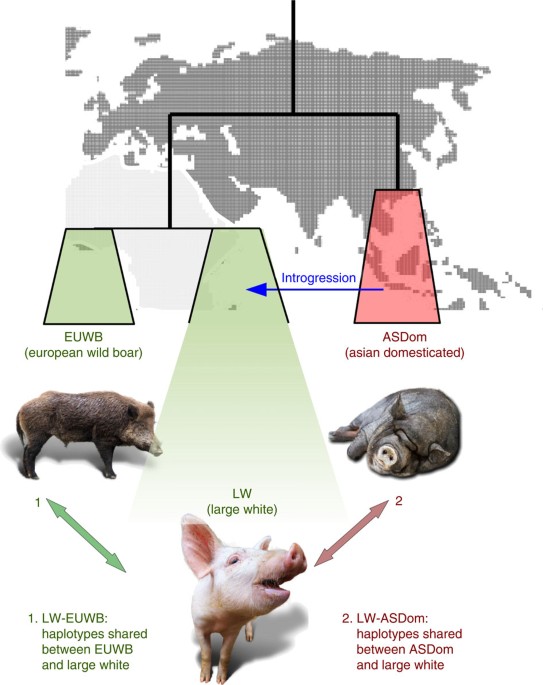
The September 2026 issue of Science carries a research article whose title reads like a compressed argument: "Ancient introgression drives wild boar expansion and phenotypic diversification of domestic pigs." Published in Volume 393, Issue 6818, across pages 1335 to 1341, the work sits at the intersection of population genetics, evolutionary biology and animal science, and it links two phenomena that researchers have usually examined separately — the geographic success of a wild mammal and the striking physical variety of its domesticated descendant.
At first glance the pairing looks almost counterintuitive. Wild boar are among the most widely distributed large land mammals on the planet, and domestic pigs are among the most variable of all farm animals in size, shape, coat and behavior. The framing of the paper suggests that these two facts may share a common cause: genetic material that entered pig lineages long ago through hybridization, then resurfaced in different contexts on both sides of the wild-domestic divide.
That is a bold proposition, and it lands in a field that has been rebuilt over the past two decades by inexpensive genome sequencing. Where researchers once inferred ancestry from bones, teeth and a handful of genetic markers, they can now compare whole genomes across large numbers of individuals, ancient specimens included. The resulting picture of evolution looks less like a tidy branching tree and more like a braided river, with lineages that split, drift apart and then partially merge again.
What Introgression Actually Means
Introgression is the movement of genetic variants from one population into another through hybridization followed by repeated backcrossing. It differs from ordinary gene flow between neighboring groups of the same species because it typically involves lineages distinct enough that biologists would treat them as separate. When the two lineages meet and produce viable offspring, and when those offspring continue to breed back into one of the parental populations, stretches of DNA from the donor lineage can become permanent fixtures in the recipient's genome.
Not all of that inherited material survives. Much of it is likely to be mildly harmful in its new genomic setting and is gradually removed by selection. But some introgressed segments carry variants that prove useful, and those can rise in frequency with remarkable speed. This process, often described as adaptive introgression, effectively hands a population a ready-made solution that another lineage spent thousands of generations assembling.
Reading the signature in a genome
Detecting introgression is a statistical exercise. Researchers look for chromosome segments that are unusually divergent from the surrounding DNA, or that match a distantly related population more closely than the recipient's own evolutionary history would predict. Distinguishing genuine introgression from incomplete lineage sorting — the retention of ancestral variation that never fully separated — is one of the more delicate problems in the field, and it shapes how confidently any single result can be stated.

Wild Boar as a Case Study in Expansion
Wild boar are a textbook generalist. Their native range spans Eurasia and North Africa, and introduced populations have taken hold on other continents. They eat almost anything, reproduce quickly, and tolerate habitats ranging from dense forest to farmland and the edges of cities. In many regions their numbers and ranges have grown in recent decades, bringing them into friction with agriculture and with suburban life.
The contribution the new paper claims, judged by its title, is to connect part of that success to ancient introgression. If boar populations inherited a broader reservoir of genetic variation from now-extinct or geographically separate relatives, they may have gained a wider set of options for coping with unfamiliar climates, pathogens and food sources. Diversity of that kind is the raw material on which selection acts, and it can matter most precisely when a species is pushing into new territory.
Domestication as a Two-Way Exchange
For much of the twentieth century, domestication was told as a one-way story: humans take wild animals, breed them in captivity, and gradually reshape them. Genomic evidence has complicated that narrative. Domestic herds do not exist in sealed containers. They interbreed with wild relatives, absorb genetic material, and sometimes return to the wild entirely, where feral populations continue to evolve.
Pigs are an unusually permeable case. Wild boar and domestic pigs remain interfertile, their ranges overlap across much of the world, and escaped or released animals readily establish feral populations. The boundary between the wild and the domesticated is therefore not a wall but a zone of continuous exchange — which is exactly the setting in which introgression thrives.
Where phenotypic diversification comes in
The second half of the paper's title concerns phenotype, meaning observable traits. Domestic pigs vary enormously: in body size, in fat deposition, in coat color and pattern, in litter size, in temperament and in disease resistance. Some of that variety reflects selective breeding. Some reflects adaptation to local conditions. The paper's argument, as expressed in its title, is that ancient introgressed variants form part of the explanation — old genetic material that was neutral or unremarkable in one context becoming valuable in another.
This is the logic of standing variation being co-opted. A variant that has persisted in a population for a long time, whether inherited from a distant relative or not, can suddenly become advantageous when the environment shifts or when breeders begin selecting for a particular trait. The result is rapid change built on an old foundation.

Why This Matters Beyond Pigs
Pigs are a model organism in several senses at once: biomedical, agricultural and evolutionary. They are also economically significant worldwide, and wild boar are a major wildlife management concern. If introgression has shaped both the invasive potential of wild populations and the trait diversity available to breeders, the implications reach into disease control, feral animal management and the preservation of genetic resources.
The pattern may also be general. Introgression is increasingly documented in cattle, sheep, dogs, chickens and crop plants, among many other organisms. The emerging lesson is that domestication rarely happens in isolation; it happens in landscapes where wild and managed populations continue to meet.
Caveats and Open Questions
A title is a summary of a long and technical argument, and the substance of that argument lives in the paper's figures, methods and supplementary material. Readers should treat the headline claim as a hypothesis being advanced and defended rather than a settled conclusion. Full text access was not available at the time of writing, so the specific lineages, time frames and genomic regions involved could not be examined directly here.
Several questions naturally follow. Which donor lineages contributed, and when? Which introgressed segments show signs of selection rather than drift? How much of the observed variation in domestic pigs traces to ancient gene flow as opposed to recent breeding or independent mutation? And how confidently can introgression be separated from the retention of ancestral variation? Each of these requires careful modelling and replication across datasets and populations.

The Bottom Line
If the paper's central claim holds up, it reframes a familiar story. The wild boar's spread and the domestic pig's remarkable physical range would not be separate chapters but two consequences of the same long history of genetic exchange — a history in which the boundaries between species and between wild and tame were crossed repeatedly, and in which the resulting diversity proved useful on both sides of the fence.
This article is based on reporting by Science (AAAS). Read the original article.
Originally published on science.org