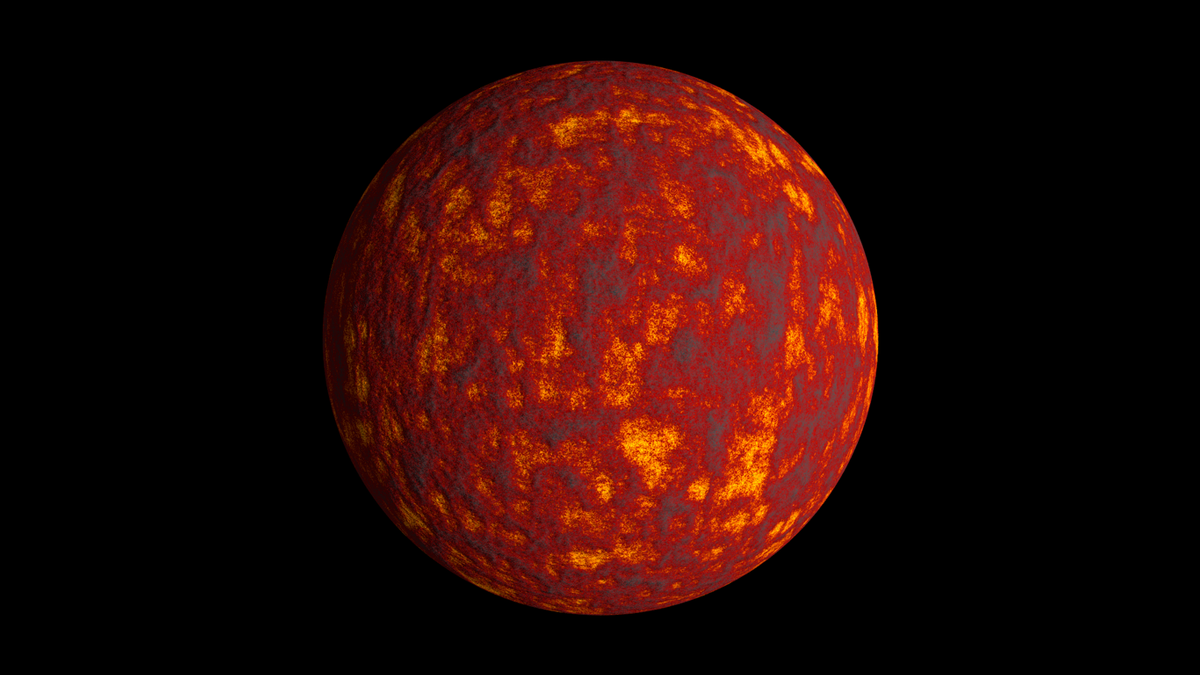
A Molten World and the Sky Above It
Before continents, oceans, or a stable crust existed, the young Earth and its rocky neighbors were likely wrapped in vast seas of molten rock. Planetary scientists call these magma oceans, and they sat beneath thin envelopes of gas vented from the interior or inherited from the cloud of material that built the planets. How tightly those two layers exchanged material — the molten interior below and the tenuous atmosphere above — remains one of the more stubborn problems in planetary science.
A paper published in Science, Volume 394, Issue 6819, pages 97–101, in October 2026 takes up that problem. Its title, "Incorporation of atmospheric components in planetary magma oceans through bubble–metal compounds," points to a specific route by which gases from above may end up dissolved or trapped within a planet's molten depths. The work appears in the peer-reviewed journal of the American Association for the Advancement of Science and belongs to the long-running effort to understand how planetary interiors and their envelopes trade material.
Why Magma Oceans Matter So Much
Magma oceans are not just a dramatic phase in a planet's youth. They function as chemical processing plants. When a body is largely molten, minerals, dissolved gases, and metallic components can separate, mix, and react under temperatures and pressures that no surface laboratory can reproduce. The Moon is widely thought to have hosted a global magma ocean tied to its formation, and similar episodes are plausible for Mars, Venus, and the early Earth. In the fast-growing catalog of rocky exoplanets, worlds on close orbits may remain partially or wholly molten for long stretches of their lives, which makes magma-ocean physics relevant far beyond our own solar system.
Because a young planet's inventory of water, carbon, nitrogen, and other volatiles can be held in or expelled from molten silicate, the boundary between interior and atmosphere is not a hard wall. It is a chemically active interface, and the balance struck there helps determine what a planet's air looks like millions of years later. The study's focus — atmospheric components moving into a magma ocean — addresses that interface directly.

Bubbles, Metals, and an Unusual Transport Route
According to the paper's title, the pathway runs through bubble–metal compounds: combinations of gas bubbles and metallic material that, together, help carry atmospheric species into the molten interior. In a magma ocean, gas bubbles can nucleate, rise, and collapse, and their surfaces offer places where dissolved species may attach, react, or be shuttled downward. Metal-rich droplets, which can be present in a molten silicate body, add another set of interfaces where chemistry happens.
The idea that bubbles and metals could act in concert is notable because it treats the atmosphere and the interior as a coupled system rather than two separate reservoirs. If atmospheric gases can be captured and delivered into molten rock efficiently, then a planet's earliest air may be partly stored underground rather than lost to space. That storage could later be released by volcanism, returned through degassing, or locked away for good depending on how the melt solidifies.
The paper sits within a broader research tradition that treats magma oceans as gatekeepers of planetary habitability. Researchers have long debated whether early atmospheres were dominated by outgassed carbon dioxide and water vapor, by remnant nebular hydrogen, or by some mixture of the two. Any mechanism that moves gas between the sky and the melt changes that accounting, and the study's framing suggests bubble–metal chemistry deserves a place in the ledger.
Questions the Work Raises
- How efficiently can atmospheric species be drawn into a magma ocean when bubbles and metallic phases are both present, compared with either one acting alone?
- Which gases are most susceptible to this transport, and does the process favor some volatiles over others in ways that would leave a detectable signature?
- How deep can such material be carried, and does it survive the pressure and temperature gradients of a thick molten layer?
- What happens to captured gas when the magma ocean eventually crystallizes — is it returned to the atmosphere, trapped in the mantle, or lost?
- Could the same mechanism operate on partially molten exoplanets, where molten regions persist rather than forming a global ocean?

Implications for Atmospheric Evolution
If bubble–metal compounds do help pull atmospheric components into a magma ocean, the consequences ripple outward. A planet's surface pressure, its inventory of volatile elements, and the composition of its eventual secondary atmosphere all depend on how much gas the interior keeps and how much it releases. Even a modest shift in that balance could change the trajectory of climate and habitability over geological time.
The mechanism also matters for interpreting the rock record. Geochemical traces in ancient terrestrial and lunar samples are often read as evidence of how volatiles behaved during magma-ocean stages. A transport route that involves both bubbles and metals would need to be accounted for in those interpretations, because it could redistribute elements in ways earlier models did not anticipate.
From the Early Earth to Distant Worlds
The study's relevance is not confined to our solar system. As telescopes characterize rocky planets around other stars, questions about which worlds retain atmospheres and which lose them have become central to the search for habitable environments. Planets that are molten for long periods — whether because of youth, tidal heating, or a close-in orbit — may process their atmospheres through their interiors in ways that are invisible from the outside until the chemistry is understood.
The paper also reinforces a broader theme in modern planetary science: atmospheres and interiors are one system. Treating them separately may be convenient, but it rarely captures what a young planet actually does. Work like this belongs to an effort to model that system as a whole.

What Comes Next
Published in Science in October 2026, the paper adds a specific chemical pathway to the discussion of how magma oceans and atmospheres interact. Follow-up work will likely test whether the mechanism holds under realistic conditions, how it scales across planet sizes, and whether its effects would be visible in the composition of ancient rocks or in the spectra of distant worlds. For now, the title alone makes the central claim clear: the sky above a molten planet may not stay above it for long.
This article is based on reporting by Science (AAAS). Read the original article.
Originally published on science.org


