From Silicon to Steel: NVIDIA's Physical AI Push
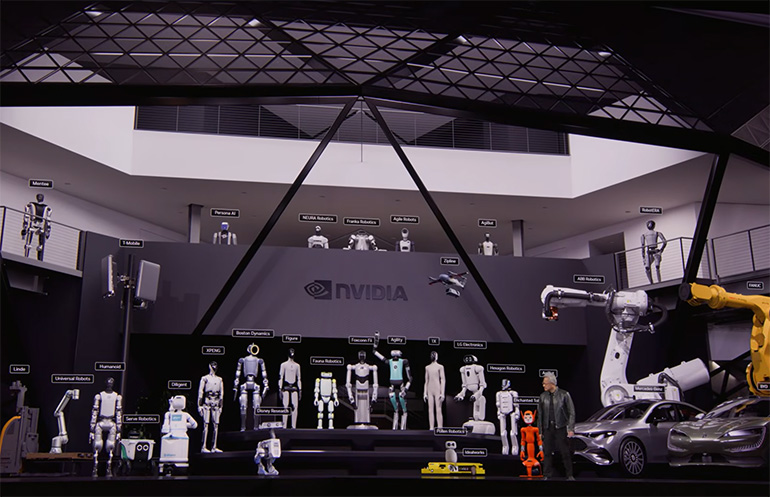
NVIDIA, long known as the dominant force in AI computing, is making an aggressive move into the physical world. The company has announced a sweeping set of collaborations with global robotics leaders aimed at accelerating what it calls "physical AI" — artificial intelligence that doesn't just process information but actively interacts with and manipulates the real world.
Unlike the digital AI powering chatbots and image generators, physical AI must perceive three-dimensional environments, reason about physics, and execute precise motor actions in real time. It's a far harder problem, and NVIDIA believes it has the platform to solve it.
The Isaac Platform as the Operating Layer
Central to NVIDIA's robotics strategy is its Isaac platform — a suite of hardware and software tools designed to power robots from the chip level up. Isaac includes the Isaac ROS framework for robot operating systems, the Isaac Sim simulation environment built on Omniverse, and Isaac Perceptor for visual AI. Together, they form a full stack that robotics companies can build on rather than reinventing from scratch.
The new partnerships expand the Isaac ecosystem significantly. Companies spanning industrial automation, warehouse logistics, surgical robotics, and humanoid development are now committing to build on NVIDIA's infrastructure. This mirrors the strategy that made NVIDIA indispensable in cloud AI — lock in developers early with excellent tooling, then ride the growth of the entire category.

Why Partnerships Matter More Than Products
NVIDIA isn't building its own robots. Instead, it's doing something potentially more powerful: becoming the shared nervous system for an industry of robot builders. By providing common simulation tools, training pipelines, and inference hardware, NVIDIA ensures that regardless of which robotics company wins the market, NVIDIA wins the infrastructure battle.
This is analogous to how AWS became essential infrastructure for the software industry. The difference is that robotics requires custom silicon — NVIDIA's Jetson and Thor processors — making the hardware lock-in even stickier than cloud services.
The Simulation Advantage
One of the most important capabilities NVIDIA brings is photorealistic simulation. Training robots in the real world is expensive, dangerous, and slow. A robot learning to grasp fragile items by dropping them repeatedly in a warehouse costs money and time. The same training in Omniverse costs compute cycles.
NVIDIA's simulation environments can generate synthetic data at scale, creating thousands of variations of lighting conditions, object orientations, and surface textures that a robot might encounter. This synthetic data pipeline is increasingly recognized as a critical bottleneck in robotics development — and NVIDIA is uniquely positioned to solve it.

Who's in the Ecosystem
The announced partnerships span a wide range of robotics applications. Industrial automation companies are integrating Isaac into manufacturing arms and quality inspection systems. Logistics players are using NVIDIA's perception stack for warehouse navigation. Several humanoid robot startups — a category seeing explosive investment — are building on NVIDIA's Thor chip for onboard processing.
The breadth is intentional. NVIDIA wants physical AI to be as ubiquitous as digital AI, and that requires presence across every sector where robots will operate.
Challenges Ahead
Despite the momentum, physical AI faces challenges that digital AI does not. Real-world environments are unpredictable in ways that data centers are not. A robot that works perfectly in simulation can fail when it encounters an unusual shadow, a slightly wet floor, or a box placed at an unexpected angle.
The sim-to-real gap — the difference in performance between simulation training and real-world deployment — remains one of the hardest open problems in robotics. NVIDIA's partnerships will need to generate real operational data to close this gap, and that means deploying robots at scale sooner rather than later.
The Bigger Picture
NVIDIA's physical AI initiative arrives at a moment when robotics investment has never been higher. Humanoid robots from Figure, Agility, and Boston Dynamics are entering commercial pilots. Warehouse automation is accelerating as labor costs rise. Surgical robotics is expanding beyond the operating room.
By positioning itself as the common platform underneath all of this, NVIDIA is making a bet that the robotics industry will follow the same pattern as cloud computing and AI: explosive growth, winner-take-most infrastructure dynamics, and enormous returns for the company that controls the picks and shovels.
This article is based on reporting by The Robot Report. Read the original article.
Originally published on therobotreport.com
