Washington Backs Japan’s Hypersonic Testing Program
The US State Department has approved a proposed $340 million Foreign Military Sales package to support Japan’s indigenous hypersonic weapons effort, a move that reinforces both the technical depth of the US-Japan alliance and Tokyo’s accelerating effort to field longer-range strike systems.
The package supports Japan’s Hyper Velocity Gliding Projectile, or HVGP, program. According to the supplied source text, the request covers unspecified equipment along with services including test preparation, test and transportation support, range surveillance, range safety, flight termination system reviews, logistics, and broader program support.
This is not a sale of a finished missile system. It is support infrastructure for development and testing, which is strategically significant in its own right. Hypersonic weapons programs are not limited by design alone; they also depend heavily on access to test ranges, safety review processes, telemetry, and specialist support that can validate performance under realistic conditions.
Japan’s Program Is Moving Forward Quickly
The source text says this is Japan’s second such request to the United States for HVGP test support, following an earlier request in March 2025. It also notes that Japan has earmarked 126.1 billion yen, about $769 million, in its defense budget for HVGP development and deployment for the fiscal year beginning April 1.
That level of funding indicates the program is moving from concept into a more operational phase. Initial deployment of the Block 1 variant is scheduled for some time this year, with Mitsubishi Heavy Industries selected as manufacturer.
The Block 1 weapon is expected to have a range of about 500 kilometers, or 310 miles. Future increments are planned to extend that range as far as 3,000 kilometers around the 2030 timeframe, according to a Japanese Cabinet Office document cited in the source text.
What the Weapon Is Designed to Do
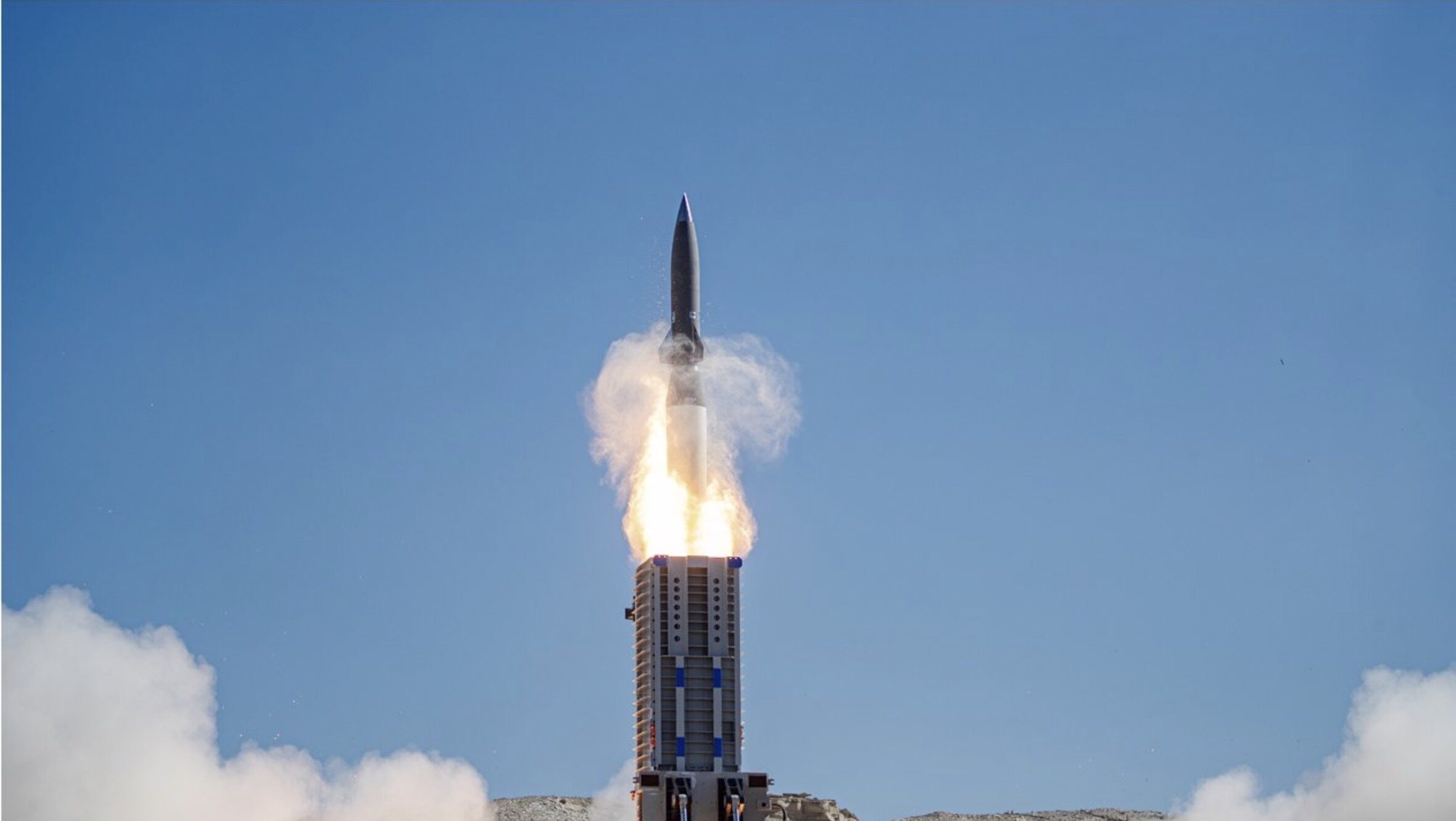
The HVGP is a boost-glide weapon. In the configuration described in the source text, a solid-fuel rocket booster launches the warhead payload to high altitude. After separation, the payload glides toward its target, using altitude to maintain high speed until impact.
Japan is pursuing the HVGP for both anti-ship and land-attack roles. The source text says the system is intended to carry an armor-piercing warhead. That mission set aligns with Japan’s wider effort to build more credible long-range strike options in response to a deteriorating regional security environment.
Japan is also developing a second hypersonic weapon, currently referred to as a Hypersonic Cruise Missile, which would be powered by a scramjet engine and resemble a more conventional missile while traveling at very high speeds over long ranges.
Why Testing Support Matters So Much
Hypersonic weapons are exceptionally demanding to develop. They operate at extreme speed, face intense thermal stress, and require precise guidance through difficult aerodynamic conditions. That makes test infrastructure a strategic asset.
US support therefore gives Japan more than funding assistance. It provides access to institutional experience, range systems, safety review processes, and technical pathways that are difficult to replicate quickly. The source text notes that Japan’s Acquisition, Technology and Logistics Agency previously conducted a pre-launch HVGP test in California in March and April 2024 to validate measurement units for a later full test.
That history shows the bilateral cooperation is already active and technically embedded. The newly approved package extends that pattern rather than creating it from scratch.
The Regional Security Context
Japan’s move into hypersonic systems reflects a broader shift in its defense posture. For decades, Tokyo maintained tighter limits on its long-range offensive capabilities. That position has changed as regional military balances grow more strained and the survivability of fixed defenses becomes less certain.
Longer-range conventional strike weapons give Japan more options for deterrence, especially in maritime and island-contingency scenarios. The anti-ship role is particularly notable because it aligns with concerns about controlling sea approaches and complicating adversary naval operations.
From Washington’s perspective, supporting Japan’s missile-development ecosystem strengthens an allied capability without requiring the US to supply the entire end system directly. It also helps deepen interoperability and strategic alignment at a time when the alliance is placing more emphasis on advanced weapons and distributed defense planning.
A Signal Beyond the Hardware
This approval sends a political message as well as a technical one. It shows the United States is prepared to help Japan build sophisticated indigenous strike systems, not just buy off-the-shelf equipment. That distinction matters because it supports Japan’s own defense-industrial base while also tying it more closely to US testing and support networks.
The deal does not mean Japan’s hypersonic program is complete or risk-free. Advanced missile projects routinely face delays, cost growth, and technical setbacks. But the support package confirms that the program is progressing with serious budget backing and allied assistance.
In the current Indo-Pacific security environment, that combination is worth watching closely.
Why It Matters
- The United States has approved a proposed $340 million package to support testing for Japan’s HVGP hypersonic missile program.
- Japan plans initial deployment of the Block 1 HVGP this year, with longer-range variants envisioned for the next decade.
- The package highlights how allied cooperation on advanced weapons now extends beyond procurement into development and test infrastructure.
This article is based on reporting by Breaking Defense. Read the original article.
Originally published on breakingdefense.com