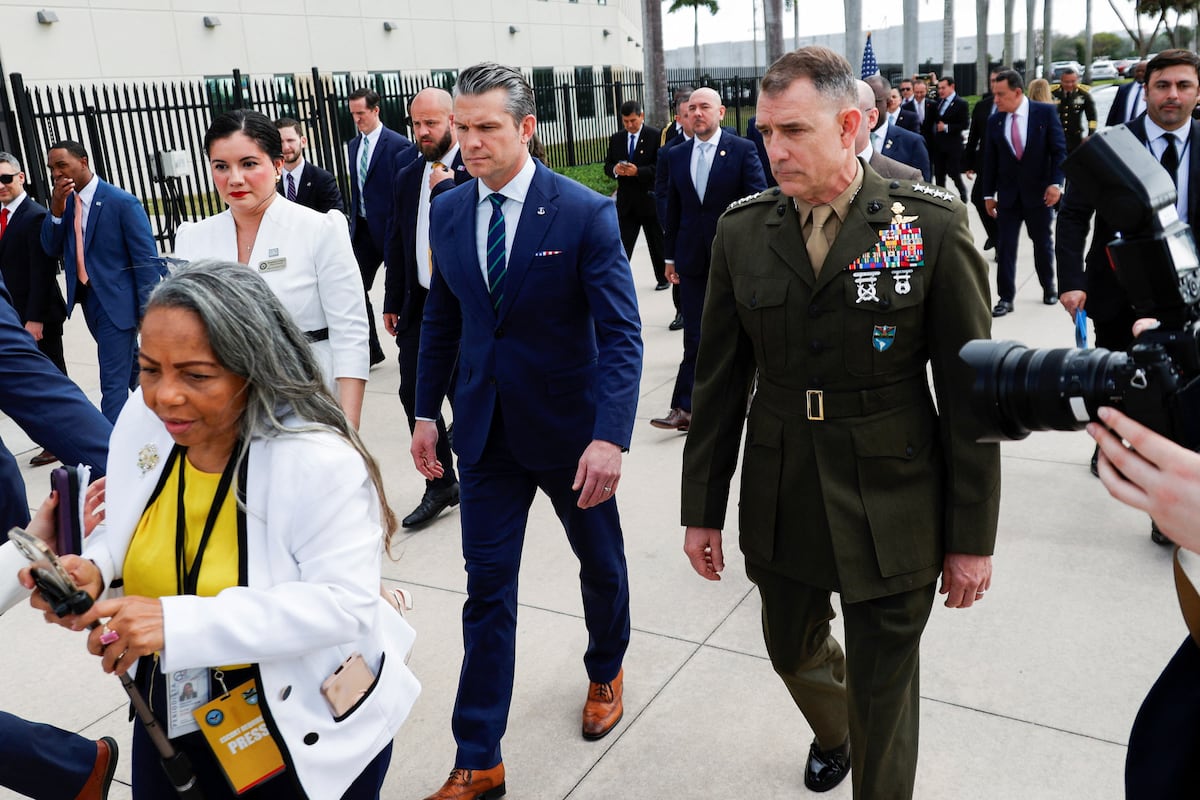
A rare military-to-military contact comes at a tense political moment
The top US general responsible for forces in Latin America held a rare meeting with senior Cuban military officials near the perimeter of US Naval Station Guantanamo Bay on Friday, according to the US military and Cuban statements cited in the supplied report. The discussion was narrow in scope, but the symbolism was broader: direct military contact between Washington and Havana remains unusual, especially at a time of heightened suspicion on the island and renewed pressure from the United States.
US Southern Command said Marine Corps Gen. Francis Donovan briefly discussed operational security matters with a Cuban delegation that included Gen. Roberto Legra Sotolongo, first deputy minister of the chief of the General Staff. Donovan also conducted a perimeter security assessment of the base and discussed force protection, safety of service members and their families, and operational readiness with base officials.
What both sides said
The US account emphasized security and readiness at the base. The Cuban armed forces, in a Facebook statement cited in the report, said the meeting took place by mutual agreement, focused on security around the dividing perimeter of the military enclave, and ended with both sides agreeing to maintain communication between the two commands.
That overlap matters. Even when broader relations are strained, perimeter security at Guantanamo Bay is one of the few areas where both governments have an incentive to keep channels functional. Tactical communication can reduce the risk of misunderstanding even if strategic relations remain hostile.
Why the timing matters
The supplied report describes the meeting as the first in recent memory by a head of Southern Command. It also says the contact comes amid growing concerns in Cuba about a possible US military attack. In that context, even a limited security meeting carries signaling value.
The encounter follows another rare contact: a visit earlier in May by CIA Director John Ratcliffe to Havana, according to the report. It also comes as President Donald Trump is described as intensifying pressure on Cuba and hinting that the island could become a greater focus of US policy after the war with Iran.
A narrow agenda inside a wider confrontation
None of this means US-Cuba relations are warming. The broader picture in the supplied report points the other way. Washington is described as steadily ramping up pressure on Havana, backed in part by hardline Cuban American politics in Florida. The article also references the formal US murder charges against former Cuban president Raul Castro over the 1996 downing of civilian aircraft, another sign of a sharply confrontational posture.
That is what makes the Guantanamo meeting notable. It sits at the intersection of hostility and necessity. Two adversarial states can still find reasons to talk when an armed perimeter, a contested history, and active forces exist side by side.
What the meeting likely does and does not change
It likely helps both militaries preserve a practical channel on local security issues. It may also help each side gauge the other’s posture around Guantanamo at a moment when rhetoric and anxiety are elevated. But there is no evidence in the supplied material that the meeting signals a broader diplomatic reset.
Instead, the most defensible reading is that it was a controlled, functional exchange in a relationship otherwise defined by mistrust. Those contacts can matter precisely because they are limited. In military affairs, modest communication is often valuable not because it resolves disputes, but because it lowers the odds that disputes spiral through misreading or accident.
For now, the significance lies less in any announced breakthrough than in the fact that the meeting happened at all. Near Guantanamo Bay, where history, symbolism, and force posture are tightly intertwined, even a brief discussion about perimeter security can resonate beyond its stated agenda.
This article is based on reporting by Defense News. Read the original article.
Originally published on defensenews.com