Directed Energy Moves From Demonstration to Operational Use at the Border
A Pentagon task force operating on the southern US border says it used a directed-energy weapon to bring down three hostile drones, marking a notable operational moment for the military’s long-running effort to turn high-energy laser systems into practical counter-drone tools.
According to the reported account, Joint Task Force - Southern Border said its personnel used an Army Multipurpose High Energy Laser system, or AMP-HEL, to engage and defeat three unmanned aircraft systems that posed what the task force described as a physical threat to US military personnel and US Customs and Border Protection members. The release did not specify the exact location of the engagements or identify who was believed to be operating the drones.
Even with those gaps, the event stands out because it places a directed-energy system in an active border security mission rather than in a test range demonstration or an abstract capability discussion. For years, laser weapons have been presented as a promising answer to the growing drone problem: low cost per shot in principle, rapid engagement, and no need to expend conventional interceptors against relatively cheap aircraft. The question has always been whether those advantages would translate into reliable real-world use.
The System Tied to the Army’s AMP-HEL Program
Breaking Defense reported that AeroVironment confirmed the task force used one of the company’s non-kinetic counter-drone systems associated with the Army’s AMP-HEL program. The company did not identify the exact system variant in use, but the article linked the timing to a counter-UAS system delivered to the Army in December. It also pointed to an AeroVironment release from that period saying the company had delivered its prototype 20-kilowatt-class LOCUST system.
The source text stops short of definitively stating that LOCUST was the exact platform used in the drone engagements. That distinction matters. Defense reporting around prototypes and fielded systems often blurs the line between a program family and a specific configuration. Still, the information provided indicates that the operational use sits within the broader Army effort to field mobile high-energy laser systems for short-range drone defense.
The task force also did not disclose whether the laser was vehicle-mounted. That detail would have helped clarify how deployable the system now is in austere border settings, where mobility, power supply, and environmental durability are central to whether a directed-energy platform can function as more than a demonstration asset.
Why the Border Has Become a Counter-Drone Test Bed
The incident also reinforces another trend: the southern border is increasingly being used as an operational proving ground for emerging counter-UAS technologies. The source says the Pentagon has expanded its role in defending against drone threats there and has treated the region as a kind of sandbox for testing new capabilities in collaboration with the Army-led Joint Interagency Task Force 401.
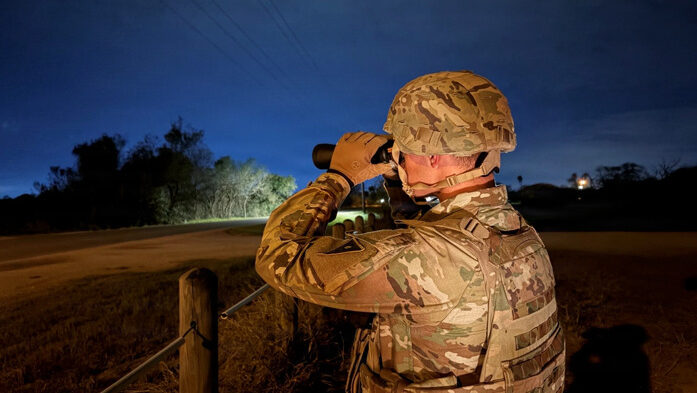
That choice is not accidental. Small drones have become an adaptable tool for surveillance, smuggling support, and intelligence gathering. In the account quoted by the source, task force commander Maj. Gen. Curtis Taylor said cartel networks are increasingly using unmanned aircraft systems to facilitate illicit human smuggling and to surveil military personnel and law enforcement partners.
If that assessment is correct, the border presents a setting where the drone threat is persistent, varied, and close to real-world operating conditions, but not identical to a conventional battlefield. That makes it attractive for experimentation. Military planners can expose systems to genuine operational pressure while refining how they coordinate with civilian agencies, law enforcement, and border authorities.
The source notes that this expanded military role has not been free of controversy, citing previous failures to coordinate with civilian agencies. That tension is a recurring feature of domestic security missions involving military technology. The drones may be small, but the policy questions are not: who has authority, what rules govern engagement, and how military capabilities are integrated into domestic or near-domestic security operations.
What the Shootdown Suggests About the Counter-UAS Market
The practical significance of the reported engagement extends beyond the border itself. Counter-drone defense has become one of the most urgent segments in military technology because inexpensive unmanned aircraft have repeatedly exposed the weakness of conventional air defense economics. Shooting down a low-cost drone with an expensive missile is rarely sustainable. Directed-energy systems promise a different cost curve, at least if they can achieve dependable targeting and sufficient power under field conditions.
The reported use of an AMP-HEL-associated system suggests the Pentagon is willing to employ such capabilities in live missions, not just showcase them for future procurement. That matters for industry because real operational use can shape acquisition decisions more powerfully than controlled trials. Vendors that can show their systems not only worked in testing but were used successfully under mission conditions gain a stronger position in the competition for future contracts.
It also matters for doctrine. A laser weapon does not replace every other counter-UAS option. Weather, line of sight, dwell time, and power constraints can all limit effectiveness. But a successful engagement can justify a layered approach in which directed energy is used alongside sensors, electronic warfare, and kinetic measures. The source quotes Taylor describing exactly that concept: layered countermeasures combined with advanced directed-energy capabilities.
In that sense, the shootdown is not just about three drones. It is about the military’s effort to normalize a new class of defensive tool. Laser weapons have long carried a futuristic reputation. What gives this report significance is its mundanity: a border task force confronting small hostile aircraft with a system designed to disable them without firing a traditional round.
Whether this becomes a turning point will depend on what follows. The source leaves major questions unanswered, including the conditions of the engagements, how repeatable the result is, and what system configuration was actually deployed. But one conclusion is already harder to avoid. Directed-energy counter-drone systems are no longer confined to concept slides and limited demonstrations. They are being pulled into operational security missions where performance matters immediately.
This article is based on reporting by Breaking Defense. Read the original article.
Originally published on breakingdefense.com