A Military Transformation Born of Necessity
Three years into the full-scale war with Russia, Ukraine confronts a stark reality: it is running out of infantry. The grinding attritional warfare along a 600-mile front has consumed manpower at rates not seen in European conflict since World War II, and mobilization remains politically fraught despite recent legislative changes. In response, Ukraine's military is undergoing what commanders describe as a fundamental transformation — one where drones and autonomous systems increasingly replace human soldiers on the battlefield.
"We don't have infantry," a senior Ukrainian military official told C4ISRNET, summarizing the blunt calculus driving the shift. "What we have are machines, and we're learning to fight with them."
From Improvisation to Doctrine
Ukraine's use of drones began as scrappy improvisation in the early months of the 2022 invasion. Volunteers modified commercial quadcopters to drop grenades, while small teams used consumer drones for reconnaissance. But over three years, this ad hoc approach has evolved into something far more systematic and sophisticated.
Today, Ukraine operates tens of thousands of drones across its front lines, ranging from small first-person-view (FPV) kamikaze drones costing a few hundred dollars each to larger reconnaissance and strike platforms. The country has built a domestic drone manufacturing industry essentially from scratch, with dozens of companies now producing military drones at scale.
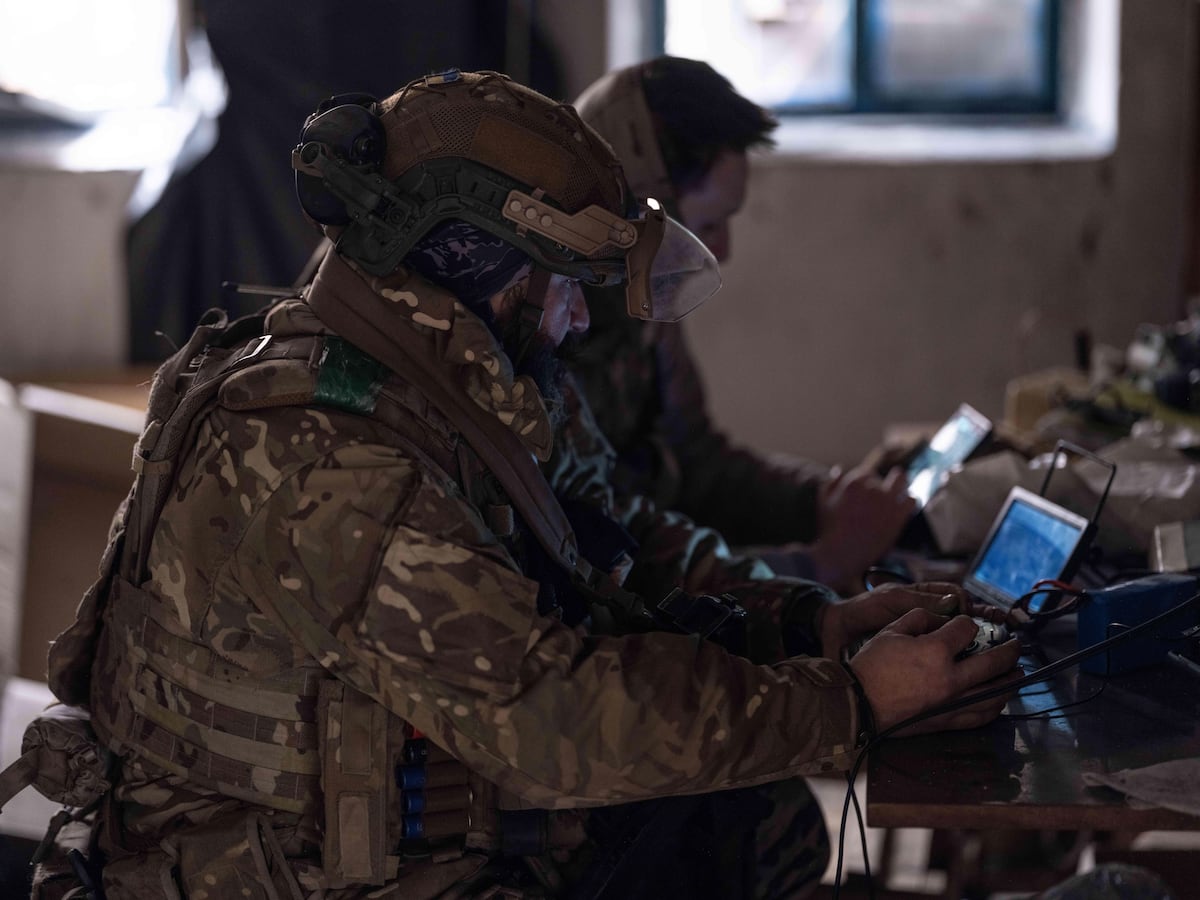
More significantly, Ukrainian military doctrine is being rewritten to place drones at the center of tactical operations rather than treating them as supplements to traditional infantry maneuvers. Entire units are being reorganized around drone capabilities, with human soldiers increasingly serving as operators and maintainers rather than front-line combatants.
The Scale of Drone Warfare
The numbers involved are staggering. Ukraine is estimated to be deploying between 3,000 and 5,000 drones per day along the front lines, with the majority being low-cost FPV drones used for direct strikes against Russian positions, vehicles, and personnel. Monthly drone production has reportedly reached six figures, with the government aiming to produce over a million units in 2026.
Russia has responded with its own massive drone programs, including the widespread use of Iranian-designed Shahed loitering munitions against Ukrainian infrastructure and the deployment of FPV drones in tactical roles. The result is a battlefield where the skies are contested as intensely as the ground, and where electronic warfare — jamming and spoofing drone communications — has become a critical capability for both sides.
- Ukraine deploys an estimated 3,000 to 5,000 drones daily along front lines
- Monthly domestic drone production has reached six figures
- FPV kamikaze drones cost as little as a few hundred dollars each
- Electronic warfare and drone countermeasures have become critical battlefield capabilities
Autonomy as the Next Frontier
The most consequential development in Ukraine's drone evolution may be the move toward greater autonomy. Current FPV drones require a human pilot to guide them to their targets via a video link, which makes them vulnerable to electronic warfare jamming. If the signal is disrupted, the drone typically crashes or goes off course.
Ukrainian developers are now integrating onboard AI systems that allow drones to navigate to targets autonomously, using computer vision to identify and track objects without requiring a continuous data link to a human operator. Several Ukrainian companies have demonstrated drones capable of terminal guidance — locking onto a target and completing an attack even after communication is severed.
This capability represents a significant technological leap and raises profound ethical and legal questions about the role of autonomous weapons in warfare. International humanitarian law requires that human beings make decisions about the use of lethal force, but the definition of meaningful human control over increasingly autonomous weapons remains hotly debated.
Implications for Future Warfare
Military analysts around the world are studying Ukraine's drone transformation with intense interest. The conflict is widely seen as a proving ground for concepts that will reshape armed forces globally, from small-unit tactics to industrial mobilization strategies.
Several NATO countries have already begun incorporating lessons from Ukraine into their own military planning. The United States Army has accelerated programs to develop counter-drone capabilities and to integrate small drones into infantry platoons. The British Army has established a dedicated drone unit modeled partly on Ukrainian innovations.
Perhaps most significantly, Ukraine's experience demonstrates that a country with a fraction of its adversary's resources can offset that disadvantage through rapid technological adoption and doctrinal innovation. The drones Ukraine fields today cost orders of magnitude less than the armored vehicles and fortified positions they destroy, fundamentally altering the economics of attritional warfare.
The Human Dimension
For all the focus on technology, Ukrainian commanders emphasize that the shift to machine warfare is ultimately about saving lives. Every position held by a drone operator working from a basement several kilometers behind the front line is a position that doesn't require a soldier in a trench exposed to artillery and sniper fire.
Yet the transition is not without costs. Drone operators report significant psychological strain from the intimate, screen-mediated experience of combat, where they watch their strikes connect in high-definition video. The military is only beginning to grapple with the mental health implications of this new form of warfare.
What is clear is that the conflict in Ukraine has accelerated a military transformation that experts had expected to unfold over decades. The war machine has evolved into a machine war, and there is no going back.
This article is based on reporting by C4ISRNET. Read the original article.
Originally published on c4isrnet.com