Drone-on-drone warfare has reached another threshold
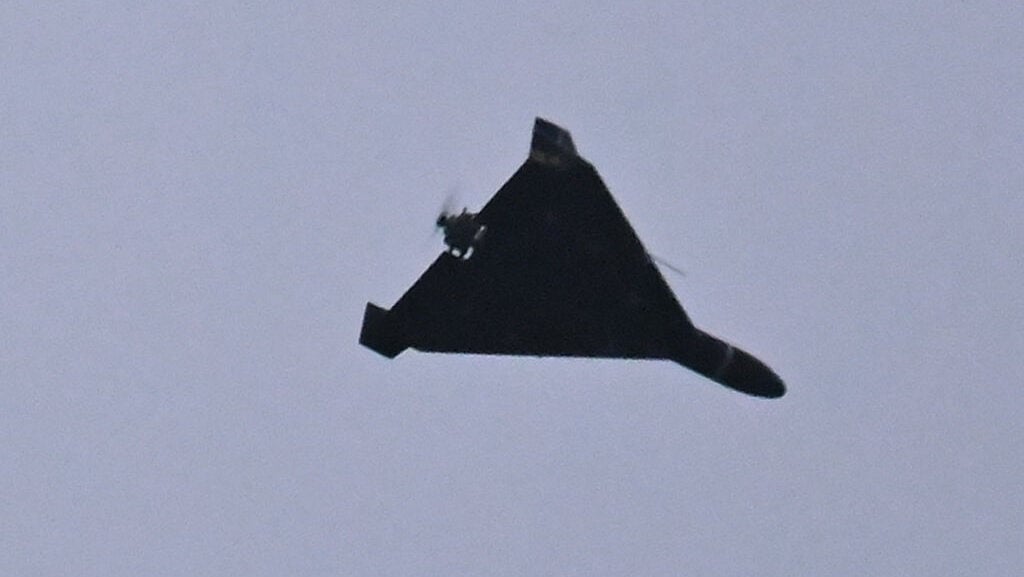
Ukraine says it has destroyed a Russian Shahed unmanned aerial vehicle using an interceptor drone launched from an unmanned surface vessel, a combination that would mark the first publicly reported downing of its kind. If sustained in practice, the tactic could add a new defensive layer against one of Russia’s most persistent long-range strike tools.
The reported intercept was publicized by Ukraine’s Defense Ministry, which released footage and said the engagement was carried out during combat missions at sea by the unmanned surface vessel division of the 412th Brigade Nemesis, part of Ukraine’s Unmanned Systems Forces.
Why the claim matters
Shahed-type drones have become a defining threat in the war, used in repeated long-range attacks that pressure air defenses, infrastructure, and cities. The significance of launching an interceptor from a surface drone is not only the kill itself. It is the emergence of a sea-air integration model that could extend defensive reach into zones where conventional air-defense coverage is thinner or more constrained.
Instead of relying solely on shore-based systems or crewed aircraft, Ukraine appears to be experimenting with a layered, mobile, and unmanned architecture. A surface vessel operating at sea can carry sensors, munitions, or launch platforms into positions that create new engagement opportunities against inbound drones.
What analysts see in the development
Sam Bendett, an analyst of unmanned systems and Russian military technology cited in the report, said the capability adds another protective layer for Ukraine against incoming Russian long-range drones. His assessment is important because the tactical value of the event depends less on novelty than on whether it integrates effectively with the wider defensive network.
That integration is the real story. Modern drone warfare is no longer about individual platforms acting alone. The advantage increasingly goes to forces that can combine sensors, launch nodes, and interceptors across domains. In this case, sea-based unmanned systems are being used to support air defense against airborne threats.
Why a USV launch changes the geometry
Unmanned surface vessels have already proven useful for reconnaissance, strike operations, and harassment in the Black Sea. Adding airborne interceptors expands their role from sea denial and maritime attack into distributed air defense support.
That shift changes the geometry of defense. A drone launched from a vessel can potentially engage a threat from directions and positions that fixed land systems cannot easily replicate. Even if the interceptor is relatively low-cost, the ability to place it forward matters. It can force the attacking side to deal with more uncertainty and more possible points of failure.
For Russia’s Shahed operations, that could be particularly inconvenient. These drones are effective in part because they are cheap, numerous, and difficult to stop perfectly with expensive traditional air-defense missiles. A more distributed network of smaller interceptors launched from diverse platforms is one obvious way to challenge that cost equation.
What is still unknown
One successful intercept does not establish a mature operational system. The supplied report does not provide details about how often the tactic can be repeated, what the engagement envelope looks like, how targeting data is shared, or how the vessel and interceptor perform under electronic warfare pressure.
Those unknowns matter. Wartime demonstrations can show possibility before they show scalability. The more useful question is whether Ukraine can field this approach consistently enough to reduce the burden on other air-defense assets or complicate Russian planning at meaningful scale.
There is also an asymmetry angle. Bendett noted that, based on available open-source information, Russia has not achieved a similar capability. If true, that would preserve Ukraine’s pattern of using iterative unmanned innovation to offset conventional disadvantages.
The broader military trend
This episode fits a wider shift in warfare, where low-cost autonomous or semi-autonomous systems are being linked across domains faster than traditional procurement cycles can easily absorb. Sea, land, and air are increasingly connected by networks of expendable or reusable robotic systems rather than by a few exquisite platforms alone.
What stands out in Ukraine is the speed of battlefield adaptation. Techniques that might once have taken years to formalize are appearing first in combat, then being evaluated in public only after footage emerges. That compresses the gap between experimentation and operational use.
It also creates pressure on larger militaries watching the conflict. The lesson is not simply to buy more drones. It is to think in terms of interoperable layers, where a surface craft can become an air-defense node and a cheap interceptor can alter the economics of enemy strike campaigns.
A small event with large implications
The intercept, as reported, is tactically specific but strategically suggestive. It shows Ukraine continuing to push unmanned systems beyond their original role boundaries, and it highlights how quickly new defensive concepts can emerge under combat pressure.
If this sea-launched interceptor approach proves repeatable, it could make Shahed-style attacks less predictable and less efficient. That would not eliminate the drone threat. But it would add friction, force adaptation, and reinforce a lesson already visible across the war: the side that links unmanned systems across domains fastest can create outsized effects with relatively modest hardware.
In that sense, the first reported kill of this kind is less a one-off stunt than a signpost. The future battlefield is not only drone-saturated. It is increasingly cross-domain by default.
This article is based on reporting by Breaking Defense. Read the original article.
Originally published on breakingdefense.com