A Critical Surveillance Capability Confirmed
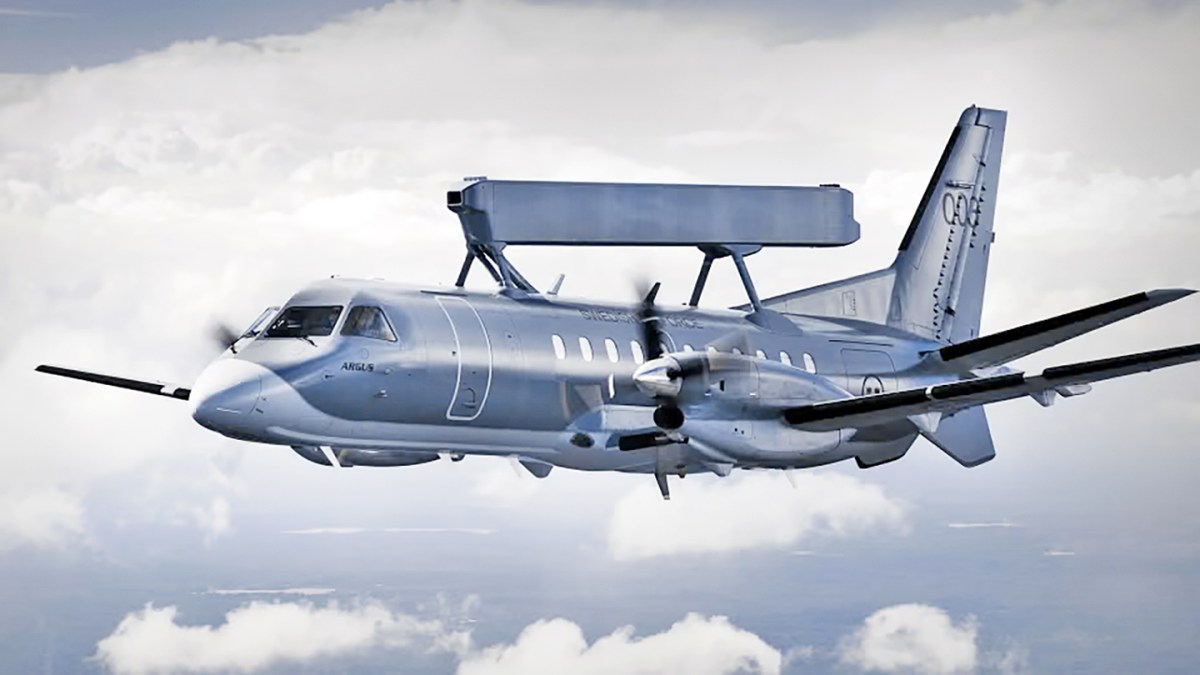
Ukraine has begun operating its Saab 340 Erieye airborne early warning and control aircraft over its own territory, confirmed by imagery and tracking data that emerged this week. The operational debut represents a significant upgrade to Ukraine's air defense and situational awareness capabilities in a conflict where aerial intelligence has repeatedly proven decisive.
What the Saab 340 Erieye Provides
The Saab 340 Erieye is a turboprop airliner converted into an airborne early warning platform by mounting Saab's electronically scanned array radar above the fuselage. The radar operates in the S-band and can detect aerial targets at ranges of several hundred kilometers, significantly extending Ukraine's radar horizon beyond what ground-based systems can achieve.
The physics of radar are clear: ground-based systems are limited by the curvature of the Earth, which creates blind spots at low altitudes that aircraft can exploit by flying very low. An airborne radar lifted to cruising altitude sees over the horizon, detecting low-flying aircraft, cruise missiles, and helicopters that ground radar would miss entirely. For Ukraine, which faces persistent threats from Russian cruise missiles flying low to evade radar, this capability is particularly valuable.
Integration with Air Defense Networks
The Erieye system's value multiplies when integrated with ground-based air defense systems. By providing early warning of incoming threats well before they reach ground radar coverage, the aircraft extends the engagement timeline available to Patriot, NASAMS, and other long-range air defense batteries. More warning time means more intercept opportunities and more efficient allocation of expensive interceptor missiles—a critical consideration as Ukraine manages finite air defense stocks.
The aircraft is also equipped with datalinks that share its air picture in real time with other assets—aircraft, ground control centers, and allied systems. This networked awareness is a cornerstone of modern air defense, allowing distributed systems to act coherently against threats that might be detected by only some of them at any given moment.
Why This Matters Now
Russia's aerial campaign against Ukraine has evolved over the course of the conflict, shifting toward a mixed strategy that includes large numbers of cheaper munitions—Shahed drones and cruise missiles flown in complex corridors designed to confuse and saturate Ukrainian air defenses. Defeating this approach requires exactly the kind of persistent wide-area surveillance that an airborne early warning platform provides.
The Erieye's operational debut also comes as Ukraine faces pressure to preserve its finite stock of air defense interceptors by improving targeting efficiency—shooting down high-value threats rather than expending expensive missiles against lower-priority targets. Better situational awareness directly enables this discriminate defense.
Survivability Considerations
Flying a slow turboprop aircraft over a war zone is not without risk. Russian fighters and surface-to-air missiles have demonstrated reach against aerial targets, and the Saab 340 is not a stealthy platform. Ukrainian operations with the Erieye likely involve careful mission planning to keep it in standoff positions where its radar range advantage allows it to surveil forward areas without itself entering the most dangerous airspace.
With an effective radar range potentially exceeding 300 kilometers, the aircraft can gather actionable intelligence on Russian air activity over much of the front while remaining in Ukrainian airspace that Russian aircraft cannot reach without crossing heavily defended territory. This standoff surveillance model mirrors how the US and NATO have used similar platforms in conflicts where aircraft survival required operating at distance from contested zones.
A Step Toward Closing the Awareness Gap
Ukraine has sought airborne early warning capability since the conflict began, recognizing that ground-based radar networks have inherent limitations against low-flying threats. The Saab 340 Erieye does not fully solve the problem—a larger platform like the E-3 Sentry or E-7 Wedgetail would provide broader coverage—but it represents a meaningful practical step toward closing the situational awareness gap that Russian forces have periodically exploited. Its operational debut is another example of Western-supplied capabilities incrementally strengthening Ukraine's defensive posture.
This article is based on reporting by twz.com. Read the original article.
Originally published on twz.com