A Demonstration Flight Turns Catastrophic
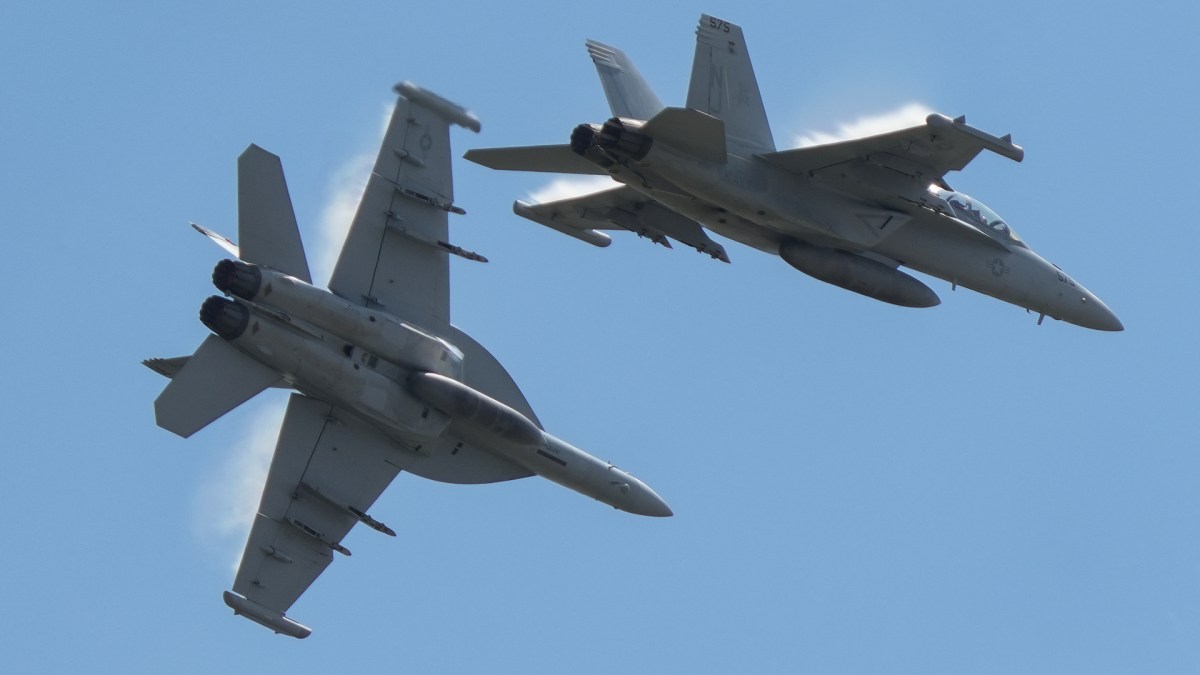
Two U.S. Navy E/A-18G Growlers collided during the Gunfighter Skies Air Show in Mountain Home, Idaho, in an accident captured from multiple angles by spectators. The aircraft were part of the VAQ-129 Growler Airshow Team based at NAS Whidbey Island. All four crew members ejected and were reported to be under medical evaluation after the crash.
According to the supplied source material, the collision occurred about two miles northwest of Mountain Home Air Force Base. Video described in the reporting shows one aircraft closing from behind and above before striking the rear of the lead jet. The two aircraft then became entangled, pitched upward and downward, and tumbled toward the ground before the crew ejections became visible.
Survival in Seconds
The most striking fact in the immediate aftermath is that all four aviators got out. In a low-altitude, fast-developing midair collision involving two heavy tactical jets, escape windows are measured in seconds. The source text describes four distinct ejection-seat blasts visible before parachutes opened over the crash site.
That does not make the outcome minor. Two aircraft were destroyed, the performance team lost a pair of specialized electronic attack jets, and a public demonstration ended in a fireball. But the successful survival of all four crewmembers prevented the accident from becoming a far larger tragedy.
The base also reported that the resulting fire was contained. In incidents like this, the ground consequences matter almost as much as the aircrew outcome, especially at a public event where spectators and support personnel may be nearby.
The Risks of Precision Demonstrations
The Growler Airshow Team flies a two-jet display, and that format places a premium on disciplined spacing, relative positioning, and closure control. Even when demonstration profiles are carefully rehearsed, any close-formation or tactical-style routine carries limited tolerance for error. When aircraft are operating with small margins, a minor misjudgment in speed, line, or separation can escalate immediately.
The source reporting describes the trailing aircraft colliding with the lead aircraft from above and behind. That characterization alone is enough to indicate that the accident sequence likely developed at close range and with little time for recovery once the geometry went wrong.
What remains unknown from the provided information is why the spacing broke down. That question will matter far beyond this single performance. Accident investigators will likely focus on formation procedures, display profile design, visual references, aircraft positioning, and any environmental or communication factors that may have contributed.
Why This Loss Matters for Naval Aviation
The E/A-18G Growler is not an expendable demonstration aircraft. It is the U.S. Navy’s frontline carrier-based electronic attack platform, built to jam, suppress, and disrupt adversary radar and air defenses. Each aircraft therefore represents both training and operational value, even when assigned to public outreach duties.
VAQ-129 serves as the Fleet Replacement Squadron for the Growler community, meaning it plays a central role in training. A mishap involving aircraft from that organization resonates beyond the air show circuit because it touches a unit directly connected to readiness and qualification.
The accident also lands at a time when military aviation is under constant pressure to balance recruitment, public engagement, flight-hour demands, and safety. Demonstration teams are useful tools for visibility and outreach, but they also expose operational aircraft and trained crews to noncombat risk. That tradeoff is not new, but high-profile accidents force it back into view.
Public Evidence Will Shape the Inquiry
One feature of modern air accidents is the abundance of real-time documentation. The supplied article references several dramatic videos and still images posted online shortly after the crash. That material will not replace formal accident investigation, but it will shape both public understanding and the early factual timeline.
Video can establish relative positions, collision angles, altitude cues, and sequence timing in ways that witness recollections alone often cannot. At the same time, it can also create premature certainty. Investigators will still need cockpit, maintenance, mission-planning, and performance data before drawing conclusions about cause.
Questions That Follow Every Demonstration Mishap
Accidents at air shows prompt a familiar set of questions. Was the maneuver set too aggressive for the safety margin available? Were the crews operating within a well-understood routine, or did small deviations accumulate? Did any aircraft handling issue or visibility problem narrow the crews’ options at a critical moment?
The supplied source material does not answer those questions, and that gap is important. The immediate facts support only a limited but significant conclusion: two Growlers collided during a public demonstration, all four crew members ejected, and both aircraft were lost.
That alone is enough to trigger scrutiny of procedures, training, and demonstration risk management. Military air arms accept risk in combat and preparation for combat. Public demonstration flights sit in a different category, where the tolerance for preventable loss is understandably lower.
The Immediate Aftermath
In the near term, attention will center on the condition of the aircrew and on preserving evidence from the crash sequence. Beyond that, the Navy will have to determine whether any broader pauses or procedural reviews are necessary for demonstration activity involving the Growler community.
For spectators, the scene was a reminder that even highly practiced military aviation displays rest on thin margins of precision. For the Navy, it was the sudden loss of two advanced aircraft in front of a public audience. For the four aviators who escaped, it was a survival story measured in fractions of a second.
This article is based on reporting by twz.com. Read the original article.
Originally published on twz.com