A first flight for an unusual maritime drone concept
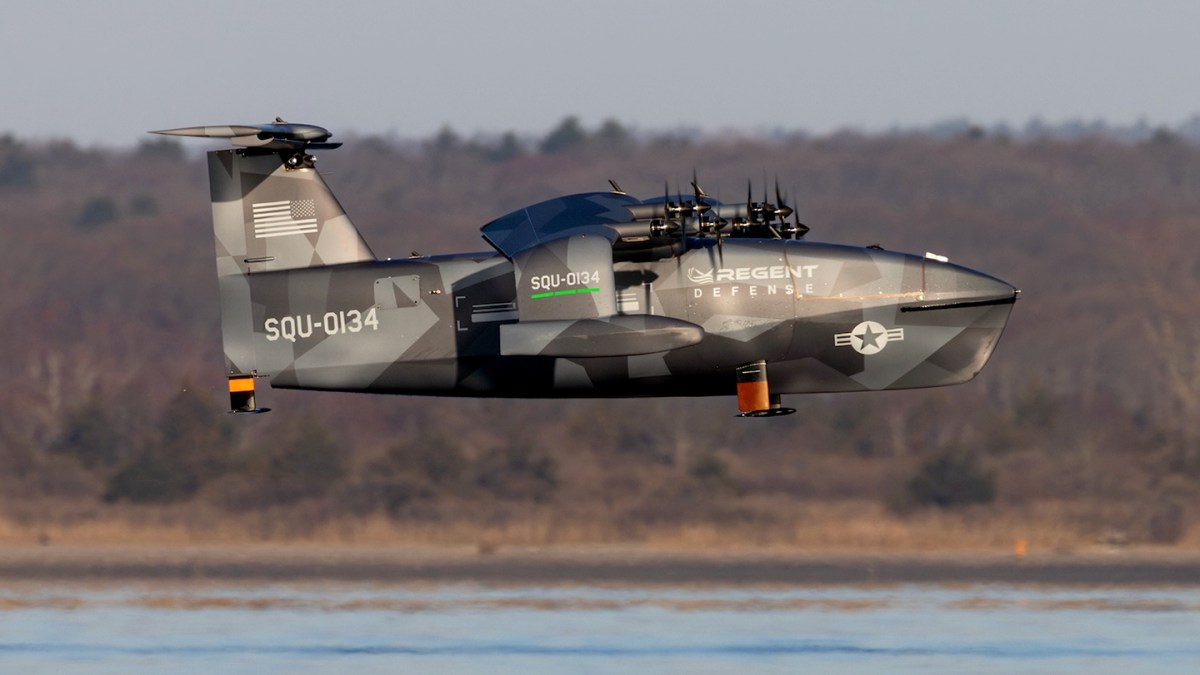
Regent’s Squire wing-in-ground effect drone demonstrator has completed its first test flight, giving public shape to a concept aimed at over-water operations in contested environments. The company describes Squire as an unmanned surface and aerial vehicle designed for intelligence, surveillance and reconnaissance, logistics, and combat search and rescue, with additional interest around counter-narcotics and anti-submarine warfare roles.
The U.S. Marines told The War Zone they are watching the aircraft’s progress, a notable sign of military attention for a platform that sits in the gray zone between boat and aircraft. That is also the core appeal of the design: Squire is meant to move over water quickly and efficiently without needing a conventional runway.
The first flight was carried out by a sub-scale demonstrator in Narragansett Bay, Rhode Island. According to the company, the aircraft reached speeds of up to 40 knots during the test.
How the concept works
Squire uses wing-in-ground effect, a mode of flight that keeps the vehicle at roughly one wingspan above the water. Flying this low allows it to benefit from the dense cushion of air near the surface, increasing lift and reducing drag. In theory, that creates an efficient operating zone that can support higher speed than a boat while avoiding some of the infrastructure and exposure demands of traditional aircraft.
The demonstrator also uses hydrofoils. During the test sequence shown by the company, the vehicle moved through three phases: floating, hydrofoiling, and then becoming airborne. As it gained altitude, its two hydrofoils retracted.
That progression is central to the design. The craft is not simply skimming water the entire time like a conventional fast boat, nor is it relying on a runway like a standard aircraft. It transitions through waterborne and airborne states in a way meant to exploit the strengths of both.
Why the Marines care
The Marine Corps interest reflects a very specific operational problem. In a future conflict in the Pacific, U.S. forces could be spread across remote locations with limited infrastructure. Supplying those dispersed units is difficult even under peacetime conditions. In a contested environment, the challenge grows much sharper.
Traditional airlift and sealift assets would already be heavily tasked, and in some cases they could be vulnerable to attack. A platform that can move over water, avoid dependence on established runways, and carry out logistics or surveillance missions close to the sea surface would naturally attract attention.
That does not mean Squire is on the verge of service adoption. It means the problem it is trying to solve is real, and the Marine Corps sees enough relevance to monitor how the technology develops.
More than a logistics vehicle
Regent is pitching Squire for a broad mission set. The company says it could handle ISR, logistics, and combat search and rescue. The source text also says the aircraft is being eyed for counter-narcotics and anti-submarine warfare operations.
Those roles vary widely, but they share one common requirement: useful over-water mobility in places where access may be difficult or risky. A ground-effect craft has obvious theoretical advantages in that environment. It can stay low, move relatively fast, and operate without a traditional runway. For rescue or resupply in particular, that profile is easy to understand.
The military relevance becomes stronger in maritime theaters where many locations are separated by water but not by great ocean-crossing distances. There, speed and flexibility can matter more than the payload or altitude advantages offered by larger aircraft.
What the first test does and does not prove
The first flight is meaningful, but it is still an early milestone. This was a sub-scale demonstrator, not a full operational system. The test shows that Regent can execute the concept’s basic transition from water to hydrofoil-assisted motion to low-altitude flight. That is important because hybrid concepts often struggle most in those transitional phases.
At the same time, the test does not answer the larger operational questions. It does not establish full mission endurance, payload utility, survivability, autonomy maturity, or performance in bad weather and rough seas. Those are the kinds of factors that determine whether an unconventional platform remains a promising demonstration or becomes a deployable tool.
Still, proving that the basic architecture can fly is an essential first step. For a concept that combines maritime and aerial characteristics, demonstration credibility matters a great deal.
A platform aimed at contested water space
Squire is being pitched for contested areas, and that framing is not accidental. The aircraft’s logic depends on operating where infrastructure is sparse, risk is elevated, and commanders need more options than a simple choice between ships and aircraft. A low-flying, over-water drone that can launch without a runway fits neatly into that gap.
The concept also aligns with the broader defense trend toward uncrewed, distributed, and harder-to-target systems. Even if Squire remains niche, it represents the kind of experimentation now shaping future logistics and maritime operations.
For Regent, the first demonstrator flight is a technical validation. For the Marines and other observers, it is an early data point on whether wing-in-ground effect vehicles can evolve from an unusual engineering idea into a practical tool for real missions. The answer is still uncertain, but the concept is now further along than sketches and promises. It has flown.
This article is based on reporting by twz.com. Read the original article.
Originally published on twz.com