The Navy is putting real money and a timeline behind a highly unusual new warship program
The U.S. Navy says it expects to spend roughly $46 billion over the next five years to design and develop the Trump-class battleship, with construction on the first ship planned for fiscal 2028. The program, first announced by President Donald Trump in December 2025, now has its clearest budget outline and schedule yet.
According to the source report from Breaking Defense, the service is requesting about $1 billion in advance procurement funding for fiscal 2027, plus $837 million in research and development for the same year. Navy Secretary John Phelan said the service is already in talks with two vendors on the design as it pushes for a rapid production timeline and aims to lay the keel in 2028.
Even by naval standards, the proposal is extraordinary. Battleships have long been absent from modern U.S. fleet planning, displaced by carriers, submarines, destroyers, and other platforms optimized for current operational realities. The decision to revive the category under a new class name signals not just a procurement choice but a major doctrinal and industrial gamble.
What the Navy says the ship will do
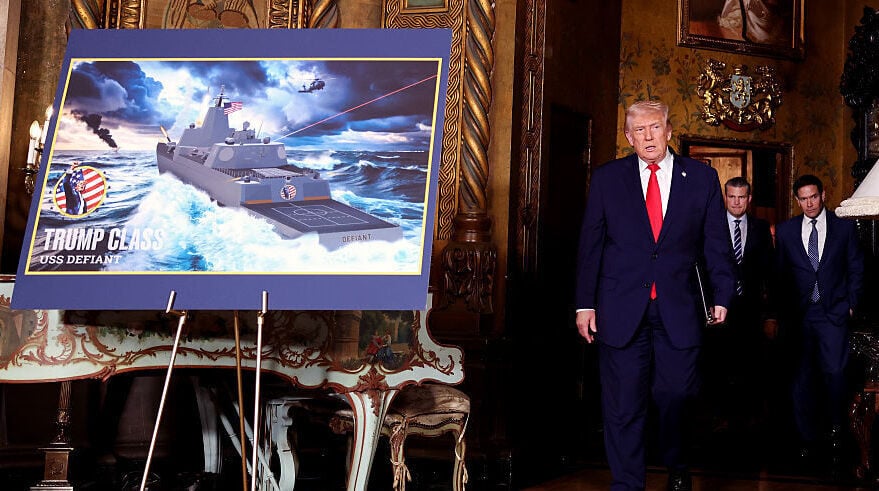
At the ship’s announcement in December, Trump said the class would feature hypersonic weapons, electronic rail guns, and high-powered laser-based weaponry. The source report also says Navy leaders view the larger battleship hull as a way to carry capabilities that proved difficult to fit into the service’s next-generation destroyer plans.
Rear Adm. Ben Reynolds, deputy secretary of the Navy for budget, told reporters that the battleship would be able to do many things existing guided-missile destroyers cannot. The argument, in essence, is that design constraints on the next-generation destroyer pushed the service toward a larger hull that can support more power, more payload, and more future growth.
That rationale aligns with a broader naval challenge. Advanced weapons such as directed energy systems and hypersonic capabilities place heavy demands on ship size, power generation, cooling, and integration. A larger platform can, in theory, absorb those burdens more easily than a smaller combatant.
How much it may cost
The five-year development figure of roughly $46 billion is only part of the story. The Navy is planning to request around $17 billion in procurement funding for the first ship in fiscal 2028 and about $13 billion in 2030 for the second. Those numbers make the Trump-class one of the most expensive naval initiatives now on the table.
Phelan cautioned that the cost estimates are preliminary and could shift as the Navy resolves key design questions, including whether the ship will be nuclear-powered. That uncertainty is important. Propulsion choice would affect cost, endurance, onboard power availability, maintenance, and the class’s overall operational profile.
Even without a final design, however, the budget profile indicates the Navy intends to move quickly and fund the program aggressively. The request for advance procurement before final construction suggests that the service wants industry preparations underway as soon as possible.
A response to destroyer design trouble
One of the clearest explanations in the source report is that difficulties with the next-generation destroyer helped drive the pivot to a battleship. In other words, the new class is not being presented solely as a symbolic or political project. Navy leaders are framing it as a response to concrete design limitations in another future surface combatant program.
If the service genuinely concluded that its destroyer path could not carry the desired mix of weapons and capability, that would help explain why it is pursuing a much larger platform despite the immense cost. A bigger hull can offer more flexibility for power-hungry systems and future upgrades, though it also raises survivability, operating cost, and fleet-composition questions.
The source report does not resolve those trade-offs, but it makes clear that Navy officials are trying to justify the class in capability terms, not just as a headline-grabbing throwback.
Why the industrial base matters
Phelan said the Navy is already talking with two vendors and that a key factor will be yard capacity. That detail may end up being as important as the budget. Building a ship of this scale on a compressed timeline depends on which yards can absorb the work, what other programs they are already carrying, and how quickly suppliers can support a new class.
Shipbuilding capacity has been a recurring bottleneck for the Navy. A program this ambitious would compete for skilled labor, steel, components, engineering attention, and yard throughput. It would also require long-term confidence that the class will survive political and budget cycles.
The service’s broader fiscal 2027 request, which the report says includes $65.8 billion for shipbuilding, suggests the Navy wants a larger industrial push across multiple lines at once. That may help support a battleship program, but it also increases execution risk.
The strategic question beneath the spectacle
The return of a battleship category invites obvious skepticism. Modern naval warfare prioritizes stealth, distributed lethality, submarines, missiles, and survivability against long-range precision threats. A large and expensive surface combatant can become an attractive target as well as a powerful weapons carrier.
Yet the Navy’s argument is not literally about refighting the past. It is about fielding a hull large enough to support new classes of weaponry and mission demand. Whether that logic ultimately supports a battleship label, as opposed to another form of large surface combatant, is a separate issue.
What matters now is that the service has moved beyond rhetoric. It has put dollars, procurement plans, and vendor engagement behind the class.
A program that will define debate even before steel is cut
The Trump-class battleship remains full of unresolved questions, including propulsion, final cost, yard selection, and the broader doctrine that would justify such a ship in a modern fleet. But the fiscal 2027 documents make one thing plain: this is no longer just a presidential announcement. It is becoming a program with real budget gravity.
That guarantees intense scrutiny from Congress, naval strategists, industry, and budget hawks. Supporters will argue the Navy needs a larger platform for hypersonics, rail guns, lasers, and future capacity. Critics will question cost, survivability, and whether the concept reflects sound force design.
Those arguments are only beginning. But with construction of the first hull targeted for 2028, the Navy has set a fast clock for proving that a revived battleship concept belongs in the next era of American sea power.
This article is based on reporting by Breaking Defense. Read the original article.
Originally published on breakingdefense.com