The Navy wants to break its cycle of prototyping without scale
The U.S. Navy has unveiled yet another new approach to acquiring uncrewed surface vessels, this time through what it calls a “marketplace” model for future fleets of drone ships. The strategy is being applied first to medium uncrewed surface vessels, or MUSVs, and it represents a clear shift away from the Navy’s most recent plan, the Modular Surface Attack Craft concept outlined only last year.
The new direction is notable partly because of what it says about the Navy’s priorities, and partly because of what it says about the institution’s frustrations. After years of experimentation with uncrewed vessels, the service is signaling that it wants to spend less time on lengthy prototyping and more time fielding designs that already appear mature enough to move toward operational use.
That makes this more than another branding exercise. It is an attempt to change the handoff between technology demonstration and fleet adoption, an area where the Navy’s drone-ship ambitions have repeatedly struggled.
A marketplace instead of a traditional development path
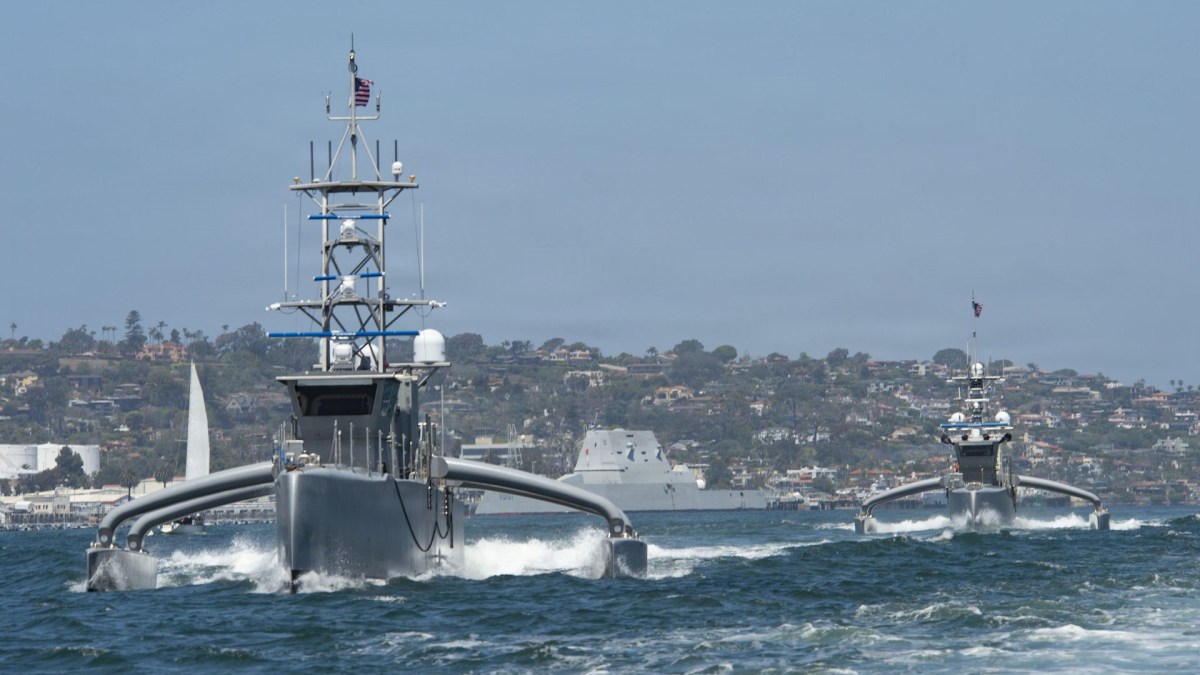
Under the model described by the Navy, future uncrewed surface vessels could be owned and operated either by the service itself or by contractors. The first application is a competition around medium-sized drone ships that can be configured for multiple missions with containerized payloads.
Secretary of the Navy John Phelan framed the approach as a faster acquisition path that draws more directly on private-sector capability. In remarks highlighted in the report, he said the department is adapting its acquisition system to deliver capability faster and is launching a market competition for a MUSV family of systems. He also said the approach is intended to leverage private investment and accelerate real capability into the fleet.
The language is telling. Rather than presenting uncrewed vessels primarily as developmental programs, the Navy is describing them as products that can be evaluated in a recurring competitive environment. That suggests a stronger preference for demonstrated utility over prolonged government-led concept refinement.
The central idea is performance at sea
Rebecca Gassler, the Navy’s first Portfolio Acquisition Executive for Robotic and Autonomous Systems, made the intent even clearer. According to the report, she said the model is meant to create a regular, recurring marketplace not just for MUSVs but eventually for other vessel classes as well, aligned with growing demand for unmanned systems across missions.
She also stressed that this is not another prototyping award. Instead, the Navy says it wants to reward demonstrated performance at sea and establish a direct path from what proves itself on the water to what is actually fielded.
That is arguably the most important sentence in the entire announcement. It suggests the service believes the old sequence of prototype, study, evaluate, redesign, and reconsider has become too slow for the pace of operational demand. The marketplace model is supposed to shorten that loop by privileging systems that can already do the job, or at least show they are very close.
The Navy’s emphasis on containerized payloads also matters. It points to a modular conception of these vessels, where the platform can be reused across missions and tailored through mission packages rather than rebuilt around a single use case. That is consistent with the broader appeal of uncrewed surface vessels: they can potentially provide scalable, lower-risk persistence if the mission systems can be swapped and updated efficiently.
A reaction to a rapidly changing battlefield
Phelan explicitly linked the shift to the pace of modern warfare, saying the character of warfare is changing rapidly. That is not mere backdrop. It is part of the acquisition argument. If threats, payloads, and operational concepts are evolving quickly, then the Navy believes its procurement system has to move faster as well.
The service is also trying to harness private-sector investment rather than relying solely on traditional, lengthy government development cycles. That could broaden the industrial base for drone ships and allow the Navy to take advantage of companies that have already absorbed part of the research and development cost.
At the same time, the approach creates questions about control, sustainment, and responsibility. A model that allows contractor ownership or operation can speed access to capability, but it also introduces new dependencies and operational considerations. The report does not resolve those questions, but the fact that the Navy is willing to entertain them indicates how strongly it wants to move beyond the old pattern.

Why this is another reset, not a first start
The announcement is significant partly because it is explicitly replacing a plan laid out only a year ago. The report describes the new strategy as the latest in a series of efforts by the Navy to speed the fielding of uncrewed surface vessels at scale. That wording captures an uncomfortable reality: the service has been trying to crack this problem for years.
The Sea Hunter, cited in the report as an MUSV-type design, is a reminder of how long the Navy has already been experimenting in this space. There has been no shortage of prototypes, demonstrations, or conceptual interest. What has been harder is translating that activity into repeatable procurement and a credible path to fleet-level adoption.
Seen in that light, the marketplace model is a recognition that the bottleneck may no longer be invention. It may be acquisition structure. The Navy appears to be saying that it does not need more years proving that uncrewed vessels can exist. It needs a process that can identify which existing designs are mature enough to matter and then get them into service quickly.
What success would look like
If the model works as intended, the result would be more than the procurement of a few medium drone ships. It would establish a template for recurring competitions in which companies bring vessels with real at-sea performance, the Navy evaluates them against mission needs, and winning designs move directly toward operational use. Over time, that could expand beyond MUSVs into other classes of uncrewed surface vessels.
The operational attraction is obvious. A family of modular uncrewed vessels could support multiple missions while reducing the burden of sending crewed ships into every task. The acquisition attraction is just as clear: regular competition, private investment, and a bias toward mature systems could compress timelines and lower some development risk.
But the Navy is not being judged on whether it can announce another framework. It is being judged on whether this one finally produces fielded capability at meaningful scale. The report’s most important phrase may be that the marketplace is intended to connect what is demonstrated on the water to what gets put into the fleet. That is the leap the service has been trying to make for years.
The new model therefore reflects both urgency and impatience. The Navy is no longer content to treat uncrewed surface vessels as a perpetual experiment. It wants them to become procurement reality. Whether this latest reset can do that is still an open question, but the shift itself is unmistakable.
This article is based on reporting by twz.com. Read the original article.

Originally published on twz.com