Autonomy still depends on connectivity
NATO’s latest large-scale push to test unmanned ground vehicles on its eastern flank is exposing a basic but consequential problem: robots are only as useful as the communications links that keep them in the fight. During the Latvian-led Exercise Crystal Arrow 2026, operators working with hundreds of unmanned ground vehicles reported that dense woodland repeatedly interfered with control and data transmission, turning the Baltic landscape into a real-world stress test for battlefield autonomy.
The exercise, running from May 5 to May 15 in southeastern Latvia, is significant because it marks brigade-level testing of unmanned ground vehicles for the first time. NATO’s Task Force X selected European manufacturers to put their platforms through trials under the Eastern Flank Deterrence Initiative, an effort aimed at accelerating defense technology adoption. But the field environment is demonstrating that scaling robots is not just a matter of platform design. Terrain can still break the system.
Why Latvia’s forests matter
Latvia is not an edge case. According to the country’s Investment and Development Agency, forests cover around half of its territory. That makes it an ideal proving ground for any alliance that expects to operate across the wooded landscapes of the Baltic region. It also means communications architectures that work in open areas can degrade quickly under canopy.
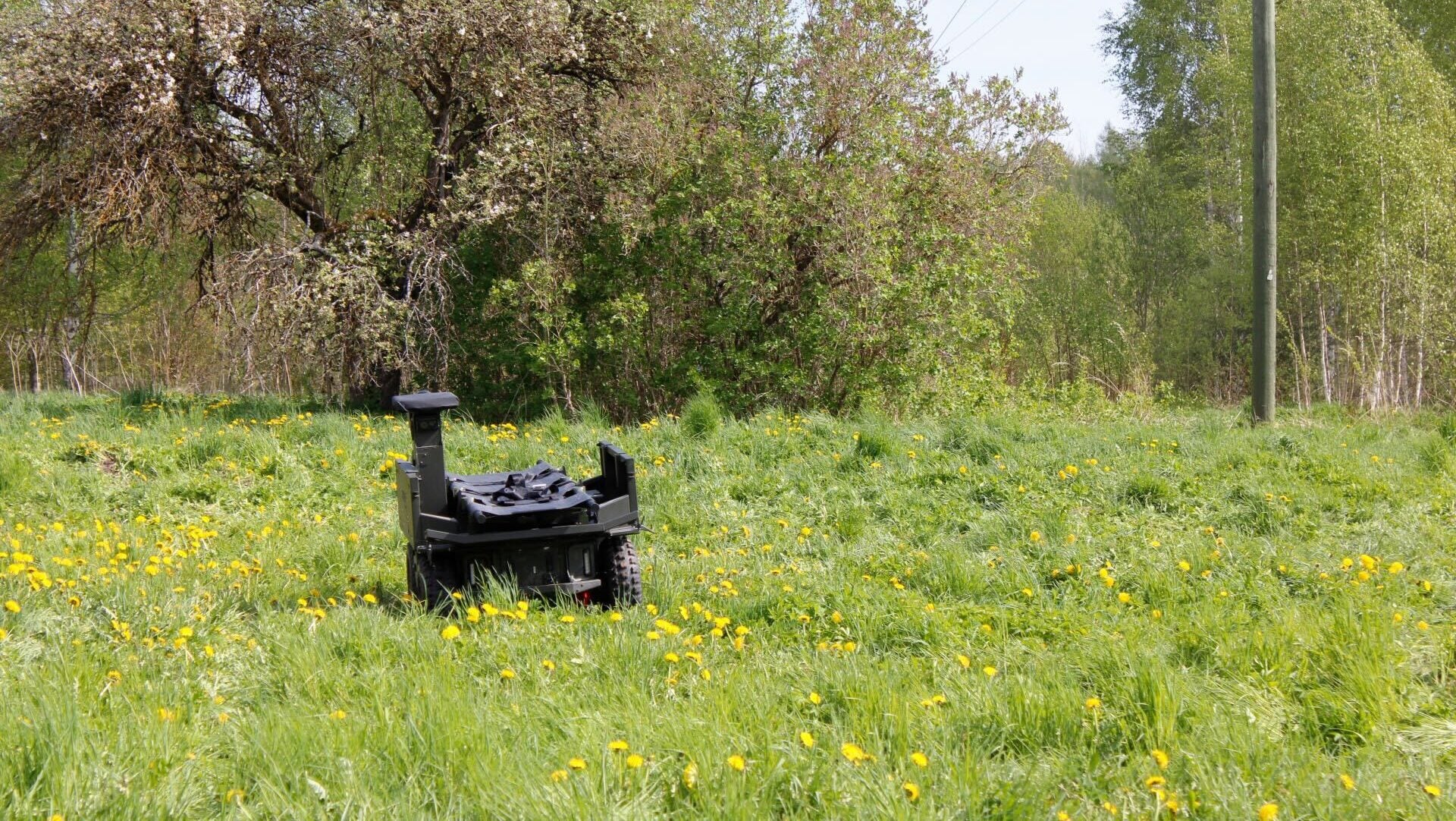
A soldier from the Latvian National Guard, speaking anonymously for security reasons, described the challenge clearly in relation to the Latvian-made Natrix UGV. When the vehicle relies on Starlink under dense foliage, the canopy can rapidly degrade the communications link or block the line of sight needed for a high-speed, continuous connection. The problem is not limited to one platform or one nationality. It is structural: modern robotic systems often depend on links that behave differently in forests than on test ranges optimized for visibility.
Redundancy helps, but does not erase the issue
The Natrix system is not built around a single communications pathway. In addition to Starlink, it carries a longer-range radio and a closer-range radio so that one can take over if another fails. That layered approach reflects a growing recognition in military technology that autonomy requires redundancy. Even so, the exercise shows that backups do not eliminate the tactical penalties of disrupted connectivity. A robot that loses bandwidth, range, or responsiveness in contested terrain may still fall short of mission needs even if it avoids total disconnection.
The soldier operating the Natrix also raised a second issue with broader strategic implications. He said he would not be comfortable relying on an American satellite system as the only connection option, noting that recent developments show such a system can be beneficial but can also disappear suddenly. The remark captures a concern that extends beyond signal strength: dependence on a single external provider can create political and operational fragility.
The problem extends into the air
The communications difficulty is not confined to ground robots. Canadian soldiers operating the American-made Raven-B drone during the same exercise reported similar interference from the tree line. Corporal Elana Clement said the height and density of the trees affected the unit’s equipment and signal, reinforcing the point that vegetation itself can be a serious obstacle for unmanned systems.
That overlap matters because future operations will likely depend on mixed fleets of aerial and ground platforms sharing data, relaying communications and extending each other’s reach. If dense foliage disrupts both layers at once, the challenge becomes more than a local nuisance. It turns into a systems-integration problem with direct operational consequences for reconnaissance, logistics and casualty evacuation.
A useful reality check for Europe’s robotics ambitions
NATO’s interest in unmanned ground vehicles is easy to understand. Platforms like the Natrix can be adapted for logistics, casualty evacuation and other high-risk missions that commanders would rather not assign to exposed troops. The exercise in Latvia is meant to speed up adoption by testing real hardware in realistic conditions. In that sense, the communications setbacks should be viewed as productive, not embarrassing. They reveal where doctrine and procurement still need work.
The lesson is not that battlefield robots are overhyped. It is that autonomy remains deeply contingent on the surrounding infrastructure. Satellite links, radio systems, fallback pathways and terrain-aware planning are all part of the weapon system, even if they are not mounted on the same chassis. Forests in Latvia are therefore doing what good military exercises are supposed to do: forcing advocates of new technology to confront the physical environment rather than the marketing brochure.
As NATO and European manufacturers continue pushing unmanned systems forward, the key question may not be whether the robots can move, carry loads or survive rough ground. It may be whether they can stay connected in the places where they are actually expected to fight. Crystal Arrow suggests that in the Baltics, the answer is still a work in progress.
This article is based on reporting by Breaking Defense. Read the original article.
Originally published on breakingdefense.com