Engine Failure Grounds Operations at Strategic Mediterranean Hub
A KC-46A Pegasus aerial refueling tanker suffered a significant engine failure during takeoff at Moron Air Base in southern Spain, forcing the closure of the installation's single runway and disrupting US and NATO logistics operations across the Mediterranean theater. The incident, which occurred during a routine deployment mission, resulted in no injuries but left the aircraft immobilized on the runway and temporarily halted all flight operations at one of the most strategically important American military facilities in Europe.
According to initial reports from US Air Forces in Europe (USAFE), the KC-46A experienced an uncontained failure of its left engine — a Pratt & Whitney PW4062 turbofan — during the takeoff roll. The crew successfully aborted the takeoff and brought the aircraft to a stop on the runway, but debris from the engine was scattered across the taxiway and surrounding areas, requiring extensive inspection and cleanup before the runway could be reopened.
Impact on Operations
Moron Air Base serves as a critical logistics and staging hub for US military operations in the Mediterranean, North Africa, and the Middle East. The base hosts a rotational force of aerial refueling tankers, strategic airlift aircraft, and fighter squadrons that support missions ranging from counter-terrorism operations in the Sahel to naval air patrols over the Mediterranean Sea. It also serves as a primary divert field for aircraft transiting between the continental United States and bases in the Middle East and East Africa.
The runway closure, which lasted approximately 36 hours according to Spanish aviation authorities, forced the diversion of multiple military and authorized civilian flights to alternative airfields in Portugal and mainland Spain. Tanker missions supporting US Navy operations in the Mediterranean were temporarily reassigned to aircraft based at RAF Mildenhall in the United Kingdom and Ramstein Air Base in Germany, adding significant flight time and reducing the efficiency of refueling operations.
Cascading Effects
The disruption illustrated the fragility of the US military's European basing infrastructure. Moron Air Base operates with a single runway, meaning any incident that closes that runway completely halts flight operations. Unlike larger bases with parallel runways or nearby alternative fields, Moron has limited redundancy, and the nearest suitable US military airfield — Naval Station Rota, approximately 60 miles to the southwest — has its own operational commitments and limited capacity to absorb diverted traffic.
The cascading effects extended beyond immediate flight operations. A C-5M Super Galaxy transport aircraft carrying time-sensitive cargo for a deployment rotation in Djibouti was diverted to Lajes Field in the Azores, adding a full day to its transit time. Two F-35A Lightning II fighters en route from Aviano Air Base in Italy to a Red Sea deployment were forced to land at Albacete Air Base, a Spanish military installation, where they remained for nearly two days while diplomatic and logistical arrangements were made for their continued transit.
The KC-46A's Troubled History
The engine failure at Moron adds another entry to the KC-46A Pegasus program's lengthy catalog of technical difficulties. The tanker, derived from the Boeing 767-200ER commercial airliner, was selected by the Air Force in 2011 to replace the aging KC-135 Stratotanker fleet. Since then, the program has been plagued by delays, cost overruns, and a series of technical deficiencies that have limited the aircraft's operational utility.
Among the most significant issues has been the Remote Vision System (RVS), the camera-based system that the boom operator uses to guide the refueling boom into receiving aircraft. The original RVS suffered from poor image quality, depth perception problems, and glare issues that made refueling operations difficult and sometimes unsafe. Boeing has developed a replacement system, the RVS 2.0, which uses a combination of cameras and augmented reality to improve the operator's view, but the upgrade has been slow to deploy across the fleet.
Engine Concerns
The PW4062 engine that failed at Moron is the same powerplant used on commercial Boeing 767 aircraft and has a generally strong reliability record in airline service. However, military operations subject engines to different stress profiles than commercial flying. Tanker aircraft frequently operate at high gross weights during refueling missions, requiring sustained high-power settings that increase thermal and mechanical stress on engine components. The aircraft also operates from a wider range of environmental conditions than a typical airline route, including hot-and-high airfields where engine performance margins are reduced.
The Air Force has not yet released the results of its investigation into the Moron incident, but preliminary indications suggest a turbine blade failure in the high-pressure section of the engine. An uncontained failure — one in which debris penetrates the engine casing — is the most serious type of engine malfunction and can pose risks to the airframe, fuel systems, and hydraulic lines in the wing and fuselage.
Basing Vulnerability in Focus
Beyond the immediate implications for the KC-46A program, the Moron incident has reignited discussion about the vulnerability of the US military's European basing network. During the Cold War, NATO maintained a dense network of air bases across Western Europe, providing significant redundancy in the event that individual facilities were damaged or destroyed by Soviet attack. In the decades since, many of these bases have been closed or returned to host nation control as part of post-Cold War force reductions.
The result is a basing network that is efficient in peacetime but lacks resilience under stress. When a single runway closure at Moron can disrupt operations across the entire Mediterranean theater, the system is clearly operating with insufficient margin. Military planners have been advocating for increased investment in alternative basing options, including the development of agreements with host nations for access to civilian airfields during contingencies and the pre-positioning of runway repair equipment at key locations.
Expeditionary Airfield Operations
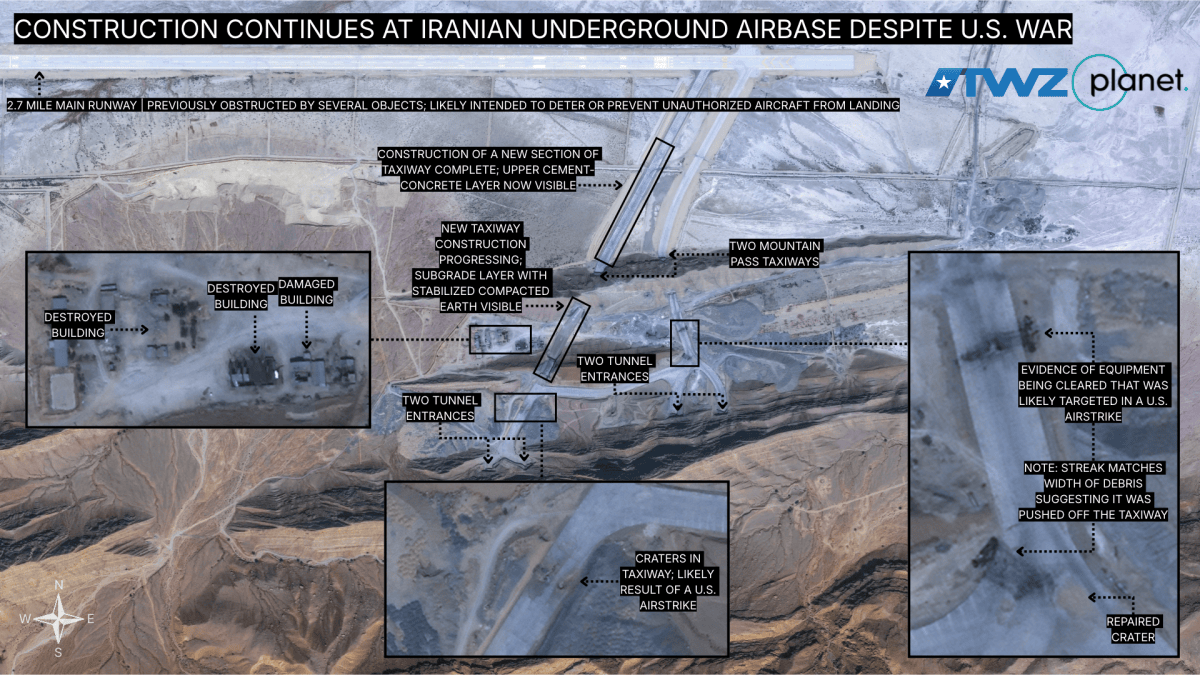
The Air Force has also been investing in expeditionary airfield capabilities — the ability to operate from austere, minimally prepared surfaces rather than depending entirely on established bases. The Rapid Airfield Damage Repair (RADR) program, which trains and equips units to quickly fill craters and restore damaged runways, is directly relevant to the kind of disruption seen at Moron. While the Moron incident was an accident rather than an attack, the operational effects were similar: a critical runway rendered unusable for an extended period.
Spanish Perspective
The incident also has diplomatic dimensions. Moron Air Base is a Spanish military installation that the US operates under a bilateral defense cooperation agreement. The agreement provides for US use of the base but requires Spanish approval for certain types of operations and imposes environmental and safety requirements. The engine failure and associated debris scatter triggered a joint investigation by US and Spanish authorities, and Spanish officials have requested a briefing on the KC-46A's maintenance and safety record.
Spain has been a reliable NATO ally and a generous host for US military operations, but incidents that disrupt operations at shared facilities test the relationship. Spanish media coverage of the event was extensive, and opposition politicians used the occasion to raise questions about the environmental and safety implications of hosting US military operations.
Analysis: Systemic Risks Exposed by a Single Failure
The KC-46A engine failure at Moron Air Base was, in isolation, a manageable incident — no one was hurt, the aircraft can be repaired, and the runway was reopened within two days. But the cascading effects of that single failure exposed systemic vulnerabilities in the US military's European posture that would become critical in a major conflict.
A military that depends on a small number of major bases, each with limited redundancy, is a military that an adversary can disrupt with relatively modest effort. The lesson of Moron is not that the KC-46A has engine problems — all aircraft types experience mechanical failures — but that the basing infrastructure supporting US power projection in Europe is thinner than it should be. Addressing that vulnerability will require not just more aircraft and more maintenance, but more bases, more runways, and more agreements with allies for contingency access to the airfields that would be needed in a crisis.
This article is based on reporting by airforcetimes.com. Read the original article.
Originally published on airforcetimes.com