Paris looks for a bridge beyond the Leclerc
France is exploring an interim solution to replace its aging Leclerc main battle tanks as delays mount in the joint French-German Main Combat Ground System, or MGCS. According to the supplied source text, Armed Forces Minister Catherine Vautrin told lawmakers that discussions are underway between France’s defense procurement agency and manufacturers on a bridging capability.
The need is increasingly pressing because the Leclerc is expected to reach the end of its service life in 2038, while MGCS is not expected before the early 2040s. That leaves a gap that Paris now appears unwilling to ignore.
The MGCS timetable has slipped badly
Vautrin told lawmakers that the future tank program is roughly a decade behind schedule, according to the supplied material. She attributed the delay to Germany’s decision to begin a program for new Leopard 3 tanks, a move that complicates the original logic of a jointly developed successor system.
That admission is significant. MGCS was meant to be the long-term replacement path for France’s Leclerc and a flagship example of European defense-industrial cooperation. If it is slipping by around ten years, that has implications not just for equipment planning but also for alliance politics, industrial work share, and strategic autonomy.
The immediate French concern is practical: a core armored capability cannot simply be allowed to age out while waiting for an uncertain multinational schedule to recover.
A stopgap, but not a dead end
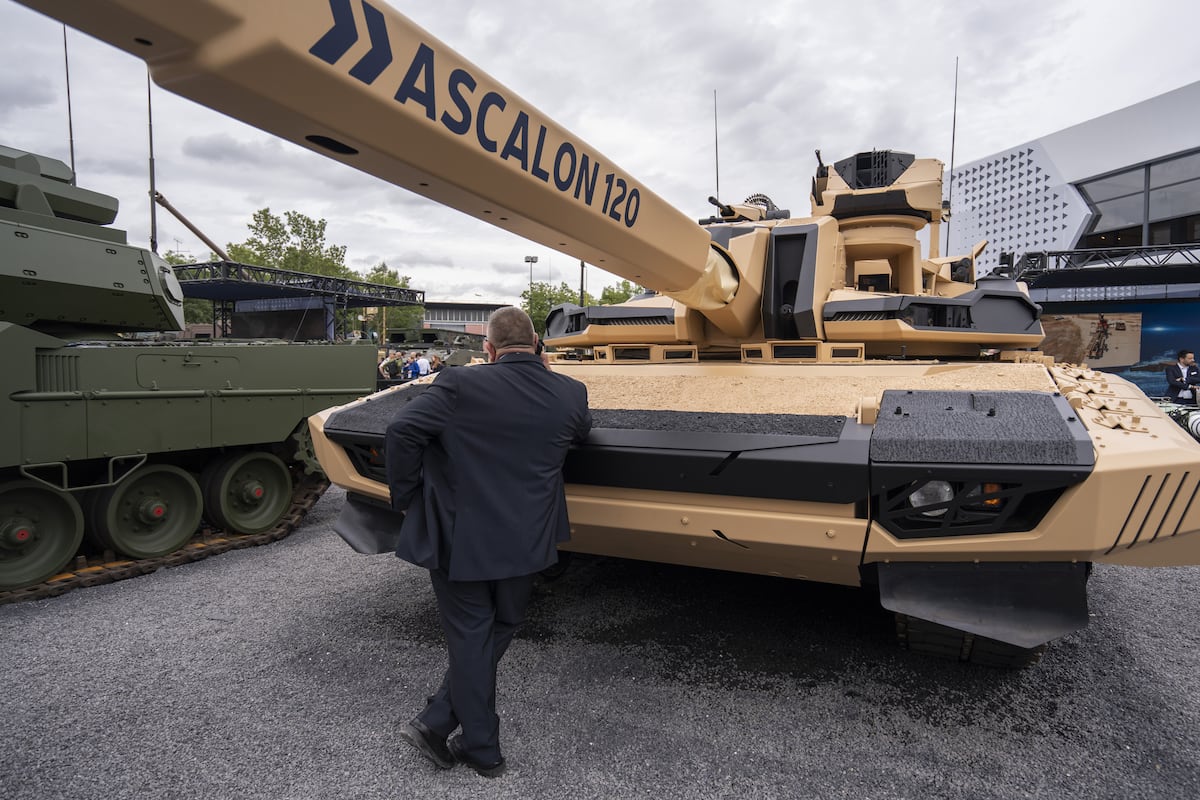
France is not presenting the proposed interim tank as a temporary patch in the narrowest sense. Vautrin said the government wants the bridging platform to be the “first building block” of MGCS, not merely the last representative of an older generation. According to the source text, the envisioned vehicle would be the first tank of a new-generation “system of systems,” with connectivity as a key focus.
That framing matters because it shows France trying to avoid a pure stopgap trap. Rather than spending heavily on a legacy platform with limited future relevance, Paris appears to want a vehicle that can feed into the architecture, doctrine, and technologies expected of later armored systems.
The minister said the interim solution could be based on a KNDS Germany platform with a KNDS France turret, and added that the turret would be French in any case. That suggests France is trying to preserve national industrial participation even while adapting to a disrupted joint program.
Part of a wider defense spending reset
The tank discussion came as Vautrin presented plans for an additional €36 billion in defense spending for the 2026-2030 period. The added money forms part of an update to France’s military planning law, which had initially budgeted €400 billion for 2024-2030.
Seen in that context, the interim tank is not an isolated procurement issue. It fits into a broader reassessment of whether France’s force structure and industrial plans remain aligned with emerging threats and delayed multinational programs. Extra funding can help buy flexibility, but it also reflects the higher cost of managing programs that do not arrive on time.
Another major Franco-German project is also under strain
The source text makes clear that MGCS is not the only joint project facing turbulence. Vautrin also said mediation is underway on the Future Combat Air System, the French-German-Spanish program centered on a next-generation fighter. According to the report, negotiations are being led by two external, qualified individuals and are focused on intellectual property, work share, and airworthiness certification.
That parallel matters because it suggests a broader pattern. France and Germany remain tied together on major defense programs, but industrial rivalry and disputes over leadership are straining execution. In FCAS, work on the fighter jet has reportedly ground to a halt amid conflict between Dassault Aviation and Airbus over leadership and work share.
For Paris, the lesson may be that strategic cooperation can remain desirable while still requiring fallback options when timelines slip. The interim tank idea reflects exactly that logic: continue to talk about MGCS, but prepare for a world in which it arrives much later than once promised.
The strategic signal
The most important takeaway from Vautrin’s comments is that France is shifting from passive delay management to active contingency planning. It is no longer enough to assume a next-generation platform will appear in time. Paris is now looking for a bridge that can preserve operational credibility, support domestic industry, and ideally contribute to the architecture of a future armored system.
That approach may prove increasingly common in Europe as ambitious multinational defense programs encounter technical, industrial, and political friction. Governments still want the benefits of shared development, but they are also rediscovering the need for sovereign or semi-sovereign fallback options.
If France moves ahead, the interim tank could become more than a stopgap purchase. It could serve as a test of whether Europe can build transitional capabilities that do not derail long-term cooperation. For now, though, the immediate reality is simpler: the Leclerc’s clock is ticking, MGCS is late, and Paris is preparing accordingly.
This article is based on reporting by Defense News. Read the original article.
Originally published on defensenews.com