Firestorm Pitches At-Sea Manufacturing as a Logistics Tool
Firestorm Labs says it successfully printed thousands of unique parts aboard the amphibious assault ship USS Essex while the vessel transited rough waters en route to the Rim of the Pacific 2026 exercise. The demonstration, described by the company to Defense One this week, is the latest sign that military interest in expeditionary manufacturing is moving beyond controlled lab conditions and into operational environments.
The company’s case is straightforward: if forces can make parts closer to the point of need, they may be less exposed to disrupted supply chains, shipping delays, and the vulnerabilities that come with moving equipment and spares across long distances. Firestorm argues that this matters most in the kinds of contested environments military planners increasingly expect to face.
According to Defense One, Firestorm CEO Dan Magy said the seas off the California coast were the roughest he had heard about there in the last five years. Even so, he said the company’s manufacturing system continued operating. That detail matters because vibration, ship motion, and humidity are the kinds of real-world factors that often separate a fieldable system from a promising prototype.
What Firestorm Demonstrated on USS Essex
The setup used for the demonstration was Firestorm’s xCell additive manufacturing unit, which the company describes as two 20-foot containers that can be transported and used in different locations. Aboard Essex, the company says the system produced parts while the ship pitched through heavy seas, giving the Navy and industry a test of whether additive manufacturing can function in a maritime setting without the stability of a shore installation.
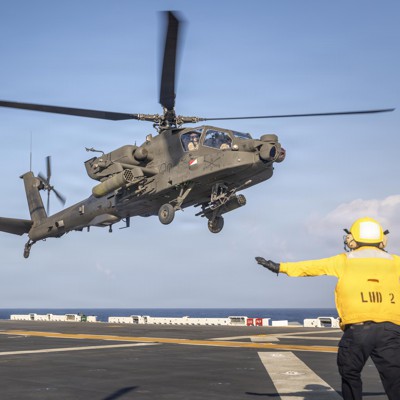
During a tour of the unit, Firestorm field operations manager Duane Blank showed items that had been printed at sea, including stops intended to protect Apache helicopter rotors from scraping against the ship’s non-skid deck coating. That example is notable because it ties the demo to a practical maintenance problem rather than a generic proof-of-concept object.
Blank also said the nylon composite used by the company can serve applications across a wide range of military and support uses, from prosthetics to drones to humanitarian assistance and disaster-relief items. Defense One’s account does not independently validate all of those use cases, but the breadth of the claim shows how Firestorm is positioning the system: not as a niche fabrication experiment, but as a flexible manufacturing node for deployed forces.
Why the Pentagon Cares About Contested Logistics
The strategic pitch behind shipboard manufacturing is rooted in logistics risk. Magy told Defense One that modern warfare is increasingly shaped by contested environments and disrupted access. In his telling, recent conflicts and regional instability have reinforced the need to rethink how equipment is sustained and replaced when supply lines are under pressure.
That argument aligns with a broader defense trend. Militaries have spent years studying how to disperse forces and keep them supplied even when ports, airfields, and long transport routes are vulnerable. Additive manufacturing fits neatly into that discussion because it offers the possibility of producing selected parts on site instead of waiting for them to arrive from centralized depots or industrial bases.
Firestorm frames this as a scalable solution, not only for maintenance of legacy systems but also for building attritable systems such as drones closer to where they are needed. The company’s rhetoric is ambitious, but the operational question is narrower and more useful: can deployed additive manufacturing produce relevant parts reliably enough, under difficult conditions, to justify its footprint and cost?
The USS Essex demonstration does not answer every part of that question. It does, however, provide a more serious test than a static display on shore or a trade-show concept. Printing while underway, in rough water, is precisely the kind of condition that critics would point to as a likely failure mode.
From Demo Value to Operational Value
What turns a demonstration into a meaningful capability is repeatability and mission relevance. Firestorm says it printed thousands of unique parts during the transit, which suggests throughput and variety. Even so, the public description leaves several important questions open: how quickly those parts were produced, how many were directly used, what quality controls were applied aboard ship, and which items would still require conventional manufacturing because of certification, materials, or safety constraints.
Those details will matter if expeditionary manufacturing is to move from an interesting supplement to a trusted logistics option. Military users need to know not only that a printer can run in bad conditions, but also that the resulting components meet operational requirements, can be integrated into maintenance workflows, and reduce risk instead of adding another layer of complexity.
Still, the Essex demonstration highlights why additive manufacturing continues to attract Pentagon attention. A containerized system that can travel with the force and fabricate urgently needed items could be valuable in maritime operations, disaster response, and forward deployments where supply predictability is low. That does not eliminate the need for large-scale industrial production, but it may change how commanders think about the last mile of sustainment.
What to Watch Next
The next phase for systems like xCell is likely to be less about publicity and more about evidence. Defense customers will want to see data on reliability, maintenance burden, materials performance, and the mix of parts that can actually be produced when ships or forward units need them most. They will also want to understand whether these units can integrate with digital part libraries, approval processes, and supply systems already used across the services.
For now, Firestorm appears to have achieved something useful: a real-world demonstration that additive manufacturing equipment can function aboard a warship in rough seas. In a period when logistics resilience is becoming a central military concern, that is enough to make the company’s test more than a novelty. It is an early operational signal in a larger contest over how armed forces will sustain themselves when moving parts and finished goods becomes harder, slower, and riskier.
- Firestorm says it printed thousands of unique parts aboard USS Essex during transit to RIMPAC 2026.
- The company used its xCell system, a two-container additive manufacturing unit designed for expeditionary use.
- Executives say the demonstration supports a wider push to make logistics more resilient in contested environments.
This article is based on reporting by Defense One. Read the original article.
Originally published on defenseone.com