The Army is pushing its next Abrams toward production faster than planned
The U.S. Army says production of the M1E3 Abrams, its next-generation version of the iconic main battle tank, could begin as soon as next year if early testing goes well. The timeline, outlined by Assistant Secretary of the Army for Acquisition, Logistics, and Technology Brent Ingraham at the Association of the United States Army’s Global Force Symposium, would mark a notably accelerated pace for one of the Army’s most consequential vehicle modernization programs.
According to Ingraham, early prototype M1E3 tanks are expected to reach operational test units this summer or early fall. Those units are part of the Army’s Transformation In Contact effort, which is intended to move new capabilities into realistic military use more quickly so that equipment, tactics, and requirements can evolve together. If those early prototypes perform well, the Army hopes production of the finalized tank could start in roughly the next 12 months.
That does not mean the program is fixed in every detail. Ingraham made clear that the schedule still depends on how the prototypes perform, and the exact configuration of the M1E3 may continue to change before the Army commits to production. But the signal from Army leadership is unmistakable: the service wants to move faster.
Prototype testing is now the decisive phase
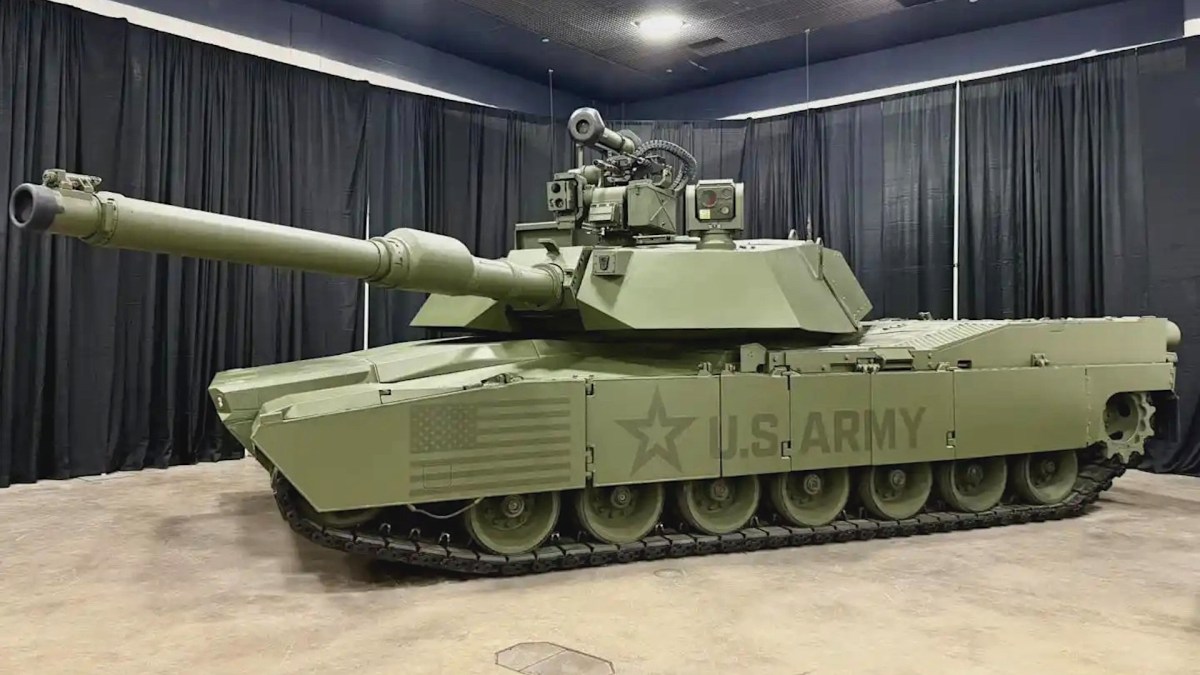
The Army officially unveiled the first early M1E3 prototype at the Detroit Auto Show in January, years ahead of the program’s original schedule. That early reveal already suggested that the service was compressing development timelines. The latest comments go further, showing that the Army is now trying to translate an ahead-of-schedule prototype into an accelerated production decision.
The next step is real-world experimentation by Transformation In Contact units. Those formations are designed to serve as hands-on testing organizations, giving the Army a way to expose emerging equipment to operational conditions earlier than in more traditional procurement cycles. For the M1E3, that means the question is no longer just whether a prototype can be built. It is whether soldiers can use it effectively enough to justify rapid movement into production.
That testing period will likely shape multiple aspects of the final tank. Ingraham said it remains unclear exactly how the M1E3’s design may evolve between the current prototypes and the production version. He also noted uncertainty around whether production vehicles will be entirely new builds. The early prototype shown in Detroit had a substantially reworked hull and an uncrewed turret, but it was still clearly derived from the latest M1A2 System Enhancement Package Version 3 Abrams configuration.
The design points to a significant Abrams evolution
Even from the limited details disclosed so far, the M1E3 appears to represent more than a routine Abrams refresh. The Detroit prototype’s substantially reworked hull and uncrewed turret indicate a more ambitious redesign than the incremental upgrades that have long defined the platform’s evolution. The Army has not yet published a final production specification in the source material here, but it is already clear that the service is looking at a tank that departs in visible ways from current fielded versions.
That matters because the Abrams has long been one of the Army’s heaviest and most recognizable combat systems. A next-generation model with a different turret arrangement and a more deeply revised configuration suggests the service is treating survivability, crew arrangement, and battlefield adaptability as open design questions rather than merely refining a legacy baseline.
The relationship between the M1E3 and prior demonstrators is also still taking shape. Prime contractor General Dynamics Land Systems had previously rolled out the AbramsX demonstrator, and the M1E3 prototype shown publicly this year inevitably invites comparison. But the Army’s own language indicates that what matters now is not concept branding. It is how rapidly a testable and supportable tank can move from prototype into useful service.
Speed is becoming a requirement, not just a preference
The Army’s comments on the M1E3 land in a broader context of acquisition urgency. The service has been emphasizing faster development and fielding cycles across multiple programs, and the Transformation In Contact construct is part of that shift. Rather than relying on long development timelines followed by large-scale rollout, the Army is increasingly trying to get hardware into the hands of soldiers early enough to learn from use before requirements harden.
The M1E3 timeline described by Ingraham fits that model closely. Build an early prototype ahead of schedule. Send it to operational units quickly. Use test performance to determine whether production can start in a matter of months rather than years. It is an acquisition philosophy built around faster feedback loops and a willingness to let operational testing influence the final product.
That does not eliminate risk. Accelerated schedules put pressure on engineering, logistics, and validation. The Army is effectively saying that it wants to make a major tank production decision soon after hands-on testing begins. The benefit is speed. The challenge is ensuring that speed does not outrun what the prototypes actually prove.
What to watch as the program moves forward
The most important near-term marker is the arrival of the early prototypes at Transformation In Contact units later this year. Once those vehicles are in the field, the Army will begin learning whether the prototype’s design choices translate into an operationally credible system. That includes not only the tank’s performance but also how much additional redesign may still be required before production.
The second key issue is configuration stability. Ingraham’s remarks leave open the possibility that the M1E3’s design could continue changing as testing proceeds. That is not unusual for a next-generation system at this stage, but it means the current prototype should not be mistaken for the finished production tank. The Army appears to be using it as a rapid-learning tool as much as a technology demonstrator.
Still, the headline is clear. The Army is no longer speaking about the M1E3 as a distant successor. It is describing a program with prototypes already visible, operational testing due within months, and a production decision that could come on a compressed schedule if those trials deliver. For a platform as central to armored warfare as the Abrams, that is a meaningful shift in tempo and one that will determine how quickly the Army can turn an early prototype into its next frontline tank.
This article is based on reporting by twz.com. Read the original article.
Originally published on twz.com