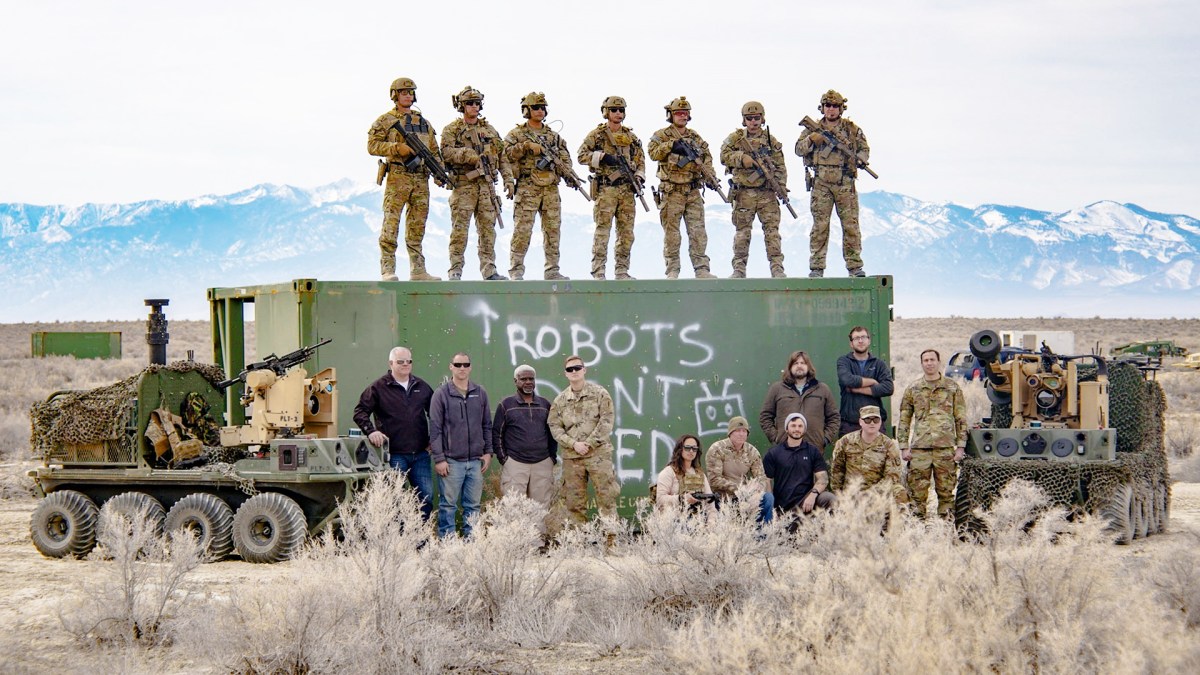
The Army is trying to make its most valuable proving grounds easier to use
The U.S. Army is loosening access rules at some of its most important test ranges, a policy shift that could reshape how quickly new defense technology gets evaluated. Speaking at the Association of the United States Army’s Global Force Symposium in Huntsville, Alabama, Maj. Gen. Patrick Gaydon, the commanding general of Army Test and Evaluation Command, said the service wants industry on its ranges and has already reduced internal barriers that previously slowed or blocked many requests.
The change centers on places such as Dugway Proving Ground in Utah, a vast Army test site that The War Zone described as roughly the size of Rhode Island. For years, Gaydon said, companies were effectively pushed to the back of the line. Under the old system, range access requests were ranked on a priority scale from one to five, with industry placed at five, the lowest category. That structure, he said, largely blocked private-sector users from getting meaningful access.
Now the Army is presenting a different message: if a company has a clear defense connection, the service says it wants that work happening on military ranges rather than being trapped in administrative review.
Why the access change matters
The Army’s reasoning is straightforward. Defense officials have spent months publicly arguing that the Pentagon needs to move faster, especially in areas where commercial technology and military needs are starting to converge. Test ranges are one of the points where that ambition often runs into reality. If companies cannot get timely access to the facilities needed to validate systems, development cycles stretch and procurement decisions slow down.
Gaydon framed the issue in exactly those terms. He called ranges “national treasures” and said the Army needs industry working with program offices to iterate and learn on sites that can support activities unavailable elsewhere. That statement is important because it shifts the language around Army ranges from control and exclusion toward shared experimentation tied to defense outcomes.
In practice, that means the Army is no longer treating outside access as an exception that automatically requires top-level intervention. Gaydon said that when he first took command, the permissions structure required him personally to approve visits. About a year ago, he said, the service changed that approach. Approval authority now sits at the tester or commander level so long as there is a defense nexus. He gave a simple boundary condition as well: a non-defense user such as a car company seeking unrelated track time would still require higher scrutiny.

From bureaucracy to delegation
That delegation may sound procedural, but it is the heart of the story. The old model concentrated authority at the top and slowed decisions. The new model pushes approvals downward, closer to the people directly responsible for testing. In any large institution, that kind of change often matters more than a broad innovation slogan because it alters how quickly work can move.
The Army appears to be pairing that authority shift with changes to the rules surrounding experimental equipment. The War Zone reported that in December, Army Test and Evaluation Command announced an overhauled safety release process intended to “combine speed with rigor.” The updated process waived a range of paperwork requirements for soldiers testing “non-type-classified systems,” meaning commercial or prototype gear that has not yet gone through the Army’s traditional fielding path.
Together, the two moves point to the same goal. The Army wants to reduce the friction between a promising piece of technology and a real-world military evaluation. Instead of forcing prototypes and commercial systems through a process designed for mature programs, it is trying to create a faster lane while preserving safety oversight.
What the Army is signaling to industry
The message to defense companies and adjacent commercial firms is unusually direct: bring relevant technology, and the Army says it will work to get it on the range. That matters not only for major contractors but also for smaller firms that often struggle with the Pentagon’s procedural burden. For them, range access can be the difference between a plausible military product and one that never gets validated under realistic conditions.
There is also a cultural dimension here. Gaydon’s comments suggest the Army is trying to replace a gatekeeping mindset with a partnership mindset. He did not describe the ranges as scarce assets that must be insulated from outside use. Instead, he described them as critical national infrastructure whose value grows when industry and Army teams can use them to iterate faster.
That does not mean access is becoming unrestricted. The service is still drawing lines around relevance to defense missions, and the Army is still responsible for protecting safety, scheduling, and mission priorities. But the threshold appears to have moved from default resistance to conditional openness.

The broader procurement problem behind the decision
The access change also reflects a larger Pentagon concern. Military leaders have repeatedly argued that the U.S. defense establishment cannot afford long development timelines when threats, software, autonomy, sensing, and low-cost systems are evolving quickly. Test ranges are where ideas meet operational constraints. If that stage is too slow, every later stage slows with it.
Seen in that light, the Army’s change is not really about visitor permissions. It is about compressing the path from concept to soldier feedback. Faster access allows developers to test earlier, fail earlier, adjust earlier, and return with something better aligned to military needs.
That does not guarantee faster procurement on its own. Range access is only one part of a much larger acquisition system. But it is one of the parts the Army directly controls, which makes it a logical place to start if the goal is to show measurable movement.
What to watch next
The real test of the new policy will be operational rather than rhetorical. The key questions are whether companies actually find the process easier, whether program offices make greater use of commercial and prototype systems on Army ranges, and whether the reduced red tape leads to quicker decisions about what should move forward.
For now, the significance lies in the signal. The Army is saying its premier testing infrastructure should not be a bottleneck by default. Instead, it wants that infrastructure to become an engine for faster military experimentation. If that policy holds, it could become one of the more practical defense innovation shifts now underway: less about slogans, and more about who gets onto the range and how quickly they can start learning.
This article is based on reporting by twz.com. Read the original article.
Originally published on twz.com