Army says cyber AI can no longer be funded as a side project
The U.S. Army is moving toward a more formal funding posture for artificial intelligence in cyber defense, reflecting how quickly AI has shifted from an experimental aid to a core operational priority. Speaking at TechNet Augusta, Brandon Pugh, the Army’s principal cyber advisor, said the service has reached the point where AI work needs dedicated funding rather than being supported only from existing operational budgets.
That matters because it signals a change in how the Army is framing defensive cyber AI. Instead of treating the technology as a useful enhancement to current tools, officials are increasingly describing it as a capability area that needs its own budget support, sustained oversight, and potentially joint funding arrangements. Pugh said those resources may not come only from the Army, noting that many of the solutions under discussion are likely to be joint in nature.
The funding argument also highlights a broader reality across government cyber programs: organizations may be able to prototype AI with small pools of discretionary money, but scaling it into live defensive operations requires a different level of commitment. Staffing, software integration, testing, data handling, and operational validation all become recurring costs. By emphasizing dedicated funding, Army leaders are effectively saying that cyber AI has moved into that next phase.
Why the Army sees AI as especially important for defenders
Pugh described AI for cyber, particularly defensive cyber, as one of the top priorities for his office over the last year. His framing suggests the Army believes AI could help rebalance a long-standing asymmetry in cyberspace, where attackers often enjoy the advantage of speed, surprise, and low-cost experimentation.
According to Pugh, there is still debate over whether AI will ultimately provide a bigger edge to attackers or defenders. His view is that defenders should gain the advantage if they adopt the technology effectively. That argument rests on two ideas. First, AI can help automate repetitive security work that currently consumes analyst time. Second, it can accelerate detection and response workflows that are difficult to execute fast enough with human operators alone.
In practice, that means AI is being discussed not just as an analytics layer, but as a way to compress the time between identifying a threat and acting on it. For military networks, that compression is particularly important. The Army operates large, complex environments where manual review and escalation chains can slow response at the exact moment speed matters most.
Pugh’s comments did not present AI as a replacement for cyber personnel. Instead, he described it as a force multiplier across the full range of defensive tasks, from handling mundane work to enabling more automated action. That is a pragmatic framing. It recognizes that the value of AI may come as much from reducing cognitive load and increasing consistency as from any headline-grabbing autonomous capability.
Three lines of effort are taking shape after an industry exercise
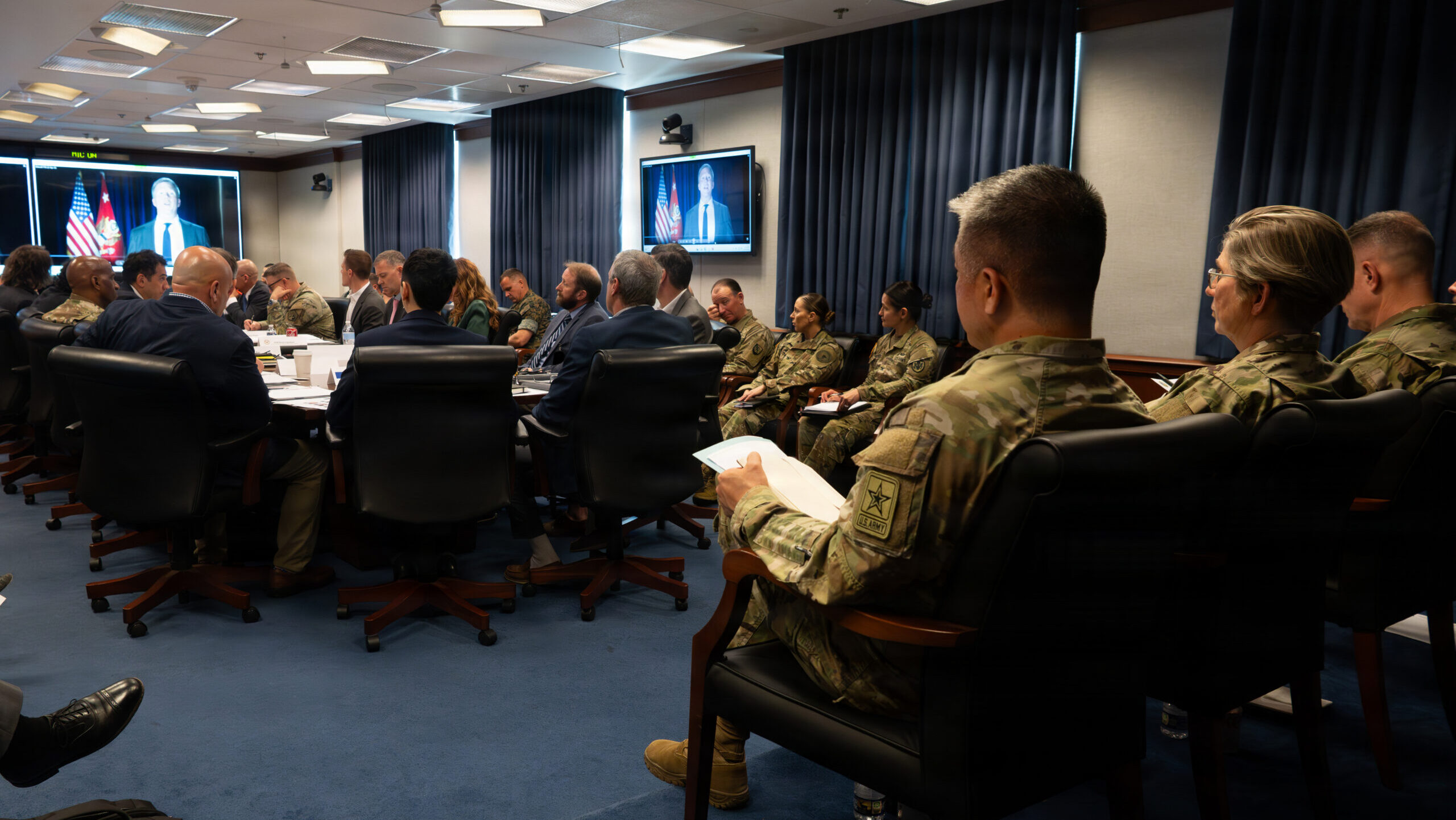
The Army’s current push follows a tabletop exercise held in April with industry executives. After that event, service leaders launched the Rapid Defense Cyber Systems initiative, or Project ARDCS, to pursue lessons from the exercise. Pugh said the Army identified roughly 17 to 20 capabilities or efforts that deserved attention, but is concentrating first on three initial lines of effort.
The first is Project Griffin, which aims to use AI to identify threats on Army networks and take action rather than merely observe suspicious activity. As described by Pugh, the effort is focused on automating cyber detection agents and enabling autonomous response. That distinction is important. Passive monitoring can surface alerts, but it still leaves human teams to determine which events matter, what action to take, and how quickly they can execute. A more active model could shift AI from a support role into a direct participant in network defense.
The Army underscored the seriousness of that effort by releasing a commercial solutions opening focused on Project Griffin. That suggests the service is actively seeking outside technology input and is trying to move beyond abstract concept development.
The second line of effort centers on agentic deception agents. Pugh did not provide technical detail, but the idea points to AI systems designed to mislead attackers with false information, decoy environments, or fabricated signals. In cyber defense, deception has long been used to waste adversary time and expose malicious behavior. Applying agentic AI to that mission could make deception more adaptive, more convincing, and more scalable across large networks.
The third effort focuses on using agentic AI to audit the security posture of vendors as well as the Army’s own networks. That area could become especially significant because supplier risk and configuration drift remain persistent weak points in defense cybersecurity. If AI tools can continuously review posture, flag gaps, and accelerate remediation workflows, they may help reduce the lag between discovering a weakness and acting on it.
From experimentation to governance and accountability
Pugh also described a management rhythm around these projects, saying officials want monthly updates on progress, roadblocks, and decision points. That detail may sound procedural, but it reveals something important about the Army’s intent. Regular reviews mean these initiatives are being treated as programs that must show movement, not just exploratory pilots that can drift without clear outcomes.
The oversight structure could be as important as the technical work itself. AI projects in government often stall between demonstration and deployment because the transition path is unclear. Budget ownership, legal review, procurement strategy, and operational authority can all become bottlenecks. Dedicated funding helps address one of those barriers, but only if paired with governance that keeps momentum and forces decisions when problems arise.
There is also an implicit caution in the Army’s approach. Automating detection and response on military networks raises serious questions about reliability, control, and unintended consequences. Deception systems require careful design to avoid confusion inside friendly environments. AI-driven audits need trustworthy outputs if commanders and security teams are going to act on them. None of those issues were resolved in the interview, but the fact that the Army is narrowing its focus to a small set of efforts suggests it is trying to build around practical use cases rather than diffuse ambition.
What this means for the next phase of military cyber AI
The bigger significance of the Army’s position is not that it wants to use AI in cyber defense. That is already widely understood across the defense sector. The more meaningful shift is that senior leadership is now linking the technology to formal budget planning and near-term implementation priorities.
If that funding materializes, the Army could move faster in three areas that align closely with real operational pain points: faster threat detection and response, more sophisticated adversary deception, and more continuous assessment of network and vendor security. Those are not speculative moonshots. They are practical defense functions where AI may provide measurable operational value if the systems perform reliably.
The Army’s message is therefore less about AI hype than institutionalization. Cyber AI is being pulled into the machinery of budgeting, acquisition, and recurring review. That does not guarantee success, but it does mark a shift from experimentation at the margins toward capabilities the service appears to want embedded in the way it defends its networks.
For the broader defense technology market, that is a consequential signal. Vendors now have clearer evidence that the Army is not just interested in AI conceptually. It is identifying specific mission areas, opening channels for commercial input, and arguing that the work deserves money set aside for it. In defense procurement terms, that is when a technology area starts to become real.
This article is based on reporting by Breaking Defense. Read the original article.
Originally published on breakingdefense.com