The Apache’s Mission Set Is Expanding Again
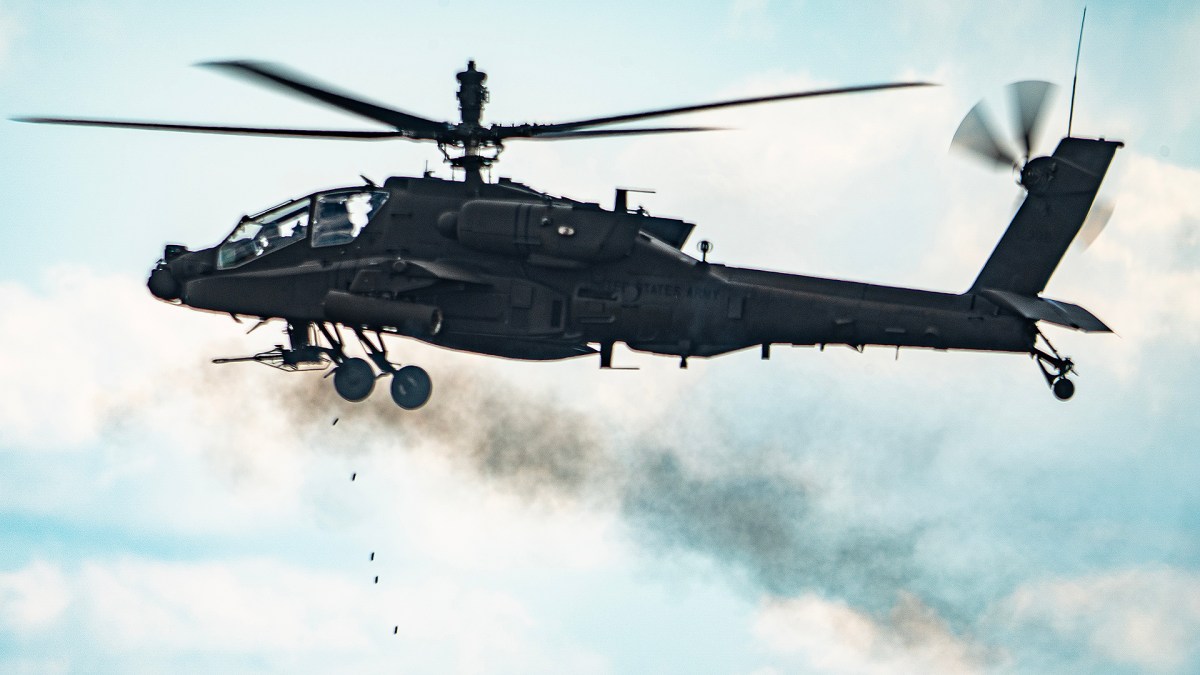
The AH-64 Apache has long been associated with anti-armor strikes, close combat support and armed reconnaissance. Now the U.S. Army is leaning harder into another role: countering drones. According to the supplied source text, the service is accelerating procurement of XM1225 Aviation Proximity Explosive, or APEX, ammunition for the Apache’s 30x113mm M230 cannon, a move meant to strengthen the helicopter’s role as a counter-unmanned-aircraft platform.
This is more than a procurement footnote. It reflects a broader battlefield shift in which helicopters, guns and specialized ammunition are being adapted to meet the rapid growth of unmanned threats. Rather than relying only on high-cost interceptors or scarce missile stocks, militaries are searching for cheaper, more plentiful ways to defeat drones. The Army’s push for more APEX rounds fits that logic exactly.
Production Is Moving Up Fast
The strongest signal in the source text is the production ramp itself. Northrop Grumman, which manufactures the round, reportedly produced 1,000 rounds in the month referenced by the article and plans to increase production fivefold to meet Army demand. The Army’s interest was described by Maj. Gen. Clair A. Gill, commander of the U.S. Army Aviation Center of Excellence, during the Army Aviation Warfighting Summit in Nashville.
That matters because production priorities often reveal which operational concepts are moving from experimentation toward practical fielding. Counter-drone capabilities have been discussed for years, but accelerating procurement indicates that the Army sees this not as a niche trial but as an increasingly relevant combat requirement.
The article’s bottom line is explicit: the Army is significantly increasing XM1225 APEX procurement to improve Apache counter-drone performance. In defense acquisition terms, that is a meaningful step from validation to scaling.
Why Ammunition Matters as Much as Platforms
Public discussion of military modernization often gravitates toward new aircraft, directed-energy systems or networked sensors. Yet ammunition can be just as decisive, especially when threat volumes are rising. Small drones and loitering systems can force defenders into an unfavorable exchange ratio if the only available response is an expensive missile.
The APEX round is presented as an answer to that problem. Fired from the Apache’s chin-mounted M230 cannon, it offers a cheaper and more plentiful engagement option than some alternatives. That point is central. The value of a counter-drone weapon is not only whether it can hit a target, but whether it can do so sustainably under operational pressure.
Ammunition that expands engagement options without requiring an entirely new platform can be especially attractive. The Army does not need to reinvent the Apache to pursue this mission. It can adapt a mature aircraft around a more relevant ammunition profile.
What Makes APEX Different
The source text describes the XM1225 APEX round as a proximity-detonating munition capable of engaging drones, personnel, vehicles and small boats. That versatility is strategically useful. A helicopter seldom enters combat with a single target type guaranteed, so a round that offers broader utility can reduce the tradeoff between counter-drone readiness and general battlefield usefulness.
The round also appears to offer area effects that differ from traditional direct-impact ammunition. In the counter-drone role, that matters because small aerial targets can be difficult to hit with precision using conventional cannon fire alone. A proximity effect can improve engagement probability without requiring a missile-class solution.
This does not turn the Apache into a dedicated air-defense platform in the traditional sense. But it does make it more adaptive in airspace where unmanned systems are increasingly common.
Testing Suggests the Concept Is Viable
The Army’s increased confidence appears to rest in part on live-fire results. The source says that in December 2025, Apaches successfully demonstrated air-to-air engagement using APEX rounds against unmanned aircraft systems at Yuma Proving Ground.
Live-fire testing is important because counter-drone claims can be easy to overstate on paper. Real-world engagement involves tracking, target geometry, timing and crew workload. A successful demonstration does not guarantee broad battlefield performance, but it does show that the concept is credible enough to justify larger procurement.
That sequence also helps explain the timing. A test in late 2025 followed by a production ramp in 2026 suggests an iterative progression: demonstrate the capability, confirm its value and then seek greater industrial output.
A Practical Advantage: Minimal Extra Training
One of the most operationally useful details in the source is that APEX rounds reportedly have ballistic properties similar to existing M789 rounds. As a result, Apache crews would require little additional training to use them effectively.
That kind of compatibility matters as much as raw performance. New weapons can be delayed or underused when they impose heavy retraining burdens, logistics changes or integration risk. By contrast, ammunition that fits within familiar handling and firing profiles can move into service more smoothly.
In military adaptation, low-friction changes often scale fastest. The Army appears to be gaining a new tactical option without paying the full organizational cost that usually comes with new mission equipment.
The Broader Battlefield Context
The rise of drones has forced almost every military to revisit assumptions about protection, air superiority and tactical movement. Small unmanned aircraft are no longer peripheral annoyances. They affect surveillance, targeting and attrition across the battlespace. That creates pressure for layered defenses that include not just ground-based systems, but airborne ones as well.
The Apache is a logical candidate for that adaptation. It already carries sensors, weapons and battlefield reach. If it can also serve as a more efficient drone killer under the right conditions, it becomes more valuable in contested environments where aerial threats are numerous and diverse.
The source article frames the APEX round as a tactical advancement, and that appears justified. The bigger significance is that the Army is using ammunition to expand platform relevance in response to a fast-changing threat environment.
A Small Round With Strategic Implications
The XM1225 APEX program will not solve the drone problem by itself. Counter-UAS operations will still require sensors, doctrine, layered defenses and multiple engagement methods. But the production ramp tells an important story about where the Army sees practical advantage right now.
It sees value in affordable volume. It sees value in using existing platforms more flexibly. And it sees value in solutions that can be fielded quickly because they do not require major retraining or reinvention.
For Developments Today, that makes this a meaningful military technology story. The future of air defense is not only about the most exotic systems. Sometimes it is about giving an existing helicopter a better shell for the war that is actually emerging. On that measure, the Army’s accelerated APEX procurement is a signal worth watching closely.
This article is based on reporting by twz.com. Read the original article.
Originally published on twz.com