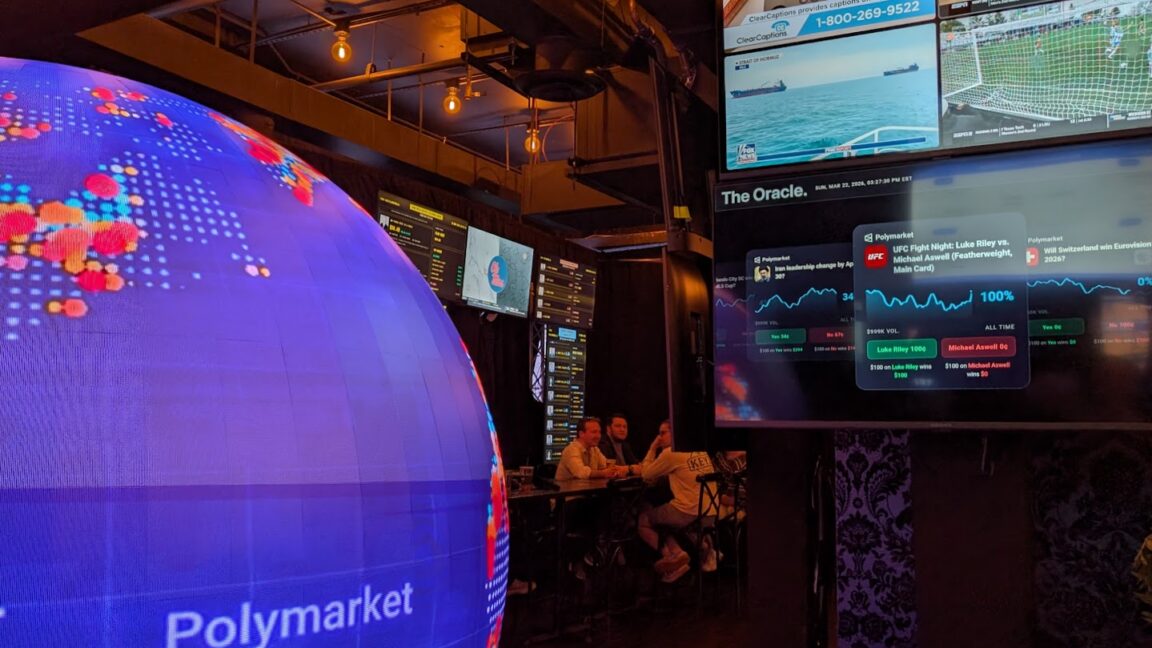
A prediction market steps into Washington nightlife
For three days in Washington, DC, Polymarket transformed a K Street bar into what it called “the world’s first bar dedicated to monitoring the situation.” The temporary venue, branded “The Situation Room,” was more than a marketing stunt. It offered a revealing snapshot of how online prediction markets want to present themselves: not only as websites for speculative bets, but as ambient infrastructure for politics, media, and real-time public attention.
Ars Technica’s reported visit described a setting that looked unlike a normal Washington bar. There were more laptops open, more conversations about cryptocurrency, and more screens showing news and market pages rather than sports. Even the channel mix mattered. CNBC and C-SPAN, not usually staples of a drinking venue, fit the concept because Polymarket was trying to dramatize a worldview in which current events are continuously tradable.
What the pop-up was trying to say
Polymarket announced the event on March 18 through a thread on X, promising live X feeds, flight radar, Bloomberg terminals, and Polymarket screens. According to the Ars account, the execution initially fell short. Power and Wi-Fi issues reportedly left displays dark during a press-preview event, though the screens were fixed by the next day.
That gap between ambition and execution is telling. The pop-up promised a command-center aesthetic in which information, speculation, and market pricing all converge in one place. Even if the hardware setup was uneven, the symbolism was not. Prediction markets increasingly want to be seen not as fringe gambling products but as tools for interpreting reality in real time.
A physical space helps communicate that identity. An app or browser tab feels transactional. A themed venue suggests community, status, and cultural legitimacy. In Washington especially, where politics and media constantly overlap, a branded “Situation Room” is an attempt to insert prediction markets into the capital’s social choreography.

What people were betting on
The source material gives several examples of the markets visible at the bar. Users were trading on control of Congress after the midterm elections, with Democrats given an 85 percent chance of taking the House and Republicans roughly even odds of holding the Senate. Other markets focused on the 2028 presidential nominees, with Vice President J.D. Vance leading Republican odds and California Governor Gavin Newsom topping the Democratic side.
Then the menu became stranger. Polymarket users gave Swiss artists zero chance of winning Eurovision 2026. Another market put the odds of Jesus Christ returning before 2027 at 4 percent. That spread is part of the product’s appeal. Politics, culture, religion, sports, and celebrity speculation sit side by side inside the same interface, all translated into probabilities and positions.
The bar setting made that range visible in a new way. Rather than scrolling past one unlikely market among many, visitors could see the entire logic of the platform at once. This is what prediction markets look like when turned into atmosphere: a room full of probabilities attached to everything from elections to metaphysics.
Why an online market wanted a bar
The most interesting question raised by the event is why Polymarket felt the need for an in-person venue at all. Prediction markets are fundamentally digital products. They do not need real estate to function. But physical presence can do other work. It can attract press, deepen community identity, and signal that the platform belongs in the broader conversation around politics and markets.
Washington is a particularly strategic backdrop for that effort. The city is crowded with people whose jobs revolve around tracking fast-moving events, assigning probabilities, and projecting confidence. A prediction market naturally wants to appeal to that temperament. A pop-up bar offers a way to materialize the product as a habit of attention rather than a mere trading interface.
The venue also bridged several adjacent cultures: crypto, media, politics, and sports-bar screen culture. That blend may help explain the concept’s appeal. Prediction markets are most successful when they feel both analytical and social, like a form of probabilistic conversation with money attached.

The limits of the spectacle
At the same time, the pop-up revealed the awkwardness of translating an online platform into a physical environment. Bloomberg terminals were promised but not visible, according to the report. Technical glitches disrupted the initial setup. And the whole venue existed only for a brief run. Those constraints make the event look less like a durable institutional presence and more like a carefully staged brand activation.
Still, that does not make it trivial. Short-lived spaces can be effective when they capture a moment in an industry’s self-image. In this case, the message was that prediction markets see themselves as central to how informed people monitor “the situation,” whatever the situation may be. They are not just a place to place a wager. They are trying to become part of the ambient machinery of interpretation.
A sign of where prediction markets want to go
Polymarket’s Washington experiment shows an industry trying to move up the cultural stack. The product already asks users to convert uncertainty into price signals. The pop-up asked something broader: whether those signals can anchor a scene, a sensibility, even a kind of political lifestyle.
That ambition fits the current moment. In an environment saturated with breaking news, social feeds, and endless analysis, prediction markets offer a clean promise: stop arguing about what will happen and put a number on it. A bar full of screens, odds, and current events turns that promise into theater.
The result, as described by Ars Technica, was imperfect but revealing. Polymarket did not just open a pop-up. It staged a claim about what prediction markets are for and who they are for. Whether that claim resonates beyond crypto-curious political obsessives is still an open question. But for a few days on K Street, the company made one thing clear: it wants to be seen not just as a market, but as a venue for how the future gets watched.
This article is based on reporting by Ars Technica. Read the original article.

Originally published on arstechnica.com