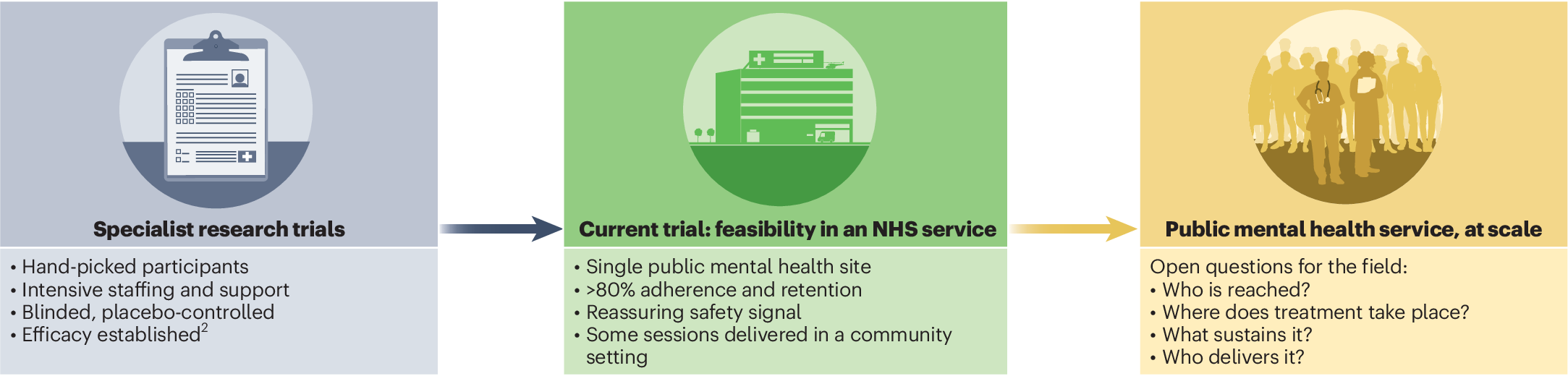
As psychedelic research matures, one of the most pressing questions is no longer whether psilocybin can help people with severe depression, but whether health systems can actually deliver it. A feasibility trial reported in Nature Medicine, published online on 21 August 2026, explores exactly that question for treatment-resistant depression within the UK health service. The study suggests that a carefully designed model can work, yet it also exposes the many logistical, regulatory, and clinical hurdles that stand between controlled research settings and routine practice.
Why Feasibility Matters
Psilocybin-assisted therapy has generated significant excitement in psychiatry. Early randomised trials, often conducted in highly controlled academic settings, have shown promising signals for people who have not responded to standard antidepressants. However, moving from a tightly supervised research protocol to a public health service is a different challenge entirely. Feasibility trials are designed to ask pragmatic questions: Can the therapy be delivered safely in existing clinical settings? Are staff willing and able to take on new roles? Can patients be recruited and retained? What does it take in terms of time, space, and money?
The Nature Medicine report focuses on these practical dimensions. By situating the trial within the UK health service, the research directly confronts the translation gap. It acknowledges that even if psilocybin were approved tomorrow, clinics would need to know how to integrate a psychedelic treatment into everyday care pathways shaped by decades of conventional psychiatric practice.

Inside the Feasibility Trial
Feasibility studies are not primarily designed to prove efficacy; they are designed to test whether a larger, more definitive trial—and eventual clinical roll-out—is realistic. The UK health service-based trial described in the article enrolled participants with treatment-resistant depression, a population that has exhausted multiple lines of therapy and often carries a heavy burden of chronic suffering. The treatment model under investigation combined psilocybin administration with structured psychological support before, during, and after the drug session.
Key implementation parameters examined in such a trial include:
- Recruitment and referral pathways from community mental health teams
- Screening procedures to ensure clinical appropriateness and safety
- Training for therapists and medical staff unfamiliar with psychedelic sessions
- Facility requirements for prolonged sessions and post-session observation
- Risk management for adverse psychological reactions
- Integration with existing antidepressant protocols and follow-up care
The trial's very existence signals that psilocybin treatment is moving beyond academic enclaves and towards possible adoption in mainstream systems. Yet the article's central message is cautionary: scientific promise does not automatically translate into clinical practice.
The UK Health Service as a Test Bed
The UK health service offers a particularly instructive setting for this kind of translational research. It is a publicly funded, universal system where new treatments must demonstrate value not only in terms of efficacy but also in terms of affordability, equity, and compatibility with existing infrastructure. The service already struggles with long waiting lists for depression therapies, and mental health teams are often stretched. Adding a time-intensive psychedelic package—which involves preparation hours, an all-day dosing session, and multiple integration sessions—places real strain on resources.
Moreover, the UK health service operates under strict drug regulations. Psilocybin is a controlled substance, so any non-research delivery would require legal exemptions or rescheduling. The feasibility trial described in Nature Medicine existed within a regulatory framework that allows research use, but scaling beyond that requires policy shifts. The article underscores that translational work is not purely clinical; it is embedded in law, governance, and public policy.

Barriers on the Path to Practice
The Nature Medicine article highlights several categories of obstacles that separate research success from practical delivery.
Workforce and Training
Psilocybin-assisted therapy requires a different skill set from conventional psychiatric care. Clinicians must be comfortable supporting patients through altered states of consciousness, handling intense emotional releases, and managing difficult experiences during the session. The trial's feasibility depends on having a trained workforce, and the research likely faced the challenge of upskilling existing staff rather than recruiting a new cadre of psychedelic specialists.
Regulatory and Legal Complexity
Even in a research context, obtaining approvals for a controlled substance can be arduous. Oversight typically involves ethics committees, medicines regulators, and law enforcement agencies. Each step adds time and complexity. If the treatment is to become routine, the legal infrastructure must evolve to permit prescribing outside research protocols without compromising patient safety.
Facility and Safety Considerations
A psilocybin session typically lasts several hours, and patients require continuous monitoring in a calm, comfortable environment. Most hospital psychiatric wards are not designed for this. The trial likely had to carve out dedicated spaces, establish safety protocols, and coordinate with emergency services. These operational details are often overlooked in efficacy trials but are decisive in real-world feasibility.
What the Trials Really Show
The phrase “trials” in the article title works on two levels: the scientific trial itself and the broader trials of trying to make the therapy work outside a laboratory. The Nature Medicine publication is a reminder that research findings are just one step. Even positive feasibility results do not guarantee adoption. Payers, regulators, professional bodies, and patient communities all need to align.
For treatment-resistant depression, the stakes are high. Many patients have no adequate options, and psilocybin represents a novel mechanism that might help where conventional treatments fail. But the translation from research to practice is a winding road. This UK feasibility trial contributes essential evidence about how that road could be paved—and how many obstacles remain.

Looking Ahead
As the field waits for larger efficacy trials and regulatory decisions, feasibility studies serve a vital role. They inform trial design for phase III investigations, guide clinical protocol development, and help hospitals prepare for potential approval. The article in Nature Medicine will likely be cited as an example of how to think about implementation early in the drug development lifecycle.
Taken together, the message is clear: bringing psilocybin-assisted therapy into a national health service is not merely a matter of prescribing a drug. It demands systemic change. The journey from research to practice is itself a trial—one that, for now, seems to be proceeding with caution.
This article is based on reporting by Nature Medicine. Read the original article.
Originally published on nature.com