A Trial at the Intersection of Nutrition and Immunization
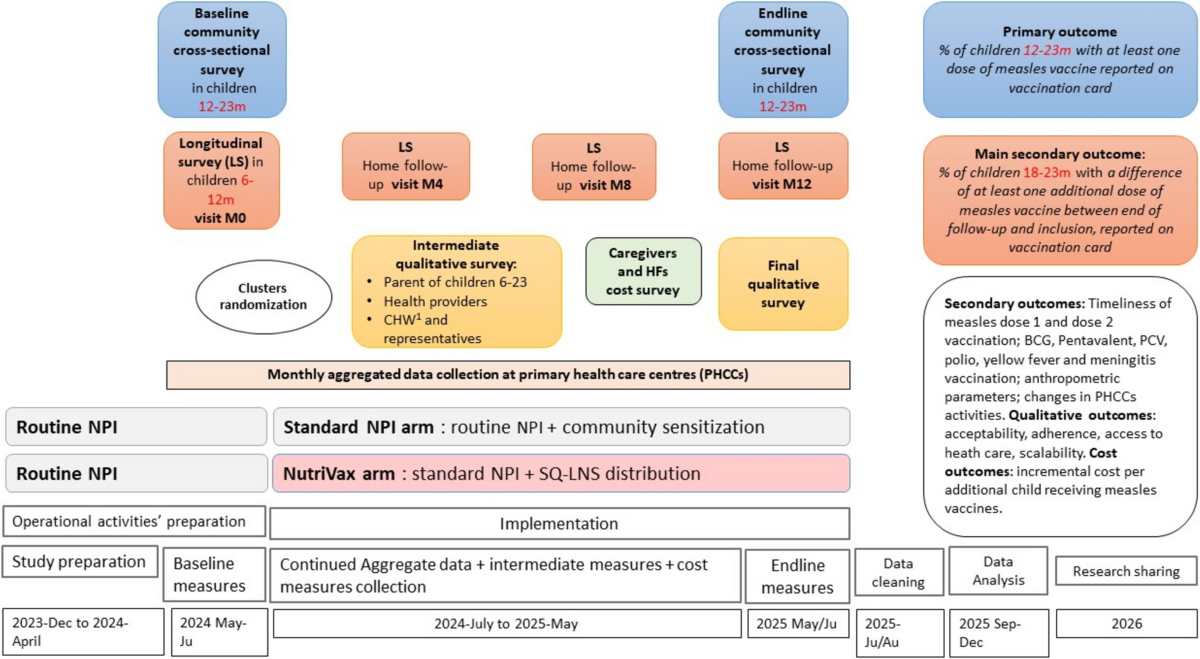
Public health programs seldom fail because a tool does not exist. They fail because the tool does not reach the child. That gap sits at the center of a study newly published in Nature Medicine, which reports a pragmatic, superiority, cluster-randomized trial carried out in Yobe State, in northern Nigeria, examining small-quantity lipid-based nutritional supplementation alongside measles vaccination coverage among children aged 6 to 23 months.
The pairing is not incidental. Measles vaccination ranks among the most cost-effective interventions available in child health, yet coverage remains uneven wherever health services are thin, households are far from facilities, and outreach depends on fragile supply chains. Nutrition programs, by contrast, often maintain frequent and routine contact with those same households through growth monitoring, supplementary feeding, and community distribution points. The trial asks, in effect, whether that existing contact can be turned into an immunization advantage.
Why Measles Coverage Is Hard to Hold
Measles is extraordinarily transmissible. When coverage slips even modestly, outbreaks return quickly, and the children who bear the consequences are typically the youngest and the most geographically isolated. Because of that, coverage is not a one-time achievement but a condition that has to be re-established continuously, dose by dose, child by child.
This is precisely why delivery research matters as much as vaccine research. A safe and effective vaccine that never reaches a child's arm produces no population immunity. The Yobe State trial treats measles vaccination coverage as its measured outcome, which places it in a specific research tradition: the study of delivery strategy rather than the study of the vaccine itself. That distinction shapes how its findings should be read and applied.

What Small-Quantity Lipid-Based Supplementation Involves
Small-quantity lipid-based nutritional supplements are sachet-format products formulated for young children and designed for home use. They concentrate energy and micronutrients into a compact daily ration that caregivers can administer directly, without cooking or refrigeration. In many humanitarian and nutrition programs they are already distributed at scale within the complementary feeding window.
Their operational feature is repetition. Because distribution is community-based and recurring, the supplement becomes a predictable point of contact between a household and the health system. That rhythm is what makes the intervention interesting to immunization researchers: a channel that already visits the child on a schedule could, in principle, carry more than nutrition.
The Architecture of the Study
Pragmatic by design
The trial is described as pragmatic, meaning it was built to test the intervention roughly as it would actually be delivered in the field, rather than under tightly controlled conditions that seldom survive contact with real programs. Pragmatic trials trade some internal precision for external relevance, and the trade is deliberate.
Cluster randomization
The study randomized clusters rather than individual children. That structure is standard when an intervention operates at the level of a community, a distribution site, or a health facility, since it would be impractical and methodologically messy to assign individual neighbors to different delivery systems and then expect the channels not to bleed into one another.
A superiority question
Framing the trial as a superiority trial means the researchers set out to ask whether the supplementation-linked approach outperformed the comparison condition, rather than merely matching it. That is a demanding question to pose and an even harder one to answer in a setting where coverage is shaped by countless factors outside any trial's control.
Where It Ran and Who It Followed
The setting is significant. Yobe State lies in northern Nigeria, a region where health agencies and researchers have long wrestled with low routine immunization coverage and heavy burdens of child malnutrition. Choosing this context signals that the investigators wanted evidence generated where the policy question is most urgent, not extrapolated from a setting with stronger infrastructure.
Why the 6-to-23-month window
The trial focused on children between 6 and 23 months of age. This is the period when complementary feeding begins, when nutritional vulnerability peaks, and when the measles vaccination schedule is typically completed. It is also a window in which households are already interacting with nutrition services, which makes it the most plausible point at which a nutrition platform could influence immunization uptake.
What Such a Trial Can and Cannot Tell Us
Studies of delivery strategy answer narrower questions than headlines sometimes suggest. This one speaks to whether a specific supplementation model, in a specific Nigerian state, was associated with a change in measles vaccination coverage.
- It can inform whether nutrition platforms are a viable route for immunization outreach in comparable contexts.
- It cannot establish how the intervention would perform in a setting with different geography, security conditions, or health system capacity.
- It speaks to coverage as measured in the trial, not to measles incidence or outbreak outcomes.
- It does not evaluate the vaccine itself, whose performance is not in question here.
- Cluster-level designs capture community effects but are less suited to fine-grained individual explanations.
Readers looking for the effect estimates, confidence intervals, and subgroup analyses should consult the full paper rather than the summary.

The Policy Stakes
If nutrition contacts can reliably lift immunization coverage, the implication is operational: instead of building parallel outreach systems, ministries could strengthen the touchpoints that already exist. Integration of this kind is attractive because it promises efficiency, but it also imposes real demands. Staff need training. Supply chains must hold two products instead of one. Data systems must capture both nutrition and immunization indicators without either being neglected.
Integration also carries risk. When a program is asked to serve two goals, one can quietly crowd out the other. A trial that measures coverage honestly, in a difficult state, is a useful check against optimism that assumes synergy without testing it.
What to Watch For Next
The natural follow-ups are replication in other Nigerian states and in other countries with comparable service environments, alongside cost analyses that ask what it actually takes to add immunization outreach to a supplement distribution cycle. Implementation research on how frontline workers experience the combined workload would be equally valuable, because programs succeed or fail in the hands of the people who run them.
For now, the Yobe State trial stands as a concrete attempt to answer a question that global child health keeps returning to: whether the systems we already have can be made to do more, rather than waiting for wholly new ones to arrive.
This article is based on reporting by Nature Medicine. Read the original article.
Originally published on nature.com


