A Study Built Around Two Different Questions
Nature Medicine published the paper online on 13 September 2026 under the title "Clinical usability of an explainable AI decision support tool and evaluation of multimodal models in NSCLC." The phrasing matters as much as any result inside it. The authors set out to do two things at once: benchmark how well multimodal models handle non-small cell lung cancer, and test whether a decision support tool built around that kind of model is genuinely usable by the clinicians who would depend on it.
That dual framing distinguishes the work from the steady flow of papers that report a single performance figure and stop there. A model can score impressively on a held-out test set and still disappoint in a clinic — if its outputs arrive too late in the workflow, if the interface hides why a recommendation appeared, or if the explanation is written for engineers rather than oncologists. According to the summary accompanying the publication, the multimodal explainable model came out ahead in the authors' evaluation. The explicit interest in clinical usability suggests the team treated that result as a starting point rather than a finish line.
What "Multimodal" Means in This Setting
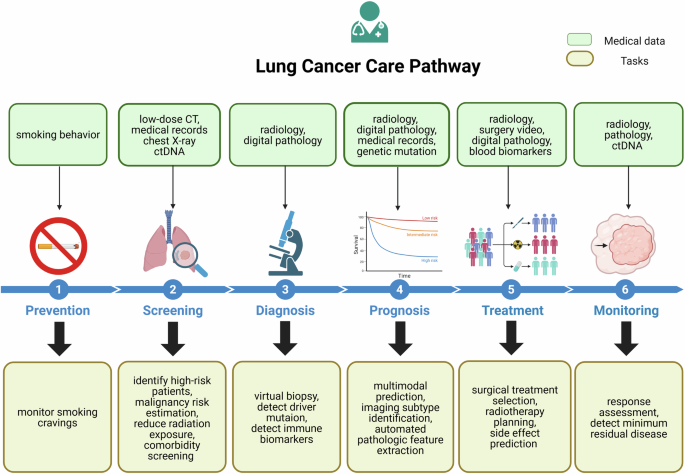
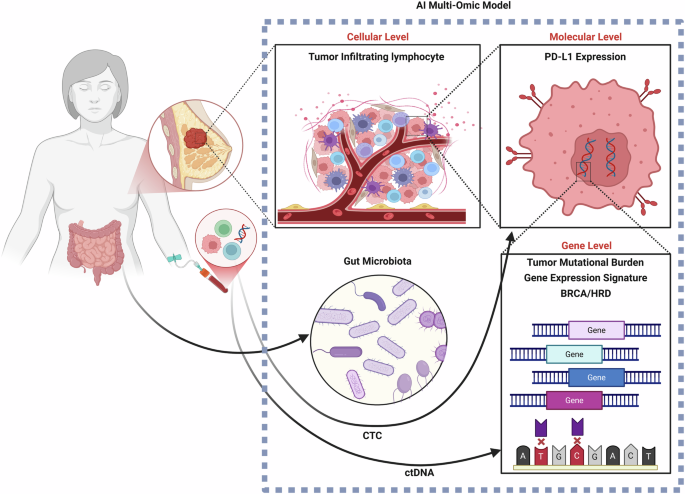
Multimodal models consume more than one type of input simultaneously, rather than treating a single scan or a single lab panel as the whole story. In non-small cell lung cancer, the relevant inputs are unusually varied. Imaging studies capture tumour size, location and spread. Pathology slides carry tissue-level detail about what the cancer cells look like and how aggressive they appear. Clinical records hold performance status, smoking history, prior treatments and comorbidities. Molecular testing adds driver alterations that increasingly determine which therapies a patient is offered.
For years those streams lived in separate systems and were reconciled in a clinician's head. A multimodal model attempts to combine them, on the premise that the combination carries information no single source does. The difficulty is that each stream has its own missingness patterns, its own units and its own reliability. When a model draws on all of them at once, the question of which input drove a given output becomes harder to answer — and that is precisely where explainability enters.
Explainability as a Clinical Requirement, Not a Bonus
An explainable model is one whose reasoning can be surfaced to a human in some interpretable form. In oncology that is not an aesthetic preference. Treatment decisions in NSCLC carry real toxicity, real cost and real irreversibility, and a recommendation that cannot be interrogated is difficult to act on responsibly. When a tool flags a patient as a candidate for one pathway over another, the treating team needs to know which features pushed the assessment and how strongly.
The paper's framing treats explainability and usability as linked rather than sequential problems. Among the considerations that pairing raises:
- Whether explanations are expressed in terms clinicians already use, rather than in abstract feature weights.
- Whether the tool clarifies a decision the clinician was already weighing, or introduces a competing judgement that has to be adjudicated.
- Whether explanations remain stable across patients who look similar on paper, so that trust is not built on coincidence.
- Whether the interface fits the pace of a real tumour board, where time per case is measured in minutes.
Each of these is a usability question as much as a machine learning question, and each is the kind of thing a purely retrospective accuracy benchmark cannot answer.
Why "Large, International, Real-World" Matters
The study is described as a large international real-world investigation. Those three adjectives do a lot of work together. Multi-centre and multi-country data reduce the risk that a model has simply learned the habits of one hospital's equipment, coding conventions or referral patterns. Real-world data, as opposed to tightly curated trial cohorts, reflects the messier mix of patients clinicians actually see — including those who would never have met strict eligibility criteria in a prospective study.
The trade-off is that real-world datasets are noisier, and the path from raw records to model-ready inputs is rarely clean. How a team handles that translation shapes what the reported performance ultimately means. A large international sample makes the findings more portable in principle, but portability still has to be demonstrated rather than assumed.

Where AI Tools Usually Stall
Clinical usability testing addresses the gap between a model that works and a model that gets used. The recurring failure modes are well documented across clinical AI: alerts that fire so often they are dismissed, dashboards that duplicate information already on screen, and outputs that arrive after the decision has effectively been made. A decision support tool has to earn its place in a workflow that is already crowded.
By naming clinical usability directly in the title, the study signals that the authors measured something beyond discrimination and calibration. Usability work typically asks whether clinicians can interpret the tool's output, whether they agree with it, whether it changes their stated plan, and whether it slows them down. Those measures are harder to summarise in a headline number, which is part of why they are frequently skipped.
Questions the Paper Leaves Open
Several things sit outside what a single study of this shape can settle. Performance measured against retrospective outcomes is not the same as improved patient outcomes, and demonstrating the latter requires prospective evaluation. Explanation quality is also difficult to quantify — a model can produce an explanation without that explanation being faithful to the computation that produced the prediction. And adoption depends on institutional factors, from electronic record integration to who carries liability when a recommendation is followed and the result is poor.
There is also the question of how such a tool behaves as practice changes. Treatment paradigms in NSCLC shift quickly as new agents and biomarker-defined subgroups emerge. A model trained on one era's decisions may encode patterns that clinicians have since abandoned.

Why This Lands Now
Lung cancer remains one of the most consequential areas for decision support, because the number of plausible treatment paths has grown faster than the amount of time available to reason through each case. Multimodal models promise to compress that reasoning; explainability and usability determine whether the compression is trustworthy. Publishing this combination of model evaluation and clinical usability assessment in a high-profile venue puts a marker down: the field is increasingly being asked to show not only that a model predicts well, but that a clinician can work with it. The next test is whether tools of this kind hold up when they are deployed prospectively, in the clinics that would use them.
This article is based on reporting by Nature Medicine. Read the original article.
Originally published on nature.com