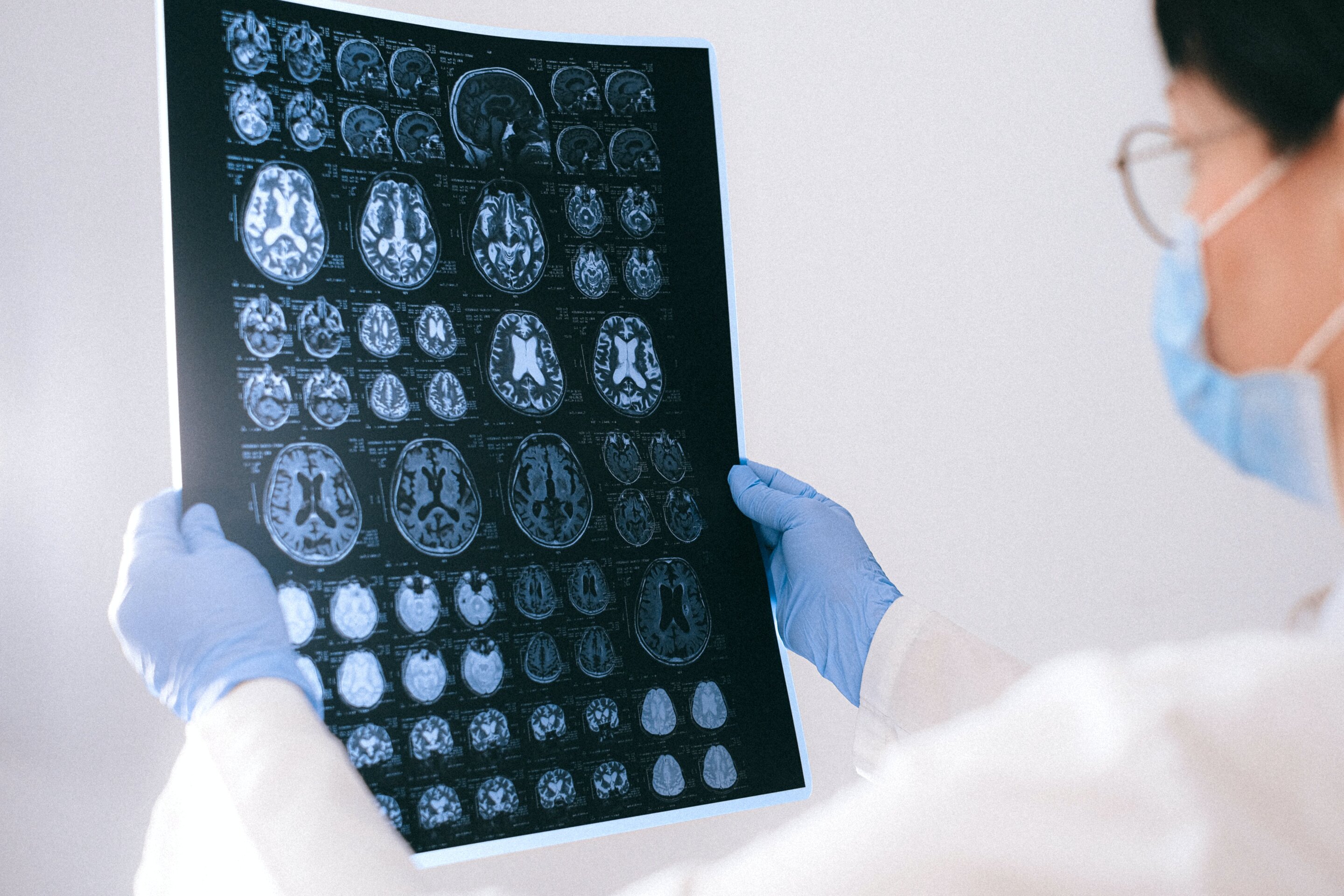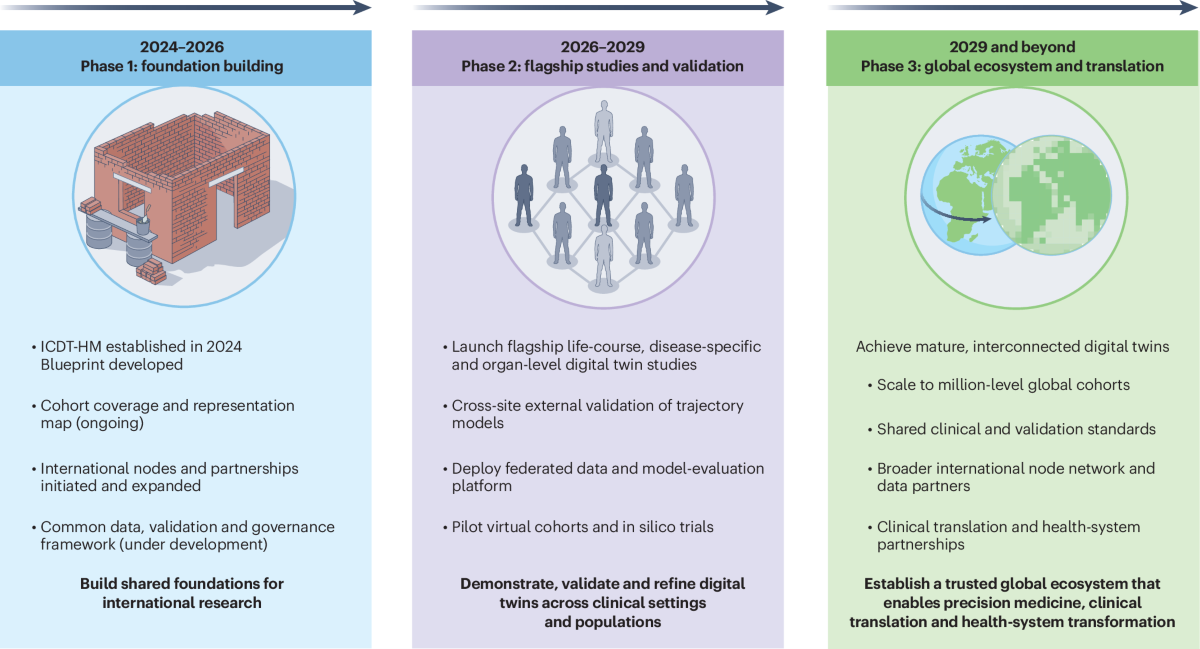
Precision medicine has spent years promising care tailored to the individual rather than the statistical average. A newly announced initiative, published in Nature Medicine, takes a step toward making that promise operational on a global scale: the International Consortium of Digital Twins in Healthcare and Medicine.
According to the publication's summary, the consortium was established to advance medical digital twins — computational counterparts of biological systems that can be simulated, interrogated, and refined as new data arrives. The journal frames the effort as a "global digital navigator of human health," a description that points to something broader than a single laboratory project: a coordinated, internationally shared layer of modeling capability intended to guide both clinical decisions and biomedical research.
What the consortium is setting out to do
The available summary is compact, but its essential elements are clear. The initiative is international in composition and ambition. It sits within healthcare and medicine generally rather than inside one specialty. And its declared purpose is to advance the field of medical digital twins — the tools, standards, and scientific foundations that would allow such models to be used responsibly at scale.
The phrase "global digital navigator" is the most suggestive part of the description. A navigator, in this reading, is not simply a model of one patient or one organ. It is an orienting layer: something that helps clinicians, researchers, and health systems find their way through an enormous and rapidly growing space of biological and clinical data. Building that layer is inherently collaborative, because no single institution, country, or health system holds enough of the relevant diversity — in populations, in diseases, in data types — to construct it alone.
Digital twins in medicine are not one technology but a family of related approaches. In practice, work in this area typically involves several recurring ingredients:
- Detailed, longitudinal data drawn from imaging, genomics, laboratory results, wearables, and electronic health records.
- Computational models that represent how a system behaves over time, not merely how it appears in a single snapshot.
- Simulation and updating loops, so a model can be tested against what actually happens and revised accordingly.
- Validation against real clinical outcomes, which is what separates a useful tool from an elegant but untrustworthy simulation.
From documentation to simulation
Today's health records are largely descriptive. They document what happened. A digital twin is meant to be generative: it allows a question to be asked before it is answered in a real body. That shift — from recording the past to exploring possible futures — is what makes the approach appealing to precision medicine, where the central problem is that two patients with the same diagnosis may need very different interventions.
The role of a navigator
If the consortium succeeds in its stated aim of advancing the field, the practical result would be infrastructure that others can build on: shared methods, shared benchmarks, and a common vocabulary. That is the sense in which a "navigator" is useful. Individual research groups can build a model of a heart or a tumor. Making thousands of such models comparable, interoperable, and clinically credible is a different kind of problem — an organizing problem, and one that benefits from international coordination.

Why precision medicine needs shared foundations
Precision medicine rests on a simple observation: populations are not uniform. Genetic background, environment, behavior, age, and the presence of other conditions all shape how a disease unfolds and how a treatment performs. Models built on narrow datasets tend to encode those datasets' limitations, which is why the international character of the consortium matters. Broad participation is one route toward models that do not simply reproduce the biases of whichever population happened to be easiest to study.
The same logic applies to trust. A digital twin that informs a clinical decision carries weight far beyond that of an academic simulation. Earning that weight requires transparency about how a model was built, what data it saw, and where it is known to fail. Consolidating these expectations across institutions and borders is precisely the sort of work a consortium is positioned to undertake.
Open questions
Because the Nature Medicine item functions as an announcement rather than a report of completed results, many specifics remain to be settled. Among the questions the field will be watching:
- What standards the consortium adopts for validating digital twins against real patient outcomes.
- How data governance will work when models draw on health records from multiple jurisdictions with differing privacy rules.
- Whether the tools developed will be accessible to health systems with limited resources, or concentrated in well-funded centers.
- How the effort connects with existing regulatory pathways for clinical software and medical devices.
- What role patients will play in shaping how their data feeds these models.
None of these are small matters. The history of health data initiatives suggests that the technical challenges, while serious, are often easier to resolve than the questions of governance, equity, and consent.

Timeline and where to find it
The item was published online in Nature Medicine on 11 September 2026, with the digital object identifier 10.1038/s41591-026-04621-1. As an announcement of a consortium rather than a study, it establishes intent and scope; results in the form of published models, benchmarks, or clinical demonstrations would come later.
What to watch next
For readers tracking the convergence of AI, simulation, and medicine, the consortium is worth following for a few concrete reasons. First, it signals that digital twins are moving from a collection of impressive individual projects toward a field with shared expectations. Second, an explicitly international framing suggests attention to the generalizability problem that has dogged so much health modeling. Third, the "navigator" language implies an aspiration to something usable at the point of care, not merely publishable in a journal.
Precision medicine has always been easier to describe than to deliver, largely because the individual-level detail required is expensive to gather and hard to interpret. Digital twins offer a structured way to use that detail once it exists. Whether the International Consortium of Digital Twins in Healthcare and Medicine becomes the coordinating force the field needs is an open question — but the announcement in Nature Medicine places the ambition squarely on the record.
This article is based on reporting by Nature Medicine. Read the original article.

Originally published on nature.com