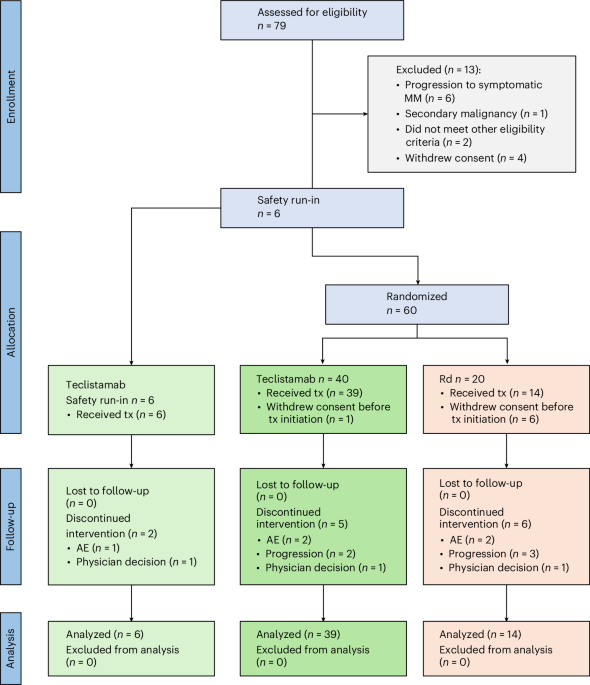
A randomized head-to-head in an unusual disease stage
Nature Medicine has published a randomized phase 2 trial that pits an injectable bispecific antibody against a long-established oral regimen in patients who do not yet have symptoms of active cancer. The paper, titled “Teclistamab versus lenalidomide-dexamethasone in high-risk smoldering multiple myeloma: a randomized phase 2 trial,” appeared online on 11 September 2026 under DOI 10.1038/s41591-026-04642-w, and it reports results from a study called ImmunoPRISM.
The comparison is notable for the population it targets. Smoldering multiple myeloma sits in the space between a benign-looking blood abnormality and full-blown myeloma, and the timing of treatment in that window has been argued over for years. The journal’s summary states that patients with high-risk smoldering disease showed a higher result on the highlighted measure, with the complete analysis — endpoint definitions, effect sizes and safety data — laid out in the paper itself.
What smoldering multiple myeloma is
Smoldering multiple myeloma is defined by the presence of clonal plasma cells and a monoclonal protein in the blood or urine, without the organ damage that defines active myeloma: no myeloma-related anemia, no kidney injury, no bone lesions, no elevated calcium. Patients often feel entirely well. For most of them, the standard approach has been observation with regular blood tests, reserving therapy for the moment the disease crosses into active myeloma.
That watch-and-wait posture is not uniform, though. A subset of patients progresses quickly, and for them the calculus shifts. Clinicians use markers such as the proportion of plasma cells in the bone marrow, the ratio of involved to uninvolved serum free light chains, and the number of focal lesions seen on MRI to sort patients into risk tiers. Those designated high-risk have a meaningful chance of developing symptomatic disease in the near term, and that is the group ImmunoPRISM enrolled.
The logic of treating earlier is straightforward: hitting a smaller, less genetically scrambled tumor burden may be easier than chasing a disease that has already damaged organs. The counterargument is equally familiar. Some patients never progress, so early treatment would expose them to toxicity and cost for no benefit — and it remains an open question whether moving a therapy earlier actually extends life or merely shifts the date at which progression is recorded.

Two very different treatment strategies
Teclistamab
Teclistamab belongs to the bispecific antibody class. It binds BCMA — B-cell maturation antigen, a protein expressed on the surface of myeloma plasma cells — with one arm and engages T cells through the other, pulling a patient’s own immune cells into contact with the tumor. It is given as a subcutaneous injection and has an established role in relapsed and refractory multiple myeloma, where it carries a risk of cytokine release syndrome and neurologic side effects that require step-up dosing and close monitoring.
Bringing that mechanism into an asymptomatic population raises the safety bar considerably. Patients with smoldering disease are not yet sick and may have years of ordinary life ahead of them, so any toxicity has to be weighed against a benefit measured in delayed progression rather than in symptomatic rescue.
Lenalidomide plus dexamethasone
The comparator arm is a familiar one. Lenalidomide is an oral immunomodulatory drug that has been a workhorse of myeloma therapy for two decades, and it is frequently paired with dexamethasone, a corticosteroid that both acts against plasma cells and dampens inflammation. The combination is inexpensive by oncology standards, entirely oral and widely used, which makes it a sensible benchmark for any new agent hoping to justify a different route of administration, a different side-effect profile and a far higher price.
Why a randomized design matters at this stage
Phase 2 oncology trials are frequently single-arm: everyone receives the experimental drug, and the result is compared against historical expectations. That design is fast but fragile, because smoldering myeloma follows such a variable course that a single-arm result can be difficult to interpret. Randomizing teclistamab against an active standard rather than against observation removes some of that ambiguity — the two groups are followed on the same schedule with the same assessments, so differences are easier to attribute to treatment rather than to patient selection or follow-up intensity.
It also sets up a cleaner comparison for the endpoints that matter in this setting. In smoldering myeloma, researchers track how many patients convert to active disease over time, how deep responses go — including the disappearance of measurable disease, or minimal residual disease negativity — and how long those responses hold. Quality-of-life and toxicity measures carry unusual weight when the alternative to treatment is doing nothing at all.

What the publication reports and what comes next
According to the journal’s summary, patients with high-risk smoldering multiple myeloma showed a higher result on the highlighted measure in the ImmunoPRISM study. The paper itself carries the full data set, including the primary endpoint analysis, subgroup findings and adverse events for both arms. As with any randomized phase 2 readout, the findings are best read as hypothesis-generating rather than definitive.
The natural next step for a result like this is a larger randomized phase 3 trial powered to demonstrate a difference in a clinically decisive endpoint, typically progression-free survival and ideally overall survival. Whether such a study materializes may depend on how durable the observed effect proves to be and how tolerable the bispecific arm is over months and years rather than weeks. Regulators, payers and clinicians will also want evidence that treating high-risk smoldering disease earlier translates into fewer complications from active myeloma — fewer fractures, less kidney damage, fewer hospital admissions — rather than simply a longer period of treatment.
For now, the ImmunoPRISM report adds a randomized data point to a debate that has long been shaped by single-arm studies and expert opinion. It gives researchers a direct comparison between an immune-engaging injectable and a cheap, familiar oral backbone in exactly the patients most likely to progress, and it puts the tolerability question squarely on the table.
Key takeaways
- Nature Medicine published a randomized phase 2 study on 11 September 2026 comparing teclistamab with lenalidomide-dexamethasone in high-risk smoldering multiple myeloma.
- The trial is named ImmunoPRISM and enrolled patients with the high-risk form of the precursor condition to active multiple myeloma.
- Teclistamab is a BCMA-directed bispecific antibody given subcutaneously; lenalidomide plus dexamethasone is an all-oral immunomodulatory combination.
- The journal’s summary reports a higher result for patients on the trial’s highlighted measure, with full endpoint and safety data contained in the paper.
- Randomized phase 2 data in this population help clarify whether earlier intervention outperforms an active oral standard.
- Confirmatory phase 3 work would be needed before treatment practice changes for the high-risk smoldering population.
This article is based on reporting by Nature Medicine. Read the original article.

Originally published on nature.com