A Large-Scale Look at Mutations That Begin With the Child
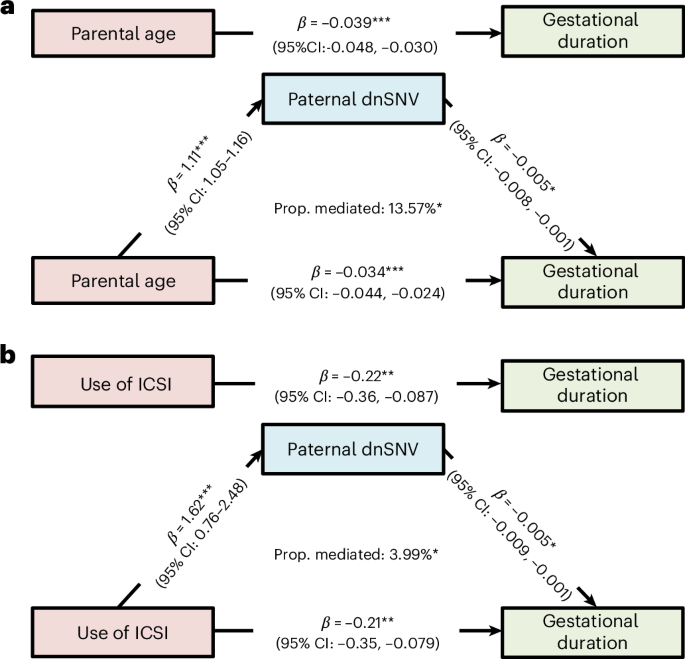
A newly published study in Nature Medicine places a substantial genomic dataset behind a question that has long resisted direct measurement: how do the biological circumstances of parents shape the health of the children they have? The paper, titled "De novo mutations bridge parental reproductive factors and offspring health," appeared online on 14 September 2026 and is framed around the idea that newly arising mutations act as a connecting thread between the two.
The headline number behind the work is 7,851 — the count of parent–offspring families whose genomes were sequenced in full. That scale matters. De novo mutations, by definition, are not inherited from either parent. They appear for the first time in a child, which means they cannot be detected by looking at parents alone, and they cannot be reliably catalogued without comparing a child's genome against the genomes of both biological parents. A cohort of this size gives researchers the statistical footing to look at patterns rather than isolated cases.
According to the study's summary, the sequencing effort enabled the identification of parent-of-origin effects alongside a second, post-zygotic class of mutation signatures. In other words, the analysis was designed not simply to count new mutations, but to ask where they came from and when they arose.
What the Study Set Out to Do
The title itself lays out the logic of the investigation. Parental reproductive factors — the conditions, timing and biology surrounding conception — sit on one side. Offspring health sits on the other. De novo mutations are positioned in between, as the proposed bridge.
Whole-Genome Sequencing Across Thousands of Families
Whole-genome sequencing reads the complete genetic code rather than selected regions, which is essential when the goal is to spot mutations that exist in a child but in neither parent. Across thousands of trios and larger family units, that approach allows researchers to separate genuine new mutations from inherited variants, and to do so at a resolution that narrower genetic tests cannot match.
Parent-of-Origin and Post-Zygotic Signals
The study's summary highlights two distinct categories of findings. Parent-of-origin signals describe mutations traceable to the maternal or paternal germline — the reproductive cells that carry genetic material into the next generation. Post-zygotic signatures, by contrast, point to changes that arise after fertilisation, as the early embryo begins to divide. Distinguishing between the two is important because they imply different underlying mechanisms and potentially different consequences for a child's development.

Why De Novo Mutations Are a Useful Bridge
De novo mutations occupy an unusual position in genetics. They are rare at the level of any single family, but they accumulate predictably across a population. Because they are not passed down, they offer a cleaner signal than inherited variation when researchers want to ask whether a parental characteristic is associated with genetic change in the next generation.
Several features make them well suited to this kind of analysis:
- They are identifiable only through parent–offspring comparisons, making family-based sequencing the natural study design.
- They arise during a defined window — in the germline before conception, or in the earliest stages of embryonic development — which allows researchers to reason about timing.
- They can be assigned, at least in part, to a parent of origin, linking a mutation back to one side of the family.
- They provide a measurable, molecular outcome that sits between a parental exposure or condition and a health outcome in the child.
That last point is what the study's framing turns on. If parental reproductive factors are associated with offspring health, de novo mutations offer a plausible mechanism by which that association could operate — a biological route rather than a statistical correlation alone.
Parental Reproductive Factors in the Frame
The phrase "parental reproductive factors" is deliberately broad. It can encompass the biological realities of the parents at the time of conception, the dynamics of the germline, and the early developmental environment in which an embryo forms. What the study appears to test is whether variation on that side of the equation is reflected in the mutation patterns observed on the other.
This is a hard question to answer well, because parental factors are tangled together in real populations. Age, health status, environmental exposures and reproductive history rarely vary in isolation. The value of a dataset numbering nearly eight thousand families is that it creates room to disentangle some of those threads — though, as with any observational genomic study, disentangling all of them is another matter.

Reading the Results Responsibly
There are limits worth keeping in view. Whole-genome sequencing of parent–offspring families can reveal that de novo mutations differ in number or in type across groups, and it can show that those differences track with parental characteristics. What it cannot do on its own is prove that a specific parental factor caused a specific health outcome in a specific child.
The word "bridge" in the paper's title is instructive. A bridge connects two shores; it does not explain everything that happens on either one. The findings are best read as evidence about a pathway — a way in which parental biology may leave a mark on the next generation's genome — rather than as a verdict on any individual family's circumstances.
It is also worth noting that the study's public summary is brief, and the deeper detail of its analysis will live in the full text. Readers should look for the specifics: which parental factors were examined, how the mutation classes were defined, what effect sizes emerged, and how the authors controlled for confounding.
What the Work Points Toward
The broader significance lies in the study design as much as in any single result. Large, deeply sequenced family cohorts are becoming a practical foundation for questions that once had to be approached indirectly and with much smaller samples. As these datasets mature, they open the door to tracking mutation patterns against health records and developmental outcomes over time.
That trajectory suggests several directions the field is likely to pursue:
- Refining how parent-of-origin effects are attributed, so that maternal and paternal contributions can be separated more sharply.
- Clarifying which post-zygotic signatures matter for development and which do not.
- Testing whether findings hold across different populations, since genomic cohorts have historically skewed toward a narrow set of ancestries.
- Turning statistical associations into mechanistic explanations that could, eventually, inform clinical guidance.

The Bottom Line
By sequencing 7,851 parent–offspring families, researchers have produced a detailed map of mutations that begin with a child rather than being inherited, and have used it to examine how those mutations sit between parental reproductive factors and offspring health. The study positions de novo mutations as a mechanistic link worth taking seriously. Confirming how strong that link is — and for whom — will be the work of the years that follow.
This article is based on reporting by Nature Medicine. Read the original article.
Originally published on nature.com