Solar abundance does not erase environmental tradeoffs
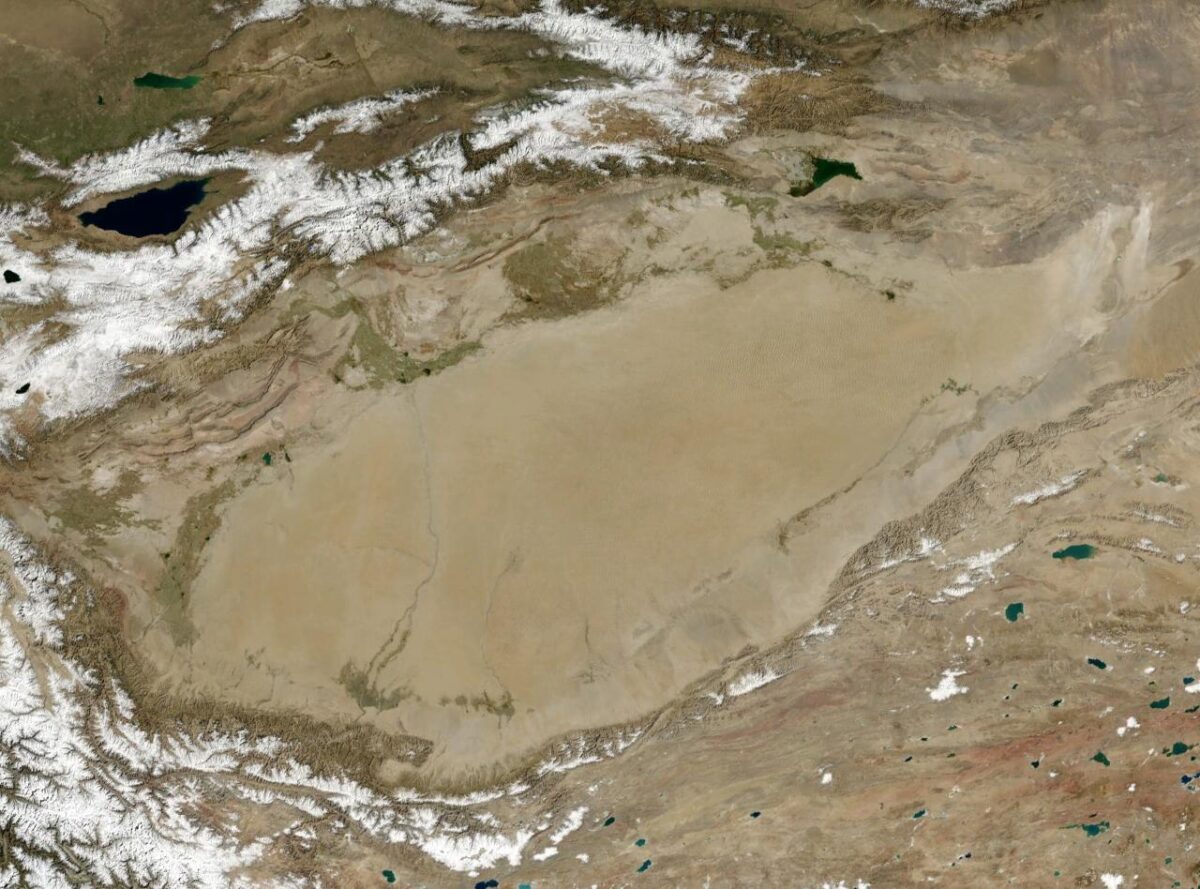
The Tarim Basin in western China has enormous solar potential, but new research suggests that a truly massive photovoltaic buildout there could come with a serious regional cost: deeper water stress in an already arid system. Researchers examining an extreme deployment scenario across the Taklamakan Desert found that utility-scale solar at very large scale could alter local climate dynamics and aggravate pressure on water resources.
The finding is a reminder that even low-carbon infrastructure can reshape the environments in which it is deployed. Solar energy is often discussed in terms of emissions, cost, and land use. This study pushes attention toward another variable that matters in dry regions: how surface changes associated with sprawling panel arrays may feed back into temperature, evaporation, and hydrological balance.
That concern is especially sharp in the Tarim Basin because the region is already defined by water scarcity. It is one of the driest large deserts in the world, with very low precipitation and extremely high evaporation rates. Water availability depends heavily on meltwater from surrounding glaciers and seasonal snow, which supply the basin’s river systems.
Why the basin is vulnerable
The hydrology of the Tarim Basin is fragile even before any climate effects from large solar installations are considered. Regional glaciers are retreating, and that means the long-term reliability of meltwater feeding the basin is increasingly uncertain. In other words, the area’s water system is already under pressure from broader climatic shifts.
Against that background, the researchers modeled a scenario in which most of the basin would be covered by utility-scale photovoltaic installations. PV Magazine emphasizes that this was an extreme setup, with total electricity generation exceeding current global demand. The scenario is not a forecast of what will literally be built. It is a stress test meant to reveal how very large-scale solar deployment could influence the surrounding environment.
Using an intentionally outsized scenario has value because it makes climate interactions easier to detect. It asks not whether a single solar farm changes the basin, but whether transforming much of the desert surface into energy infrastructure could produce system-level effects that planners need to understand before buildout reaches very large scales.
What the study suggests
The core result is that massive PV deployment in the Taklamakan Desert could alter regional climate dynamics in ways that intensify water stress. The source text does not present this as an argument against solar development in general. Instead, it highlights a specific risk in a specific geography: the physical presence of extensive panel arrays may interact with local atmospheric and land-surface processes in ways that compound aridity rather than easing it.
That matters because the Tarim Basin is often seen as attractive precisely because it is vast, sunny, and sparsely populated. In energy planning, deserts can look like obvious locations for giant renewable projects. But the new research argues that suitability cannot be judged by sunlight and space alone. In water-limited systems, climate feedbacks must also enter the equation.
The study therefore complicates a common assumption in the clean-energy transition: that scaling renewables in harsh environments is mostly an engineering and transmission challenge. In some places, it may also be a regional environmental-management challenge.
Implications for energy strategy
China’s solar expansion has been among the most ambitious in the world, and desert regions are central to many long-term visions of utility-scale generation. Findings like these do not eliminate that path, but they do suggest that scale and placement deserve more scrutiny. An installation that looks beneficial in grid terms could still generate unintended local stress if it shifts evaporation, surface energy balance, or downstream water availability.
This is particularly important when a region depends on glacial and snow-fed river systems that are already exposed to warming. Any additional factor that worsens water stress may have consequences for ecosystems, agriculture, and communities tied to those flows.
The broader lesson extends beyond western China. Many countries are eyeing deserts and semi-arid regions for large renewable projects. As deployment grows, the environmental conversation will need to move beyond the idea that solar has no meaningful local footprint. Its footprint is vastly different from fossil energy, but it is not zero.
A more mature view of renewable scale
One of the strengths of the study is that it pushes renewable planning into a more mature phase. Early debates often asked whether solar worked. Today, in many places, it clearly does. The harder question is how to deploy it at enormous scale without underestimating regional side effects.
That is not a contradiction of decarbonization. It is a requirement for doing decarbonization well. A transition built on oversimplified assumptions can create new pressures even while solving older ones. Research like this is valuable precisely because it surfaces tradeoffs before they become infrastructure lock-in.
It also reinforces the need for location-specific modeling. A design that is low risk in one desert may behave differently in another depending on water sources, soil conditions, topography, and the surrounding climate system. Treating all high-insolation regions as interchangeable would be a mistake.
Planning for both power and water
The Tarim Basin study does not say solar should stay out of deserts. It says very large-scale deployment in an arid basin with climate-sensitive water supplies may have consequences that cannot be ignored. The fact that the modeled scenario exceeds current global electricity demand does not make the warning irrelevant. It makes the underlying mechanisms easier to spot before real projects approach comparable density.
As renewable infrastructure gets bigger, so do the stakes of getting siting right. In the Tarim Basin, the central challenge is not a shortage of sunlight. It is whether one of the world’s driest landscapes can absorb a transformed surface without making water scarcity worse.
For policymakers and planners, that means the future of utility-scale solar will depend not only on how much energy can be harvested, but on how carefully the environmental context of that harvesting is understood. In drylands, clean power and water resilience may need to be planned together or risk working against each other.
This article is based on reporting by PV Magazine. Read the original article.
Originally published on pv-magazine.com