A major offshore wind project enters its next phase
One of Poland’s most significant clean-energy projects has moved into offshore construction. Ørsted and PGE have begun installation work on Baltica 2 in the Polish sector of the Baltic Sea, marking the start of the foundation phase for a 1.5-gigawatt wind farm that the companies say will generate enough electricity to supply roughly 2.5 million households.
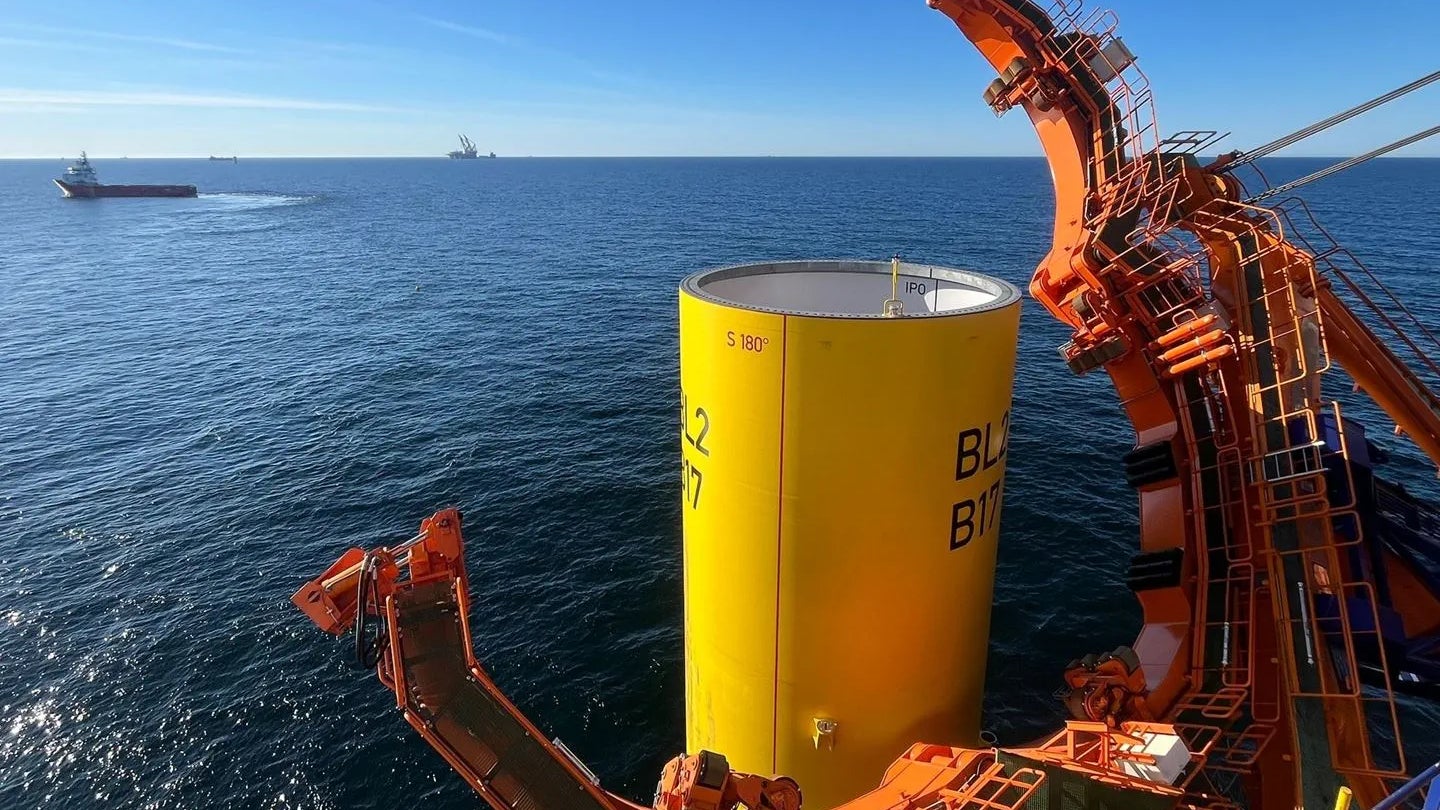
The first monopile foundations have already been installed, turning a long-developed project into visible marine construction. For Poland, the step matters beyond headline capacity. It signals progress on a large source of domestic zero-emission generation at a time when energy security, system diversification and industrial build-out remain tightly linked.
The scale of the engineering
Baltica 2 is a large physical undertaking. Van Oord is carrying out the installation program for 111 monopiles, of which 107 will support wind turbines and four will serve offshore substations. Each monopile is around 100 meters long, more than 10 meters in diameter and weighs on average about 1,500 tonnes. These are not generic components. According to the source material, they are engineered for their specific locations and designed to support turbines for around 30 years in marine conditions.
The project is located about 40 kilometers off the Polish coast near Ustka. Construction and offshore operations are being staged from the Port of Gdańsk, which is being used for pre-assembly, storage and deployment of components. That logistical footprint matters because large offshore wind projects do not just add generation; they also create port activity, marine contracting demand and grid-related infrastructure work onshore.
What comes next
The foundation installation campaign is expected to continue through the fourth quarter of 2026. Turbine work will follow, with Siemens Gamesa supplying 107 turbines rated at 14 megawatts each. Installation of those turbines will be handled by Cadeler and Fred. Olsen Windcarrier. Commissioning of the full wind farm is expected by the end of 2027.
Ørsted and PGE share ownership and operational responsibilities equally. That partnership structure reflects the project’s dual role as both an international offshore wind development and a national strategic asset. Once completed, PGE chief executive Dariusz Lubera said the wind farm is expected to generate 5 to 6 terawatt-hours of electricity annually.
Why Baltica 2 matters for Poland
The energy case for the project rests on three overlapping goals. The first is supply. A 1.5-gigawatt offshore wind farm is a substantial addition to Poland’s electricity system, especially one backed by a 25-year contract for difference with the Polish government. That mechanism provides price stability during the support period and reduces financing uncertainty for a project of this scale.
The second goal is security. Poland has been pushing to broaden its energy base, and large offshore resources in the Baltic Sea offer a domestic source of power that is not tied to imported fossil fuels. Lubera explicitly framed the investment as strengthening Poland’s energy security while providing a stable source of zero-emission power.
The third goal is industrial capability. Offshore wind requires a supply chain spanning ports, vessels, foundations, turbines, substations and grid integration. As projects like Baltica 2 move forward, they help define whether Poland becomes merely a host market for offshore assets or builds a more durable role in the wider Baltic wind ecosystem.
A milestone, not the finish line
The project has already secured the necessary permits and a grid connection agreement with Poland’s transmission operator, PSE. Those steps reduce major development uncertainty, but they do not eliminate execution risk. Offshore wind projects remain complex marine operations with long timelines and heavy logistical demands. The installation of the first monopiles is therefore best seen as a milestone that confirms momentum rather than a conclusion.
Still, it is an important one. Offshore wind build-out across Europe has faced cost, supply-chain and financing pressure in recent years. Against that background, concrete progress on a project of this size stands out. Baltica 2 is no longer a target on a policy slide or a capacity number in an investment deck. It is becoming infrastructure in the water.
If construction continues on schedule, Poland will gain not only a large new clean-power asset by the end of 2027 but also a stronger claim to being a serious offshore wind market in the Baltic. For a country balancing decarbonization with security concerns, that combination is likely to matter as much as the headline gigawatts.
This article is based on reporting by Energy Monitor. Read the original article.
Originally published on energymonitor.ai