A practical idea for a persistent solar problem
Floating photovoltaic systems promise to turn reservoirs, industrial ponds, and other water surfaces into power plants without competing for scarce land. But like conventional solar arrays, floating modules still lose performance as they heat up. A research team from FH Aachen University of Applied Sciences in Germany says a relatively simple spray-cooling setup could help address that problem, and it has now built a dynamic model to show when the approach works best.
The researchers developed what they describe as a system-level model of spray cooling for floating PV, linking thermal behavior, electrical output, and active cooling control in one framework. The work was not aimed at an exotic or highly engineered cooling method. Instead, the focus was on a low-cost spray system that could plausibly be deployed in real installations.
That practical emphasis matters. Many cooling concepts for solar modules look promising in theory but become difficult to justify once cost, complexity, maintenance, and real operating conditions are considered. By centering the study on a comparatively straightforward pump-and-sprinkler arrangement, the team is positioning spray cooling less as a laboratory novelty and more as a candidate for targeted field use.
Model validated against a 750 kW floating PV site
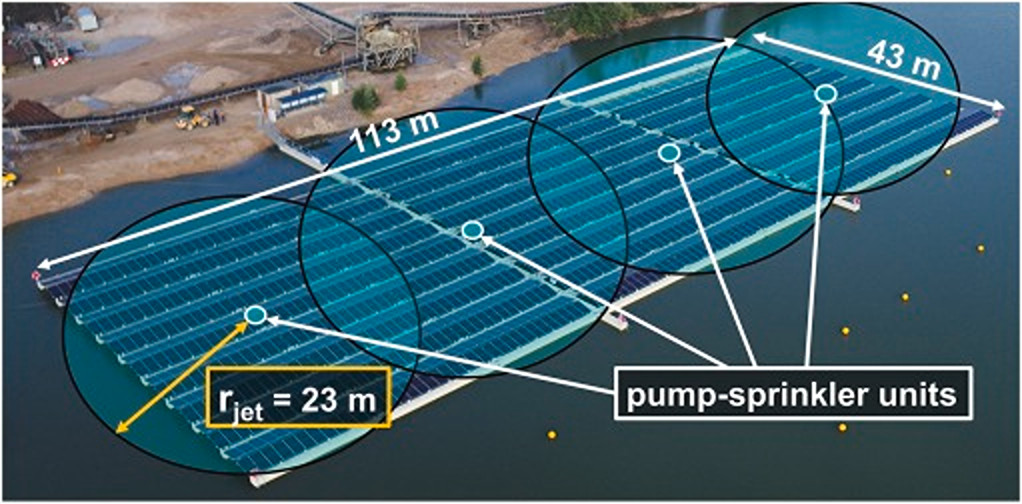
The German team did not stop at simulation. According to the source report, the model was validated against a 750 kW floating PV installation equipped with four pump-sprinkler units. That validation step is important because cooling performance in solar systems depends on fast-changing environmental factors, including temperature, irradiance, humidity, wind, and local operating schedules.
By comparing the model with a real installation, the researchers were able to test whether their framework could capture the behavior of an active cooling system under practical conditions rather than idealized assumptions. The reported result is a more credible basis for estimating how much cooling can improve module performance in different climates.
The headline numbers are notable. Simulations across four climates found that spray cooling can cut module temperatures by as much as 42% and increase energy yield by as much as 3.8%. Those are not universal gains, however. The study emphasizes that benefits depend strongly on local conditions, which means geography and weather patterns will likely determine whether the concept makes economic sense.

Why temperature control matters for floating PV
Solar modules generally become less electrically efficient as they get hotter. Even when sunlight is strong, elevated temperatures can drag down output. Floating arrays already benefit from being installed over water, but that does not eliminate thermal stress altogether. Under some operating conditions, active cooling could push temperatures lower and help recover output that would otherwise be lost.
The appeal of spray cooling is straightforward: use water and a simple delivery system to remove heat from the panel surface. In principle, the concept fits naturally with floating PV because water is already available on site. The challenge is turning that apparent advantage into a system that performs reliably without excessive energy use, maintenance burdens, or operating costs.
The modeling work addresses that challenge by examining cooling as part of the entire power-generating system rather than as an isolated thermal intervention. That broader perspective can help developers assess tradeoffs between the electricity required to run pumps and the additional generation created by cooler modules.
Climate determines the payoff
The most consequential finding may be that spray cooling is highly climate-sensitive. A cooling strategy that delivers worthwhile gains in one region may offer only marginal improvements in another. That means floating PV operators will need more than a generic rule of thumb before deciding to install such systems.
For project developers, this points toward a more selective deployment model. Spray cooling may be best suited to sites where high irradiance and persistent thermal stress combine to create a measurable performance penalty. In milder environments, the extra hardware and operational complexity may be harder to justify.
That distinction could shape how the floating solar industry thinks about optimization. Instead of treating cooling as a universal upgrade, developers may increasingly view it as a location-specific tool, one to be used only where simulation and field data show a strong enough return.

What the research changes
The study does not suggest that spray cooling will transform floating solar economics on its own. A yield gain of up to 3.8% is meaningful, but it is incremental rather than revolutionary. Still, in utility-scale energy projects, even modest percentage improvements can matter if they are delivered consistently and at low cost.
The more lasting contribution may be methodological. By coupling thermal and electrical behavior with active cooling controls and validating the model against an operating plant, the FH Aachen team has provided a more grounded way to analyze when cooling is worth deploying. That could support better project design, more realistic cost-benefit assessments, and smarter adaptation to local climates.
For the broader energy sector, the work reflects a familiar pattern in solar innovation. The biggest gains are no longer coming only from new module chemistries or dramatic hardware overhauls. Increasingly, they also come from system tuning: better controls, smarter site-specific engineering, and targeted interventions that squeeze more output from existing architectures.
Floating solar is still a relatively young segment of the PV market, and developers are continuing to test how best to optimize it across different environments. This new modeling work suggests that active spray cooling deserves a place in that conversation, not as a one-size-fits-all fix, but as a practical option whose value rises or falls with local operating conditions.
Key takeaways
- The researchers modeled spray cooling as part of the full floating PV system, including thermal and electrical effects.
- The approach was validated against a 750 kW installation using four pump-sprinkler units.
- Simulations reported module temperature reductions of up to 42% and energy-yield gains of up to 3.8%.
- The gains are highly dependent on climate, making site selection and local analysis critical.
This article is based on reporting by PV Magazine. Read the original article.
Originally published on pv-magazine.com




