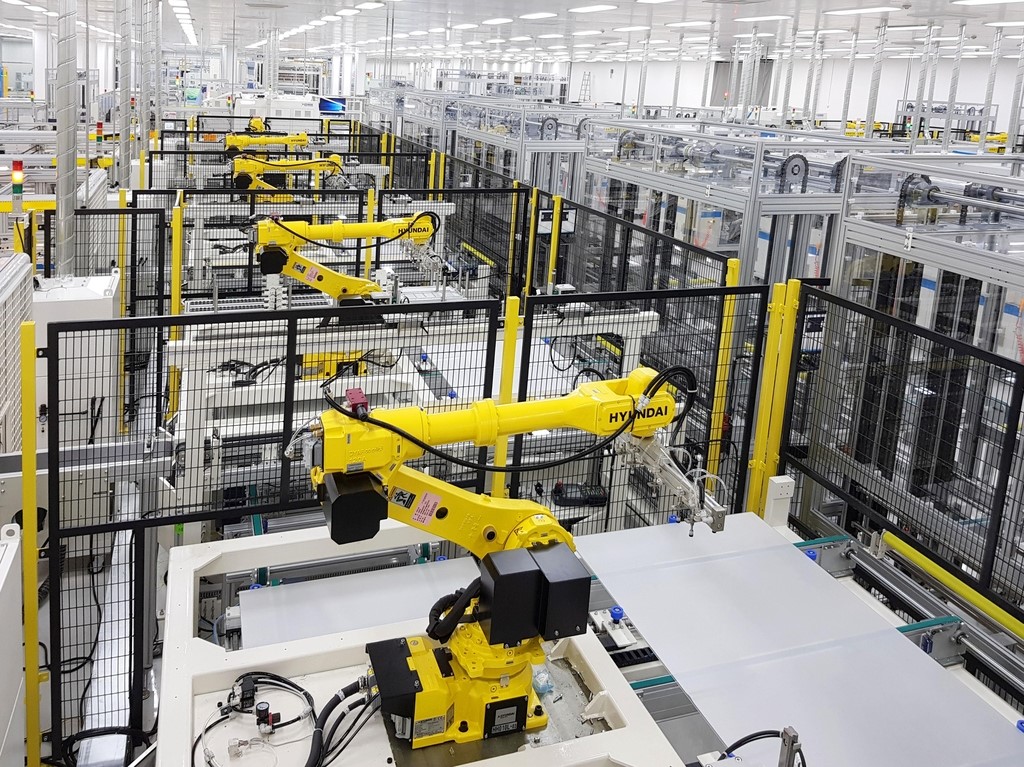
Seoul adds a carbon standard to industrial support
South Korea has expanded investment tax credits for solar manufacturing facilities that meet a defined carbon-emissions threshold, giving domestic producers a clearer incentive to invest in lower-carbon production. Under revised enforcement rules that took effect on April 1, photovoltaic module facilities producing at or below 655 kilograms of carbon dioxide per kilowatt are eligible for the credits.
The change is notable because it ties industrial support to a measurable carbon-performance benchmark rather than offering a simple blanket subsidy. In effect, the policy rewards manufacturers not only for producing solar equipment, but for producing it with a lower embedded carbon footprint.
What the revised rule does
According to the report, South Korea’s updated framework clarifies that investment tax credits apply to facilities producing photovoltaic modules within the threshold. The Korea Photovoltaic Industry Association said the revision covers the full production ecosystem rather than isolated manufacturing steps. That matters because it suggests the government is trying to shape entire supply chains, not just individual process upgrades.
The policy direction is also consistent with a wider trend described in the source material: South Korea is increasingly using procurement rules and tax measures to support domestic solar manufacturers. Rather than competing on price alone, companies are being encouraged to compete on product quality and carbon performance.
Why it matters for the solar market
Solar power is usually discussed in terms of emissions savings during operation. But policymakers and buyers are paying more attention to emissions tied to manufacturing itself. That makes the carbon footprint of a module a commercial characteristic, not just a sustainability talking point.
South Korea’s revised tax treatment reflects that shift. If manufacturers can qualify for tax credits by meeting a carbon benchmark, low-emissions production becomes directly linked to project economics. That could influence investment decisions about factory upgrades, technology choices, and sourcing strategies.
It could also affect how domestic producers position themselves in markets where buyers care about supply-chain emissions. The report says the revisions are intended to increase incentives for local manufacturers to adopt low-carbon production processes and secure high-efficiency technologies. That combination is important: the policy is not framed as a simple protectionist measure, but as a way to promote a different basis for competition.
Competition beyond price
The source material cites the industry association’s view that the revised rule gives domestic companies with strong technological capabilities a basis to compete on quality and carbon performance rather than price. That distinction is central to the strategy. Solar manufacturing is highly price competitive, and producers in many countries face pressure from larger-scale rivals. By attaching fiscal support to carbon intensity, South Korea is effectively trying to create an advantage for manufacturers able to demonstrate cleaner production.
That approach also aligns with a broader industrial logic. If governments want domestic manufacturing capacity in strategic clean-energy sectors, they may need tools that do more than subsidize output. They may also want those tools to steer investment toward technologies that can meet stricter environmental expectations over time.
A signal for future policy design
The revised rule could have significance beyond South Korea. Carbon-accounting rules, procurement standards, and industrial incentives are becoming more prominent in clean-energy policy worldwide. A threshold-based tax credit creates a model that other governments may study, especially if they want to support domestic manufacturing while maintaining a climate rationale for intervention.
There are still open questions the source text does not answer, including how producers will document compliance, how widely the credits will be used, and whether the policy materially changes production economics. But the policy direction is clear. South Korea is treating low-carbon manufacturing as something that can be defined, measured, and rewarded.
Why this is more than a narrow tax change
On paper, the announcement is a technical revision. In practice, it signals a more strategic view of solar manufacturing. The country is not only backing domestic production capacity; it is trying to shape what kind of production wins support. If successful, that could help turn carbon performance from an external reporting metric into a factor that directly guides capital spending in the solar sector.
For manufacturers, the message is immediate: cleaner production can now carry clearer fiscal value. For policymakers, the message is broader: industrial competitiveness and emissions standards are no longer separate conversations. In solar, they are becoming part of the same policy design.
This article is based on reporting by PV Magazine. Read the original article.
Originally published on pv-magazine.com