Hydrogen’s next phase is looking less like a land rush and more like a test of discipline
The low-carbon hydrogen market did not experience a dramatic contraction in the first quarter of 2026. Instead, it became more selective. That is the central message from GlobalData’s Q2 2026 hydrogen market outlook, which points to a sector moving beyond announcement-driven expansion and toward projects that can actually be financed, permitted, supplied with power, and connected to real industrial demand.
On the surface, the quarter’s headline change was relatively modest: total announced capacity fell by 360 kilotonnes per annum. On its own, that decline does not suggest a market in retreat. What matters more is what the change appears to say about investor behavior. Developers seem less willing to add speculative projects while policy settings, financing conditions, and long-term offtake arrangements remain uncertain.
That shift may mark an important transition for hydrogen’s role in the broader energy economy. For several years, momentum in the sector was often measured by the size of project pipelines and the scale of national ambitions. The latest outlook suggests that those headline figures are becoming less important than the practical work needed to move projects from concept to construction.
Progress is shifting deeper into the project pipeline
GlobalData reported growth in projects moving through feasibility, front-end engineering and design, and construction. That matters because it points to a market that is still active, but is becoming more grounded in execution. In other words, fewer projects may be getting announced, while more of the viable ones are advancing through the difficult stages that determine whether capacity will ever be built.
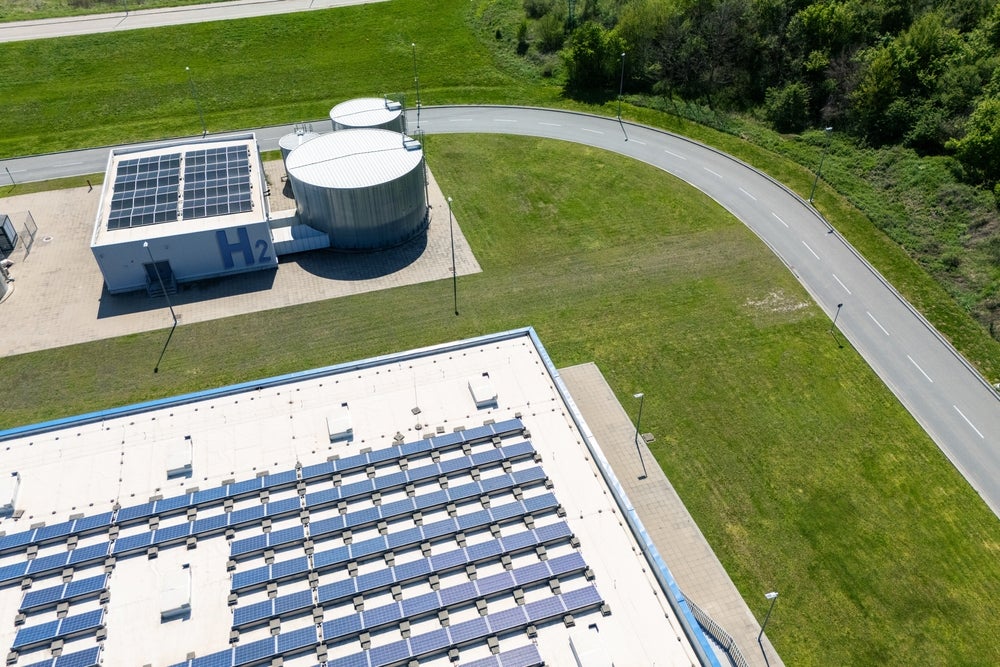
For renewable energy companies, this changes the nature of the opportunity. Hydrogen is looking less like a standalone technology bet and more like a systems challenge. Success increasingly depends on whether developers can combine renewable generation, grid access, permitting, and industrial demand into a commercially credible package. That is a much narrower gateway than simply announcing a large electrolyzer target.
Delivery discipline, in that context, may become more valuable than sheer scale ambition. A smaller project with strong renewable power access, realistic permitting, and durable subsidy support could now be more attractive than a much larger concept with unresolved commercial assumptions.

Green hydrogen is holding ground while blue hydrogen faces new pressure
The divergence between production pathways in the first quarter adds another layer to the story. Green hydrogen remained stable and continued to dominate announced capacity. Blue hydrogen moved in the opposite direction, with announced capacity falling 6.2% over the quarter.
According to the outlook, part of that decline reflects rising natural gas prices and expectations of further volatility linked to conflict in the Middle East. For investors, that reinforces a structural problem with blue hydrogen economics: exposure to gas markets. When feedstock prices move sharply, production costs can change quickly, confidence in long-term supply agreements can weaken, and financing risk can increase.
That does not mean blue hydrogen disappears from the mix. But the first quarter appears to show investors becoming more cautious about pathways that remain tightly coupled to commodity risk. Renewable-powered electrolysis is not insulated from cost pressure, but it is not exposed to gas prices in the same way.
A market maturing through constraint
The sector’s changing tone is notable because it follows a period in 2025 when policymakers and developers increasingly embraced what the article describes as “production pathway pragmatism.” The idea was that multiple low-carbon routes would be needed to accelerate scale. The latest quarter suggests that capital markets may be applying a harder filter, rewarding projects with clearer fundamentals and becoming less patient with pathways that carry more uncertainty.
That kind of selectivity is not necessarily a negative sign. In many emerging industries, the move from exuberant announcements to tougher execution standards is part of maturation. It can mean slower headline growth in the short term, but better odds that the projects that survive will actually reach operation.
Hydrogen’s next phase, then, may be defined less by who can promise the biggest buildout and more by who can solve the hardest combination of variables: renewable supply, grid access, permitting, subsidies, offtake, and financing. The market appears to be rewarding credibility over spectacle.
If that pattern holds, 2026 could be remembered as the year hydrogen stopped being judged primarily by ambition and started being judged by delivery.
This article is based on reporting by Energy Monitor. Read the original article.

Originally published on energymonitor.ai