California’s offshore wind strategy is moving ahead even as federal energy policy turns against it
California officials and industry advocates are continuing to push a long-range offshore wind buildout despite a major shift in federal policy. According to the candidate source, the state is still working from targets first formalized in 2022: 5 gigawatts of offshore wind by 2030 and 25 gigawatts by 2045.
The contrast is political as well as industrial. The article describes a White House that wants those projects to stall, while California stakeholders are signaling that the state intends to keep developing its offshore resource. That matters because California is not a marginal player. The source characterizes it as the world’s fourth-largest economy, and it links the state’s energy planning directly to that economic scale.
A large resource base is central to the argument
The case for persistence starts with the size of the resource. The source says California holds an estimated 200 gigawatts of offshore wind potential, drawing on a National Renewable Energy Laboratory study of technically recoverable wind resources. The same source also notes that not all technically recoverable capacity is realistically recoverable, which is why the California Energy Commission translated that broader estimate into lower but concrete planning goals.
Those goals, established under California law AB 525, remain the backbone of the state’s offshore wind posture. Rather than treat offshore wind as a symbolic climate measure, the planning framework described in the source treats it as a meaningful future contributor to California’s electricity supply.
That framing is important because it shifts the debate away from whether offshore wind exists in principle and toward how much of it can be built, where, and on what timeline. California is not presenting offshore wind as a niche demonstration technology. The state’s own targets position it as part of a serious utility-scale power strategy.

Floating wind is not optional on much of the Pacific coast
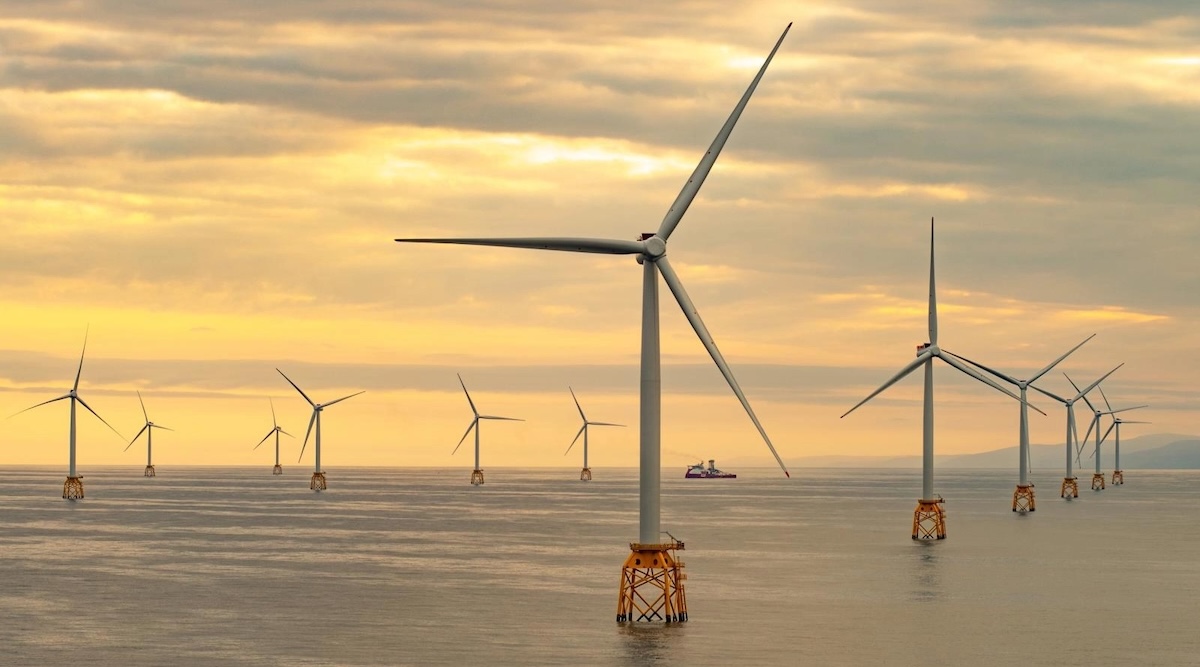
The source also highlights why California’s offshore plans differ from many Atlantic Coast projects. Much of the Pacific coastline is too deep for traditional monopile offshore turbine construction. As a result, state planning has emphasized floating wind turbine technology.
That detail is more than technical background. It helps explain why California’s offshore wind timeline is closely tied to the maturation of floating platforms. The article notes that floating wind was already on a development path by 2022 and that US innovators had received substantial support from the Department of Energy for related research and development.
In other words, California’s ambitions depend not only on seabed leases and transmission planning but also on a technology pathway tailored to deep-water conditions. The state is effectively betting that floating wind can move from emerging option to deployable infrastructure at the scale required by its 2045 target.
Industry groups are still making the economic case
Supporters are not selling the strategy on climate goals alone. The source cites Offshore Wind California, a trade organization that in 2022 said the 25-gigawatt target sent a strong signal that the state was committed to leadership in the sector. Its executive director argued at the time that hitting 5 gigawatts by 2030 would position California to meet or even exceed the longer-term 2045 goal.
The economic pitch is expansive. Offshore Wind California described a scenario in which the industry could support tens of thousands of jobs, supply more than 15 percent of the state’s current electricity needs, power at least 7 million homes, and generate tens of billions of dollars in state GDP by 2050.
Those figures are scenario-based rather than present-day outcomes, but they show how advocates are framing offshore wind: not as a narrow environmental initiative, but as a manufacturing, infrastructure, labor, and power-system opportunity.
Why this remains a consequential fight
The source makes clear that the broader policy environment has become less supportive. Even so, California’s position appears to be that resource quality and long-term need matter more than short-term federal hostility. Governor Gavin Newsom, as quoted in the source, described California as home to one of the world’s strongest offshore wind resources and said the state’s growing need for clean electricity gives that resource strategic importance.
That combination of state law, resource potential, and economic scale helps explain why California stakeholders are still advancing the conversation. The political argument may shift from one administration to another, but the wind resource itself does not. For planners focused on 2030 and 2045, that is the more durable fact.
The immediate takeaway is straightforward: California’s offshore wind agenda has not disappeared with a federal policy reversal. The targets remain, the resource case remains, and the state’s preferred technology pathway remains in view. The harder questions now are execution, timing, and whether the policy support needed to turn a 25-gigawatt vision into built capacity can hold over the long development cycle such projects require.
This article is based on reporting by CleanTechnica. Read the original article.
Originally published on cleantechnica.com