Agrivoltaics moves from slogan to system design
Agrivoltaics is often presented as a simple win: put solar panels on farmland, keep growing crops underneath, and get more value from the same acreage. The reality is more useful and more complicated. The model can work, and in some settings it can improve both agricultural and energy outcomes, but the gains are highly dependent on where projects are built, what is being grown, and how the solar installation is configured.
Recent discussion around the topic has centered on a common claim that crops grown under solar panels outperform crops grown in full sun. The supplied source material supports part of that idea, but not as a broad rule. Field trials have shown that partial shade can help in hot, dry environments by lowering water stress, reducing evaporation, and cooling the local microclimate. Those same conditions can also modestly improve solar performance. But those results do not extend automatically across all regions, seasons, and crop types.
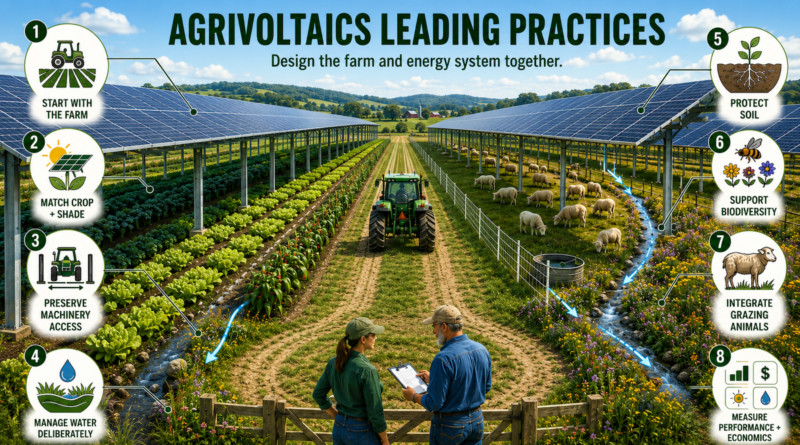
That distinction matters because agrivoltaics is not one technology. It is better understood as a family of land-sharing arrangements. Some projects place elevated panels above vegetables. Others rely on sheep grazing beneath conventional utility-scale arrays. Some create pollinator habitat between panel rows. Other systems place solar over fish ponds, orchards, or greenhouse structures. All of those approaches combine electricity generation with agricultural or ecological use, but they are not interchangeable in cost, productivity, or land-management demands.
Scale leadership is not where many public narratives place it
The source text argues that the most common public framing of agrivoltaics overstates the United States' role. The evidence supplied points instead to China as the clear scale leader. A 2026 paper in Scientific Data, as described in the source material, identified 1,678 agrivoltaic projects in China totaling 134.55 gigawatts by the end of 2022. That figure uses a broad definition that includes crop-based, fishery-based, greenhouse, and related co-use systems, but the headline point is difficult to miss: deployment at scale is already happening most visibly in China, not primarily in the US.
The United States still appears in the story, but in a different role. The supplied text says US activity is meaningful in research, demonstration projects, sheep grazing, and pollinator habitat. That is a credible form of leadership, especially in building evidence for where dual-use solar works best. It is not the same as dominating installed capacity.
This difference between deployment leadership and research leadership is likely to shape how the sector develops. Countries with large installed fleets generate practical knowledge about permitting, land management, grid integration, and economics. Countries with strong research programs can refine designs, identify the best crop-panel combinations, and test how outcomes vary across climates. The next phase of agrivoltaics will depend on both.
Why definitions shape policy and investment
One of the most important insights in the source material is definitional. Policymakers and investors can make poor comparisons if they treat all agrivoltaic projects as equivalent. A utility-scale solar site that allows sheep grazing underneath is not the same as an elevated array built specifically to support high-value vegetables. A solar-fishery installation has very different economics and land-use implications from a solar greenhouse or orchard canopy.
That matters because each model solves a different problem. In arid regions, crop-focused agrivoltaics may offer resilience by conserving soil moisture and limiting heat stress. In other settings, the most practical dual-use approach may be grazing or habitat restoration rather than row-crop production. The technology choice is therefore inseparable from local environmental conditions and the surrounding agricultural economy.
Oversimplified messaging can create two problems at once. It can encourage unrealistic expectations among farmers and local governments, and it can also hand critics an easy target when a project underperforms. The stronger case for agrivoltaics is not that it always boosts yields. It is that under the right conditions it can improve total land productivity, diversify revenue, and reduce tradeoffs between renewable energy expansion and agricultural use.
Where the model appears strongest
Based on the supplied material, the strongest case appears to be in hot and dry climates where partial shade provides a measurable agricultural benefit. Under those conditions, reduced evaporation and lower plant stress can be an asset rather than a drawback. That does not mean all crops benefit equally. Some crops need more direct sunlight than others, and some farming systems may not justify the added structural complexity required to raise panels higher or space them differently.
The source text also points to forms of agrivoltaics that are easier to scale because they require fewer changes to standard solar development. Sheep grazing under conventional arrays is one example. Pollinator habitat is another. Those uses may not generate the same imagery as vegetables growing under elevated panels, but they can still provide agricultural or ecological value while preserving power output and limiting design costs.
That design spectrum suggests the market may split into two tracks. One track will favor simpler, lower-cost co-use options that fit existing utility-scale solar practice. The other will support more specialized projects where crop value, water savings, or land scarcity justify a more customized build. Both are agrivoltaics, but they should not be judged by the same performance assumptions.
The takeaway for energy and land-use policy
The most durable conclusion from the source material is that agrivoltaics should be treated as a site-specific strategy, not an ideology. Solar and farming can share land. In some cases, they can do so very effectively. But success depends on definitions, climate, agricultural goals, and engineering choices.
For developers, that means avoiding one-size-fits-all claims. For regulators, it means writing rules that distinguish among very different dual-use configurations. For farmers, it means evaluating projects against local water conditions, crop plans, and operating constraints rather than marketing language.
Agrivoltaics is important precisely because it is more than a visual symbol. It is a flexible set of tools for combining clean energy generation with productive landscapes. The opportunity is real, but so is the need for precision. As deployment expands, the sector is likely to be shaped less by viral images and more by the harder work of matching system design to place.
This article is based on reporting by CleanTechnica. Read the original article.
Originally published on cleantechnica.com