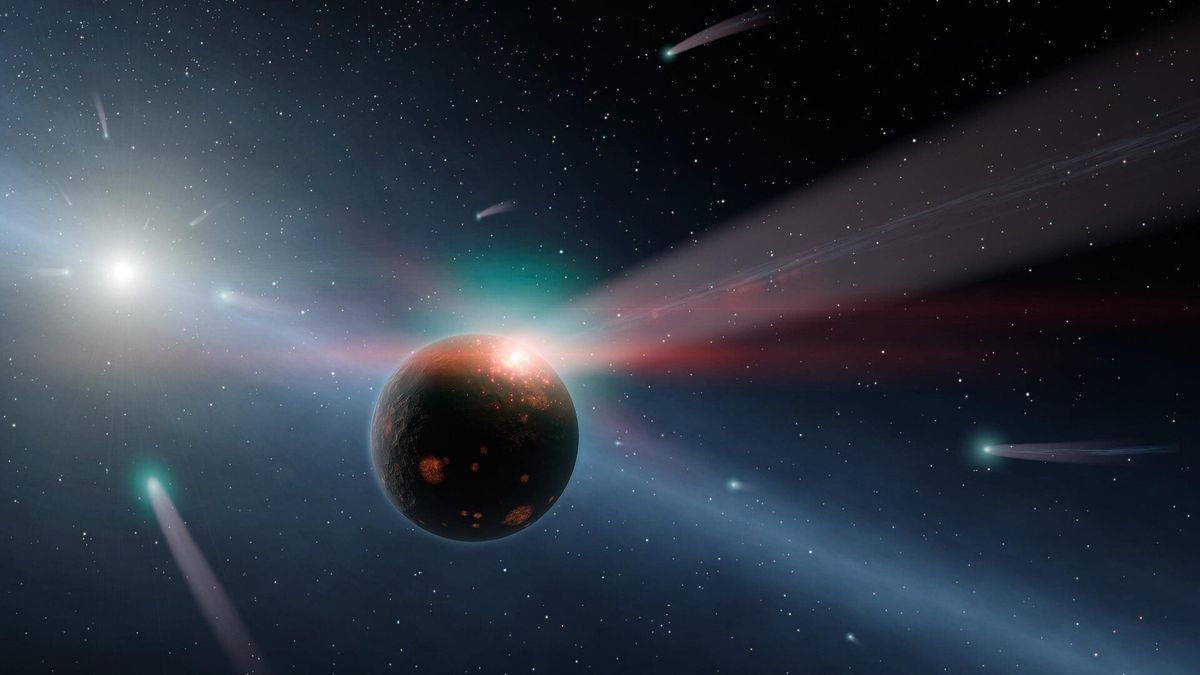
A new modeling study is challenging the longstanding idea that comet impacts supplied Earth with much of the chemical feedstock needed for life. Using more than 100,000 simulations of comet impacts, researchers concluded that fragile prebiotic molecules carried by comets would usually have been destroyed on impact with early Earth.
The work does not rule out cometary delivery completely. Instead, it argues that successful delivery of molecules with a direct role in abiogenesis would have been an exceptional case, rather than a major pathway toward life’s emergence.
A difficult delivery route
Comets contain compounds that are important to prebiotic chemistry, including hydrogen cyanide. This has helped support the idea that repeated impacts could have brought key ingredients to Earth during the planet’s early history.
But the simulations indicate that the impact process itself was hostile to those fragile organics. In most modeled cases, the compounds did not survive the collision with Earth’s ancient surface. The study’s central implication is that finding a molecule in a comet is not enough to establish that it could have reached the early planet intact and in meaningful quantities.

Timing is part of the challenge
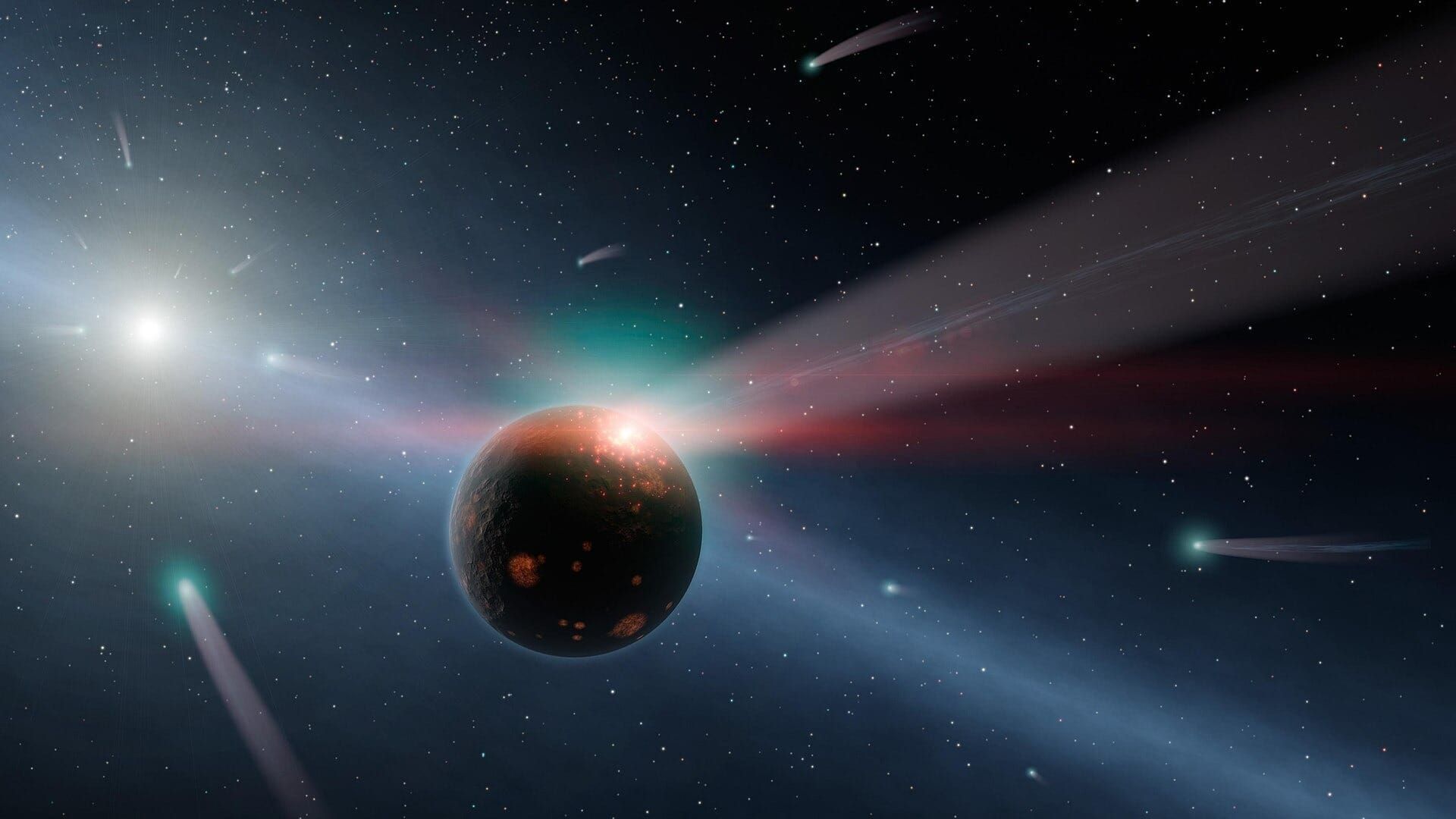
The researchers also examined the chronology of bombardment and early life. They found that the most probable period for a successful cometary impact was the early Hadean, more than 100 million years before the estimated emergence of the last universal common ancestor, or LUCA, at 4.2 billion years ago.
That gap matters because it weakens a simple account in which comet impacts directly seeded the chemistry that later produced life. The team notes that comet bombardment declined rapidly, while the impact process efficiently destroyed the very organics often proposed as useful cargo.
Taken together, the results led the researchers to characterize successful delivery of prebiotic feedstock molecules as exceedingly rare. The conclusion is a recalibration of probability, not a claim that comets were chemically irrelevant to Earth’s past.
An Earth-centered alternative
In place of a comet-led account, the researchers argue that life was more likely assembled from molecules originating within Earth itself. Their interpretation favors an internal source of chemical building blocks leaking from the planet’s interior.
This does not settle the origin-of-life question. The available source material does not identify a single confirmed setting or mechanism through which Earth-derived molecules formed living systems. It does, however, shift attention toward terrestrial environments and away from a broad assumption that comet impacts were a principal supplier of prebiotic ingredients.
What the study does and does not say
- It challenges the assumption that comet impacts played an important role in delivering prebiotic molecules to early Earth.
- It is based on more than 100,000 simulations of comet impacts.
- It finds that key fragile molecules would generally be destroyed during impact.
- It identifies a mismatch between likely successful-impact timing and the estimated emergence of LUCA.
- It does not exclude rare successful deliveries or the possible importance of comets on other worlds.
Mars may offer different conditions
The findings may not translate directly to every planet. The researchers noted that Mars could offer better odds for the survival of key molecules during impacts because of its smaller mass and thin atmosphere.
That distinction is important for planetary science. A process that was inefficient on Earth may be more plausible elsewhere, depending on a world’s gravity, atmosphere and surface conditions. Comets could therefore remain relevant to questions about prebiotic chemistry beyond Earth even if their direct role here was limited.
The study’s broader lesson is that origin-of-life theories must account for both chemistry and delivery physics. It is not enough for a potential ingredient to exist in space; it must survive transit, impact and the conditions that follow. By placing those constraints into a large simulation set, the researchers have made the cometary route appear substantially narrower than older assumptions suggested.
For now, the central question remains open: how did nonliving chemistry become biology? This analysis does not provide the final answer. It instead narrows one prominent possibility and strengthens the case for examining how Earth’s own interior and surface environments might have supplied the raw materials for life.
This article is based on reporting by 404 Media. Read the original article.

Originally published on 404media.co