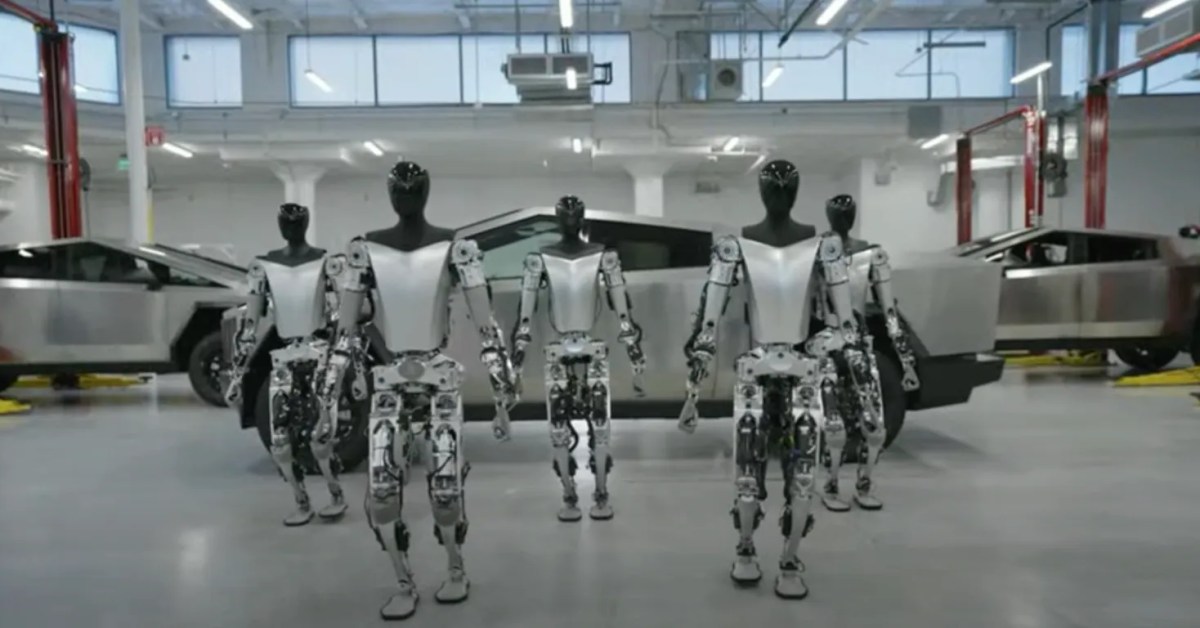
Tesla's Optimus Output Climbs to Hundreds per Week
Tesla is now assembling several hundred Optimus humanoid robots every week at its Fremont facility, according to a new report, a rate roughly ten times higher than what the company managed in the second quarter. The figure represents a meaningful change in the program's trajectory, shifting Optimus from something closer to a hand-built engineering exercise toward a genuine production line.
For most of the robot's public life, the conversation has centered on prototypes, stage demonstrations, and long-range promises. Producing hundreds of units weekly suggests at least one part of the puzzle has been addressed: the ability to repeatedly assemble a complex bipedal machine built from dozens of actuators, sensors, and power systems, and to do it at a pace measured in units per week rather than per quarter.
The headline number is still modest when compared with automotive manufacturing, where Tesla measures output in thousands of vehicles per week. But humanoid robots are not cars. Each unit packs dense electronics, articulated joints, and software-heavy control systems, and no company has previously demonstrated this kind of cadence at all.
The Robots Still Can't Generalize
The same report points to a limitation that the production numbers do nothing to resolve. The Optimus units coming off the line reportedly remain unable to handle general tasks — they cannot reliably adapt to unfamiliar jobs, unfamiliar objects, or unfamiliar surroundings.
That distinction carries most of the weight in this story. A robot that repeats a rehearsed motion inside a controlled cell is an automation device, functionally similar to the fixed machinery that has populated factory floors for decades. A robot that can be handed a new assignment and work out how to complete it is something else entirely, and the distance between those two categories is where much of the anticipated value in humanoid robotics sits.
Walking and Thinking Are Different Problems
Tesla's visible progress on locomotion has been real. Balance, gait, and coordinated movement are engineering challenges with reasonably clear success criteria: either the machine stays upright and moves where it is told, or it does not. Generalization is a different class of problem. It has no single benchmark that settles the question, and improvement often looks like a slow accumulation of capability rather than a step change.
A robot that has been trained to pick one type of component from one type of bin may perform that action flawlessly thousands of times. Place a differently shaped object in a differently lit environment, and the same system can fail in ways that appear trivial to a human observer. That gap is what the report describes as the current state of the fleet.
Why Generalization Is So Difficult
Human environments are defined by variation. Lighting shifts, surfaces change, objects sit at unexpected angles, and instructions arrive in ambiguous language. A system tuned tightly to one setting tends to treat every deviation as noise rather than as information. Closing that gap typically requires broad training data, robust perception, and models that transfer knowledge from one task to the next instead of starting over.
None of those requirements are solved by manufacturing volume alone. They are software and data problems, and they tend to move on their own schedule.

A Manufacturing Lead Without an Intelligence Lead
The central tension in the report is the mismatch between two clocks. Hardware iteration can be accelerated with tooling, suppliers, floor space, and additional shifts. Software that generalizes improves through data diversity, model architecture, and compute, and it does not always respond to more capital or more working hours. Tesla appears to have sped up one clock while the other keeps its own time.
There is a subtler issue as well. Building hundreds of robots a week does not automatically generate the data needed to close the capability gap. If that fleet is performing the same narrow set of tasks in the same facility, it produces a large volume of highly repetitive information and comparatively little of the variation that tends to matter for generalization.
Why the Ramp Still Matters
It would be easy to treat the generalization problem as a reason to dismiss the production milestone. That reading misses what the ramp actually buys:
- Hardware feedback at volume. Failures that appear once in a prototype show up as patterns across hundreds of units, making design flaws easier to identify and correct.
- Cost learning curves. Higher volumes push suppliers, tooling, and assembly processes down the cost curve, which matters for any eventual commercial case.
- A test fleet. Hundreds of new machines each week create a population large enough to validate software updates across many units rather than a handful.
- Deployment experience. Moving robots out of the lab and into working environments surfaces operational problems — maintenance, charging, safety, uptime — that no simulation fully captures.
Each of those advantages compounds if the cadence holds. Annualized, a rate of several hundred units per week implies output in the tens of thousands of machines, a scale no humanoid program has previously approached.

Where the Units Go
The report does not settle where that accumulating fleet will ultimately be deployed. That question matters because the value of an Optimus unit depends heavily on what it can be trusted to do. A robot limited to narrow, pre-mapped tasks can still be useful in structured settings, but its economics look much closer to traditional automation than to the general-purpose labor that has driven interest in humanoids.
If generalization remains out of reach, the near-term path likely runs through increasingly structured environments: defined stations, known parts, controlled lighting, and human supervision nearby. That is a legitimate business, but a smaller one than the vision that has animated the sector.
What to Watch Next
Two metrics deserve attention going forward, and they pull in different directions. The first is cadence — whether several hundred units per week becomes a floor or proves to be a temporary surge. The second is task repertoire, which is far harder to measure from the outside.
Signals worth tracking include whether Tesla begins describing Optimus deployments in terms of specific jobs rather than demonstrations, whether the robots appear in environments the company does not fully control, and whether software updates meaningfully expand what a single unit can do without retraining for each new assignment.
Tesla has now shown it can build humanoid robots in quantity. The harder question — whether those robots can learn to handle work they were never specifically prepared for — remains open, and no production line answers it.
This article is based on reporting by Electrek. Read the original article.

Originally published on electrek.co